

 By
By 
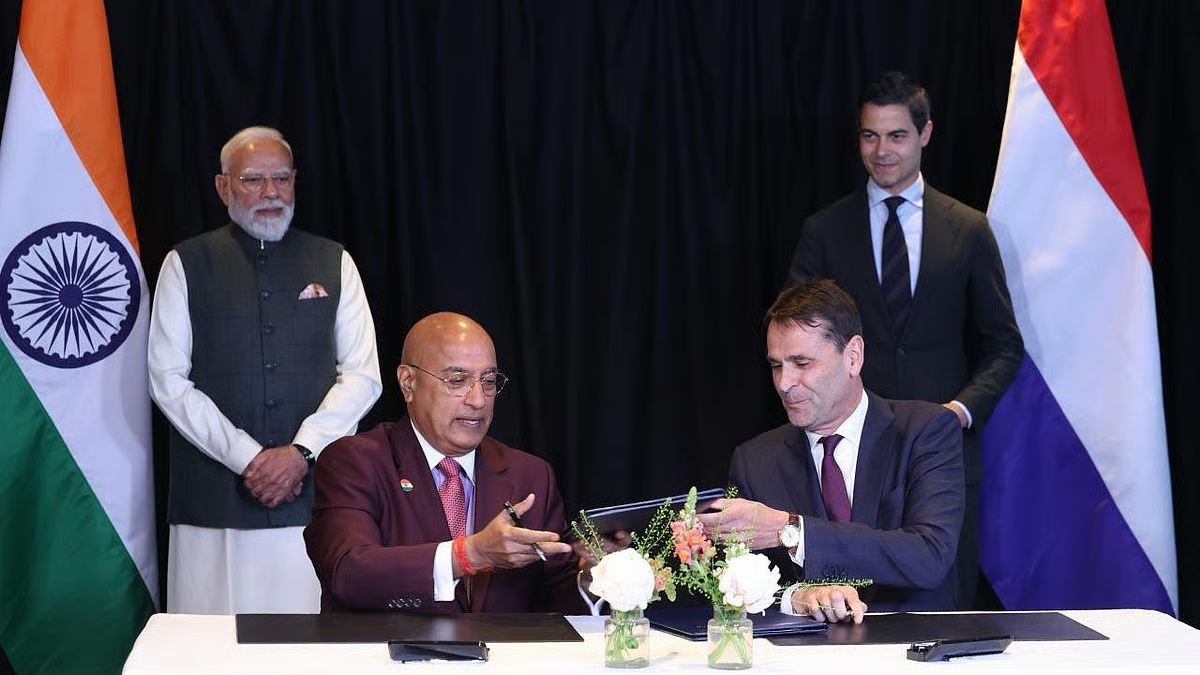
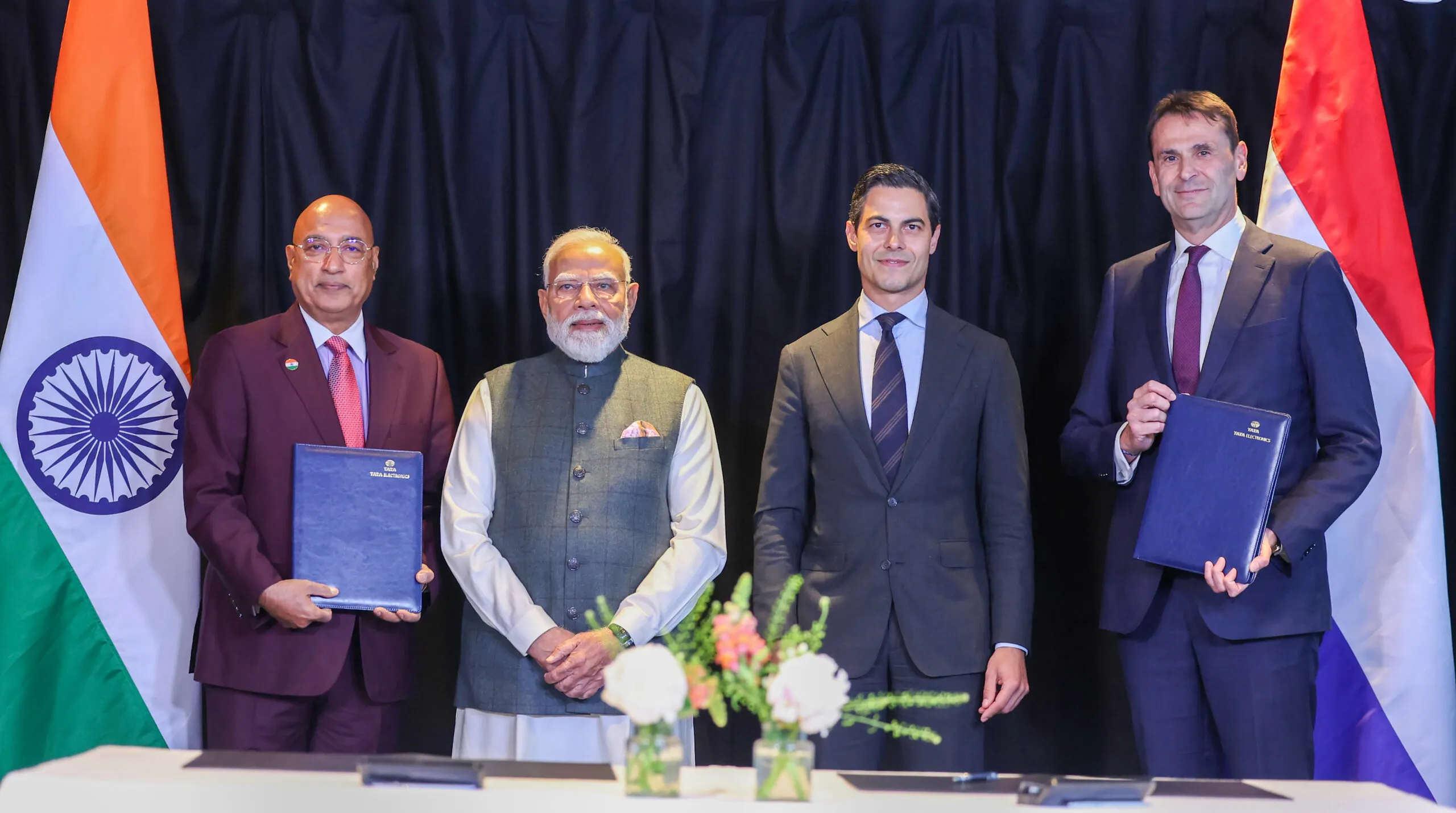
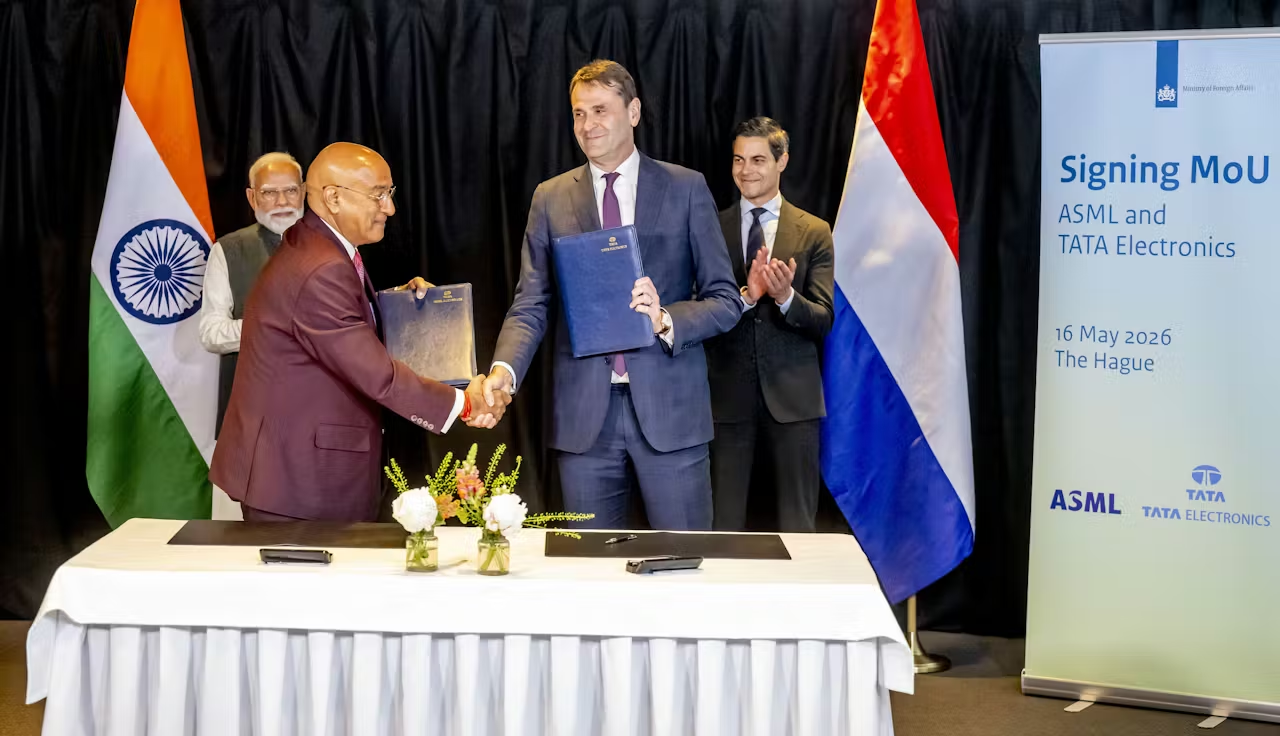
India’s ambitions to become a global semiconductor manufacturing hub received a major push after Tata Electronics signed a strategic agreement with Dutch semiconductor equipment giant ASML during Prime Minister Narendra Modi’s visit to the Netherlands. The partnership, announced in the presence of PM Modi and his Dutch counterpart, is being seen as one of the most significant developments yet in India’s rapidly evolving chip manufacturing ecosystem.
The agreement between Tata Electronics and ASML focuses on enabling India’s first commercial 300 mm semiconductor fabrication facility at Dholera in Gujarat. The collaboration is expected to play a crucial role in establishing India’s first large-scale front-end semiconductor fab and strengthening the country’s long-term technological self-reliance.
Why the Tata-ASML Partnership Matters
ASML is widely regarded as the world’s most important semiconductor equipment manufacturer because of its dominance in lithography technology — the process used to print intricate circuit patterns on semiconductor wafers. The company is the only global supplier of Extreme Ultraviolet (EUV) lithography systems, which are essential for manufacturing advanced chips used in AI systems, smartphones, high-performance computing, automotive electronics, and next-generation technologies.
Industry experts have described the Tata-ASML deal as a defining moment for India’s semiconductor ambitions because access to advanced lithography technology is considered one of the biggest barriers in entering the global semiconductor manufacturing race.
Under the Memorandum of Understanding (MoU), ASML will provide Tata Electronics with its advanced lithography tools and related solutions for the upcoming Dholera semiconductor fab. The Dutch company will also assist in the establishment, ramp-up, and operational scaling of the facility.
The partnership goes beyond machinery supply. Both companies will jointly work on developing local talent, strengthening India’s semiconductor supply chain, and creating research and development infrastructure that can support the long-term sustainability of semiconductor manufacturing in the country.
Dholera Fab at the Centre of India’s Semiconductor Mission
The semiconductor fabrication plant being developed by Tata Electronics in Dholera, Gujarat, is one of the flagship projects under India’s semiconductor mission. The proposed facility is expected to involve investments of around $11 billion to $14 billion, depending on project phases and infrastructure development.
The plant will manufacture chips across multiple technology nodes, including 28nm, 40nm, 55nm, 90nm, and 110nm technologies. These semiconductors are expected to cater to industries such as automotive, consumer electronics, artificial intelligence, industrial automation, telecommunications, and mobile devices.
Tata Electronics has already partnered with Taiwan’s Powerchip Semiconductor Manufacturing Corporation (PSMC) to access semiconductor manufacturing technologies and expertise. The addition of ASML now significantly strengthens the technology stack required for India’s first commercial fab.
Construction work at the Dholera site is progressing rapidly, although earlier reports suggested that engineers had to redesign parts of the facility because of geotechnical challenges linked to soft, saline soil conditions at the reclaimed site. Specialized firms were reportedly brought in to stabilize the foundations because semiconductor fabs require ultra-low vibration environments for precision manufacturing.
PM Modi Pushes for Stronger India-Netherlands Technology Partnership
The agreement was announced during PM Modi’s official engagements in the Netherlands, where semiconductor technology emerged as a major focus area in bilateral discussions. Both leaders discussed expanding cooperation in critical technologies, renewable energy, ports, healthcare, and digital innovation.
PM Modi also encouraged Dutch companies to increase investments in India, particularly in high-tech sectors such as semiconductors and clean energy. The visit further highlighted the growing strategic relationship between India and the Netherlands in advanced technologies.
The Netherlands has emerged as one of India’s top five foreign investors, making the relationship economically significant beyond just semiconductor collaboration. The semiconductor partnership is also being viewed through a geopolitical lens, especially amid ongoing global supply chain realignments and technology restrictions arising from US-China tensions.
Global semiconductor firms are increasingly looking to diversify manufacturing locations outside traditional hubs, and India is positioning itself as an alternative destination with government-backed incentives, infrastructure support, and a large engineering talent pool.
Tata Electronics Expands Semiconductor Ecosystem Partnerships
The ASML agreement is part of Tata Electronics’ broader strategy to build an integrated semiconductor ecosystem in India. Over the past year, the company has signed multiple partnerships with global technology leaders to strengthen India’s capabilities across chip manufacturing, packaging, assembly, and semiconductor design.
Earlier, Tata Electronics signed an agreement with Intel to explore semiconductor manufacturing and advanced packaging in India. The collaboration also included plans to scale AI-powered PC solutions for Indian markets.
The company also entered into partnerships with institutions such as the Centre for Development of Advanced Computing (C-DAC) to support indigenous semiconductor design and intellectual property development.
Industry analysts believe these partnerships indicate Tata Electronics’ intention to create a vertically integrated semiconductor ecosystem spanning fabrication, assembly, packaging, design services, and electronics manufacturing.
ASML’s Role and Global Significance
ASML occupies a unique position in the global semiconductor industry. Its lithography systems are considered among the most complex machines ever built, requiring extreme precision and involving advanced optics, plasma-based light sources, and nanoscale engineering.
Major global chipmakers such as TSMC, Samsung Electronics, and Intel depend heavily on ASML’s equipment for manufacturing advanced semiconductors. Because of its near-monopoly in EUV lithography, ASML has become strategically important in global technology and geopolitics.
The company’s willingness to partner with Tata Electronics is therefore being interpreted as a major vote of confidence in India’s semiconductor manufacturing ambitions.
Challenges Ahead for India’s Chip Ambitions
Despite the optimism surrounding the agreement, experts caution that semiconductor fabrication remains one of the most difficult industries to build from scratch. Semiconductor fabs require massive capital investment, uninterrupted utilities, ultra-clean environments, highly skilled engineers, and long-term policy consistency.
Discussions across industry forums and online communities reflected both excitement and caution. Some observers described the partnership as transformational because of ASML’s involvement, while others pointed to India’s relatively limited experience in advanced semiconductor manufacturing compared to countries like Taiwan, South Korea, and the United States.
Talent development is expected to become a major focus area. Tata Electronics and ASML have already announced plans to accelerate local skill development and create a pipeline of semiconductor experts in India.
A Defining Moment for India’s Semiconductor Future
India has committed billions of dollars in incentives to attract semiconductor manufacturing projects, with multiple semiconductor-related projects already underway. The Tata-ASML partnership is likely to become one of the centrepieces of this national strategy.
If executed successfully, the Dholera fab could reduce India’s dependence on imported chips, strengthen domestic electronics manufacturing, and integrate the country more deeply into the global semiconductor supply chain.
The agreement also signals that India is no longer limiting itself to chip assembly and packaging but is actively moving toward advanced semiconductor fabrication — a sector dominated by only a handful of countries worldwide.
For India’s technology ecosystem, the Tata-ASML collaboration may ultimately represent more than just a business agreement. It could mark the beginning of India’s transition into a serious semiconductor manufacturing nation.
With inputs from agencies
Image Source: Multiple agencies
© Copyright 2026. All Rights Reserved. Powered by Vygr Media.