

 By
By 
There is something deeply revealing about the way the internet reacts to a woman after childbirth.
A woman can spend nine months growing a human being, go through childbirth, lose sleep for months, adjust to a radically different routine and learn how to care for a newborn and yet, when she finally steps outside, one of the first things strangers may notice is her waistline.
Katrina Kaif’s recent experience is a particularly striking example. After welcoming her son in November 2025, the actor largely stayed away from the public eye. When photographs of her eventually surfaced at a public celebration in Mumbai, the conversation quickly moved away from the occasion itself and towards her appearance. Her fuller face and postpartum weight became fodder for social-media commentary, with some users comparing her current appearance with older photographs.
It would be easy to dismiss this as yet another example of celebrities being scrutinised because they live in the public eye.
But that would miss the point.
The uncomfortable truth is that Katrina's experience is not particularly unusual. It is simply a more visible version of something countless women experience privately at family gatherings, in neighbourhoods, at workplaces, among friends and even inside their own homes.
The celebrity may have cameras following her. The ordinary mother has relatives, acquaintances, social media feeds and her own mirror.
The audience may be different. The pressure is remarkably similar.

Why Is a New Mother Expected to ‘Bounce Back’?
Perhaps the most problematic phrase in the entire conversation is “bounce back”.
The expression sounds harmless. It is not.
“Bounce back” suggests that pregnancy and childbirth are deviations from a woman's normal life temporary disruptions after which she is expected to return to her previous physical form as quickly as possible.
But childbirth is not a minor interruption.
Pregnancy changes the body. Recovery takes time. Hormonal shifts, exhaustion, disrupted sleep, physical healing and the demands of caring for a newborn can profoundly alter a woman's daily life. Postpartum care itself is not supposed to be understood as a single event with an identical recovery schedule for every woman.
So why has losing pregnancy weight become almost synonymous with postpartum recovery?
Why is a woman congratulated for “getting her body back” when what she may actually need is time, rest, nourishment, medical care and emotional support?
And perhaps the more important question is this: who exactly is she supposed to get her body back for?
That question becomes particularly uncomfortable when applied to celebrities.
Actresses are expected to look glamorous for a living. Their faces and bodies are routinely photographed, discussed and commercialised. But that professional visibility somehow gets transformed into a perceived public entitlement over their bodies.
Katrina Kaif has spent years being associated with fitness and glamour. That image appears to have made the reaction to her postpartum body even more striking. The underlying message becomes: if someone known for being exceptionally fit can look different after having a baby, then somehow she has failed to maintain the image people associate with her.
But motherhood does not come with an obligation to preserve a pre-pregnancy celebrity persona.
The Pattern Did Not Begin With Katrina Kaif
Katrina is hardly the first Bollywood actress to encounter this scrutiny.
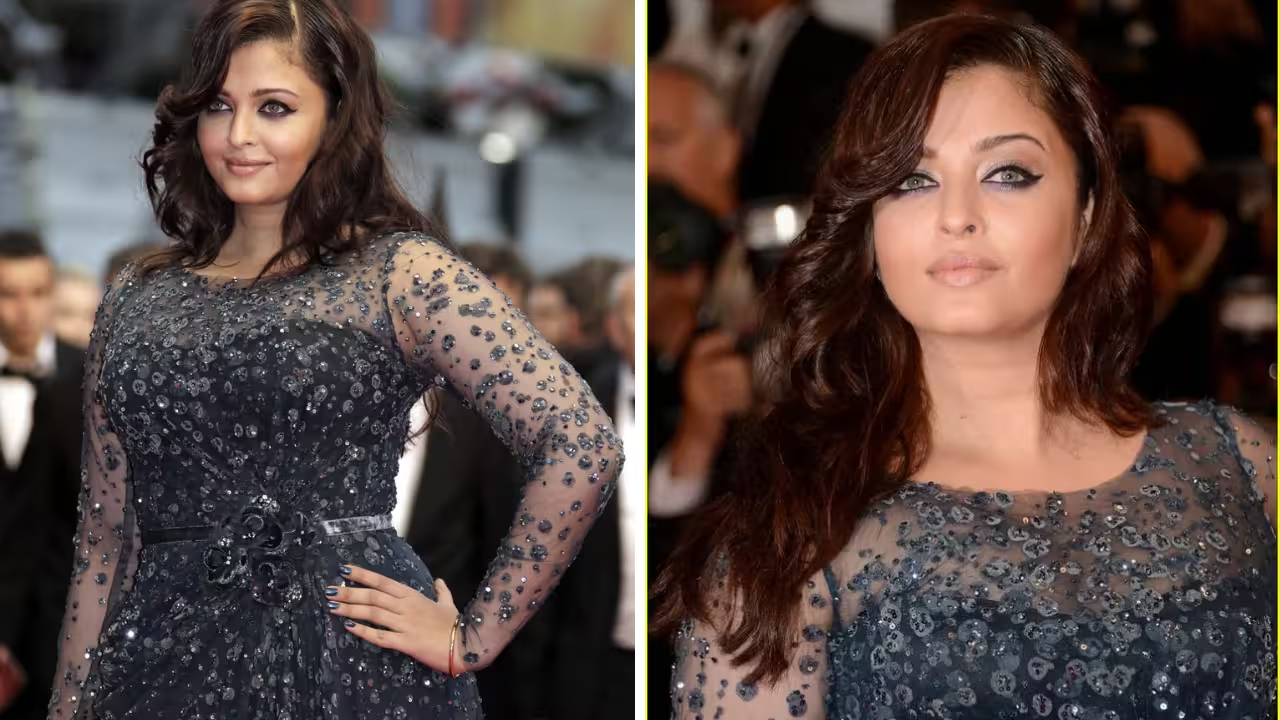
Aishwarya Rai Bachchan faced intense public commentary after the birth of her daughter Aaradhya in 2011. Her status as a former Miss World seemed, ironically, to make the scrutiny worse. Instead of being allowed the ordinary privacy of postpartum recovery, her body became a public discussion.
Kareena Kapoor Khan experienced similar attention after becoming a mother. After the birth of her first son, her weight gain and specific parts of her body became subjects of public commentary. Even after her second pregnancy, her appearance continued to attract scrutiny.
Bipasha Basu has also spoken about the body-shaming she experienced after welcoming her daughter Devi, including criticism surrounding the expectation that her body should continue to resemble the glamorous image associated with her earlier career.
Swara Bhasker has been even more direct about rejecting this expectation. After becoming a mother, she publicly criticised the pressure to lose postpartum weight according to timelines determined by strangers online. Her argument was not that women should reject fitness or health, but that their bodies should not be treated primarily as objects whose value depends on remaining conventionally desirable.
That distinction matters.
Because the conversation about postpartum weight often hides behind the language of “health” and “self-care”.
When ‘Self-Care’ Becomes Another Word for Looking Thin
“Take care of yourself.”
On the surface, it is an entirely reasonable thing to say to a new mother.
But what does “taking care of yourself” actually mean?
Does it mean getting adequate medical attention? Eating nutritious food? Resting when possible? Asking for help? Recovering physically? Protecting mental wellbeing?
Or does it secretly mean losing weight, exercising harder and looking attractive again?
The difference is enormous.
A woman can be deeply committed to her health and still have a postpartum body that does not resemble her pre-pregnancy body.
She can exercise and remain heavier.
She can eat well and have a changed body shape.
She can sleep as much as circumstances allow and still look tired.
She can care deeply about herself without prioritising weight loss.
The problem begins when appearance is presented as evidence of whether she is taking care of herself.
That is precisely why comments such as “Why aren't you taking care of yourself?” can be so damaging. The statement may sound like concern, but the concern is often less about wellbeing and more about whether the woman's appearance continues to satisfy an aesthetic expectation.
A mother's body does not become a public project simply because it has changed.
The Most Dangerous Pressure Is Sometimes the Pressure Nobody Voices
There is another layer to postpartum body-shaming that deserves far more attention.
Not every woman is explicitly told that she needs to lose weight.
Sometimes nobody says anything at all.
She simply sees other women online.
She watches celebrity transformation videos.
She scrolls through photographs of women who appear to have returned to their pre-pregnancy bodies within months.
She hears casual conversations about someone who “lost all the baby weight”.
She notices how people praise a new mother who appears slim and ask concerned questions about another who does not.
Eventually, the comparison moves inside her own head.
A recent account of postpartum experiences highlighted precisely this phenomenon: women can internalise beauty expectations even when nobody around them directly orders them to lose weight. Another reported study cited in that discussion found that 70% of 114 postpartum women surveyed were concerned about postpartum weight, with pressure coming from multiple directions including society, family, media and personal body dissatisfaction. Exposure to “fitspiration” content was also associated with greater upward comparison, anxiety and lower body satisfaction in another study discussed in the report.
That should make us rethink what we call harmless social-media content.
A before-and-after photograph may look motivational to one woman.
To another woman sitting awake at 3 a.m. with a newborn, it may feel like another reminder that her body is failing to meet an invisible deadline.
The Ordinary Mother Pays the Price Too
Celebrity mothers at least have some advantages that ordinary women may not.
They may have access to personal trainers, nutritionists, stylists, childcare support and professional teams.
The average mother does not.
She may be returning to work while caring for a baby. She may be recovering without domestic help. She may be struggling with sleep deprivation. She may have financial pressures. She may be trying to find time for a shower, let alone an hour-long workout.
And yet she is exposed to the same cultural message: you should look like your old self again.
One account cited in the recent discussion around postpartum body image illustrates just how deeply this pressure can affect an ordinary mother. A woman who had worked hard to lose weight before pregnancy found herself struggling with her changed body after childbirth. Even with a supportive husband, she described looking at old clothes and photographs and wondering whether she was still attractive enough.
Another mother described having almost no photographs of herself during her child's first year because she was too conscious of how different she looked.
Think about that.
A woman can be so afraid of not looking “good” that she becomes absent from her own child's memories.
That is no longer a conversation about weight.
That is a conversation about identity.
Women Also Participate in This Culture
It would be convenient to blame men, social-media trolls or the entertainment industry alone.
But that would be incomplete.
Women can reinforce these standards too.
Women comment on other women's bodies. Female relatives sometimes advise new mothers to “control” their weight. Friends compare postpartum transformations. Mothers compare themselves with other mothers.
The problem is cultural, not simply gendered.
We have inherited an idea of femininity in which looking desirable is treated as evidence of discipline, confidence and even self-respect.
That is why a woman who gains weight can be accused of having “let herself go”, while a woman who loses it rapidly is praised for her determination.
Either way, her body becomes the report card.
And motherhood becomes another test she is expected to pass while looking beautiful.

The Celebrity Transformation Trap
There is an irony here.
Celebrity transformations can genuinely inspire women.
Seeing someone regain fitness can make another mother think, “Maybe I can do that too.”
There is nothing inherently wrong with wanting to exercise, lose weight or change one's body after pregnancy.
Women are allowed to want those things.
The problem is turning one woman's choice into another woman's obligation.
A celebrity who loses weight quickly is praised.
A celebrity who does not is criticised.
The message to ordinary women watching both is confusing: you are free to choose provided you eventually choose the socially approved outcome.
That is not freedom.
It is pressure wearing the costume of choice.
Postpartum Bodies Do Not Have One Deadline
One of the most damaging assumptions surrounding postpartum weight is that there is a universal timeline.
There isn't.
Every pregnancy is different. Every birth is different. Every body is different. Recovery can be affected by numerous physical, emotional and practical circumstances.
And weight is not even the whole story.
A woman can return to her pre-pregnancy weight and still have a different body structure. Her abdomen, hips, breasts, skin and overall shape may change. A number on a weighing scale cannot tell the complete story of what pregnancy and motherhood have done to a body.
So the obsession with the scale is strangely simplistic.
We are asking a complex human body a very small question: How much do you weigh now?
And then using the answer to determine whether she has “recovered”.
That is absurd.
We Need to Stop Treating Mothers as Before-and-After Pictures
Perhaps the greatest problem is that we have become accustomed to seeing women's bodies as visual narratives.
Before pregnancy.
After pregnancy.
Before weight loss.
After weight loss.
Before motherhood.
After motherhood.
The woman herself disappears somewhere between the two photographs.
Katrina Kaif's experience should therefore not be reduced to another celebrity controversy. It should force us to examine why a woman's body after childbirth remains so fascinating to strangers.
Aishwarya Rai's experience demonstrated this more than a decade ago.
Kareena Kapoor's did too.
Bipasha Basu's did.
Swara Bhasker's response did.
And now Katrina's experience has brought the conversation back again.
How many times do we need the same lesson?
What Should We Ask a New Mother Instead?
Maybe we need to retire one question from our vocabulary:
“When are you going to lose the baby weight?”
And replace it with questions that actually matter.
“How are you feeling?”
“Are you getting enough rest?”
“Do you have help?”
“Are you eating properly?”
“Do you need some time for yourself?”
“Are you recovering well?”
“Is there anything I can do?”
These questions recognise the woman rather than merely evaluating her body.
And if she wants to talk about losing weight, let her.
If she wants to return to the gym, support her.
If she wants to change her diet, that is her choice.
If she wants to remain exactly as she is for a while, that should also be her choice.
The goal should not be to replace one rigid rule with another. The goal should be to give women ownership of their bodies again.
A Mother Does Not Need to ‘Get Her Old Body Back’
There is something else we need to stop saying: “You will get your old body back.”
Maybe she will.
Maybe she won't.
But perhaps that should not be the objective in the first place.
A woman's body is not a lost possession that she has to retrieve after giving birth.
It is her body.
It has changed because her life has changed.
And she is allowed to decide what happens next.
Swara Bhasker's rejection of the idea of “bouncing back” captures an important part of this conversation: motherhood can fundamentally change life, and there is nothing inherently wrong with acknowledging that change rather than treating the previous version of oneself as the only acceptable one.
The same principle applies to Katrina Kaif.
She does not owe the public the face, waistline or silhouette she had before pregnancy.
Neither does any other mother.
The real measure of progress is not how quickly a woman becomes visually indistinguishable from her pre-pregnancy self.
It is whether we can finally learn to look at a new mother and see a human being before we see a body.
Because the problem was never that mothers failed to “bounce back”.
The problem is that society keeps demanding that they do.
And perhaps it is time society learned to stop bouncing the responsibility back onto women.
With input from agencies
Image Source: Multiple agencies
© Copyright 2026. All Rights Reserved. Powered by Vygr Media.