
 By
By 
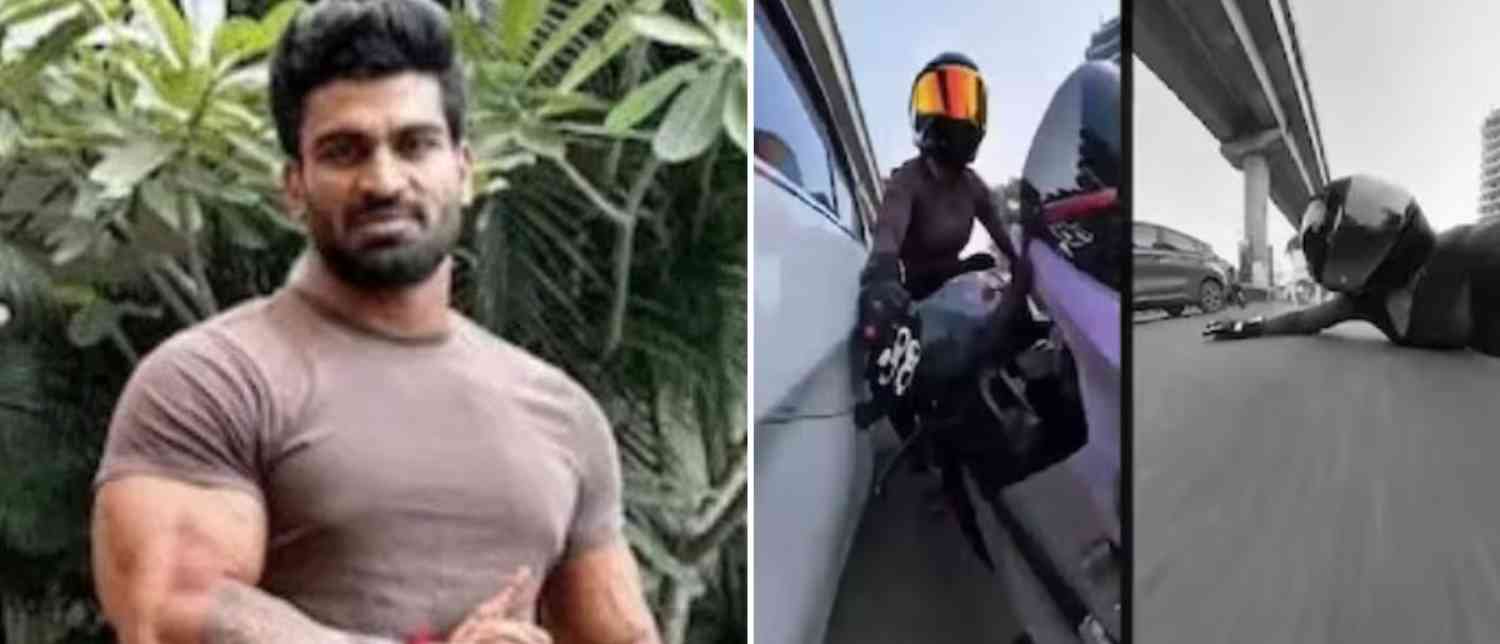
The Gurugram hit-and-run case involving a woman biker has taken a serious turn, with an attempt-to-murder charge being added against accused driver Kalyan Bainsla after a video of the incident triggered widespread outrage. The case, which began with allegations of reckless driving and a hit-and-run on Golf Course Road, has now become a larger debate over road rage, harassment of women motorists and the responsibilities of drivers involved in road accidents.
The woman at the centre of the case, who has identified herself as Sia on social media, has rejected Bainsla’s claim that the collision was accidental. In her first detailed response to his version of events, she questioned why he allegedly continued following her before the crash and, more importantly, why he did not stop after the collision if he genuinely felt concerned about her condition.
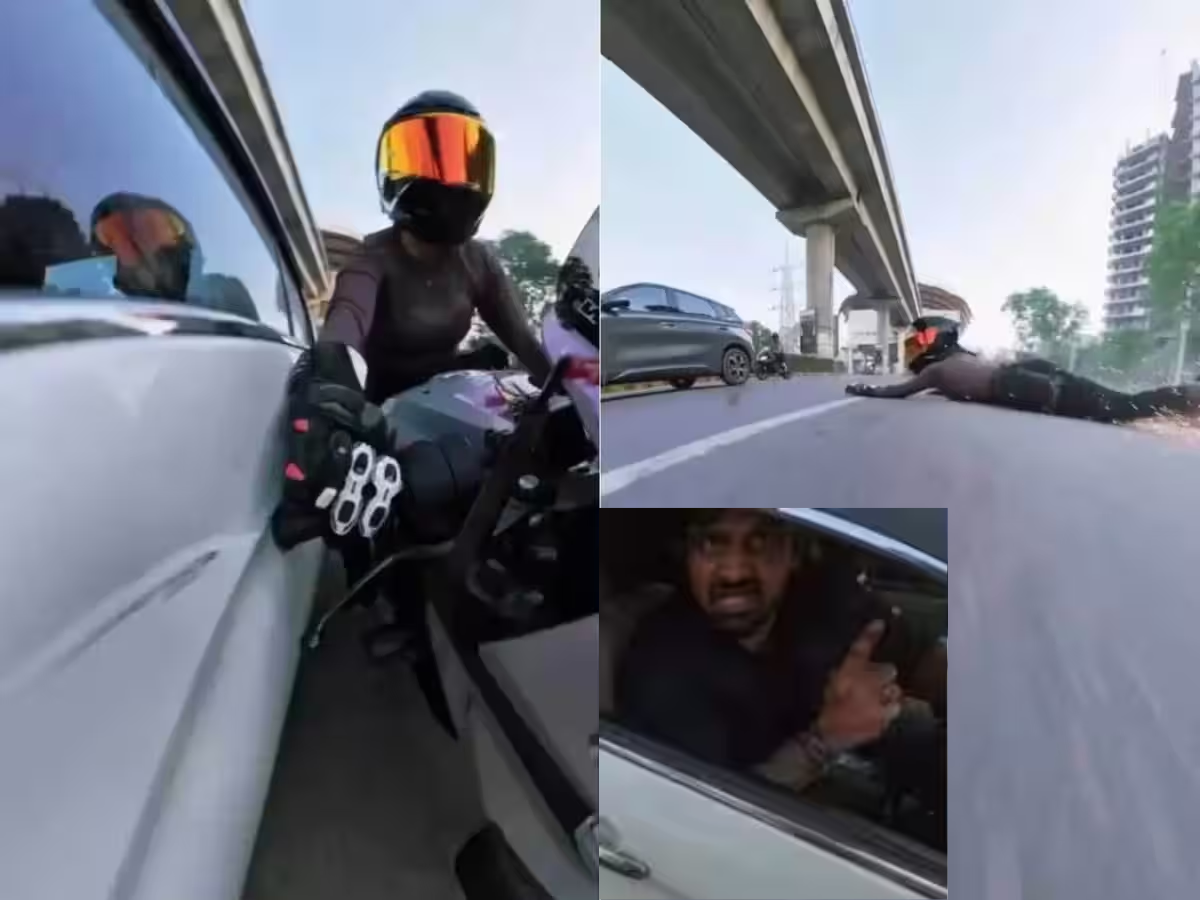
The case has drawn attention largely because the confrontation was recorded on camera. Footage from an action camera mounted on Sia’s Aprilia RS 457 sports bike appears to capture the moments before the collision, the impact and the aftermath. The visual evidence has since circulated widely online, prompting police action.
What happened on Golf Course Road?
The incident took place on Sunday morning on Gurugram’s Golf Course Road, where Sia was riding with a group of fellow bikers.
According to her account, a white sedan began following the group and repeatedly attempted to get close to her motorcycle. She alleged that the occupants of the car made gestures and asked her to stop. Sia said she tried to maintain distance from the vehicle because she felt uncomfortable with the manner in which it was approaching her.
She has further alleged that the car continued to make aggressive manoeuvres and repeatedly attempted to cut across her path. At one point, a friend riding behind her reportedly tried to place his motorcycle between Sia and the car in an effort to prevent the vehicle from getting too close.
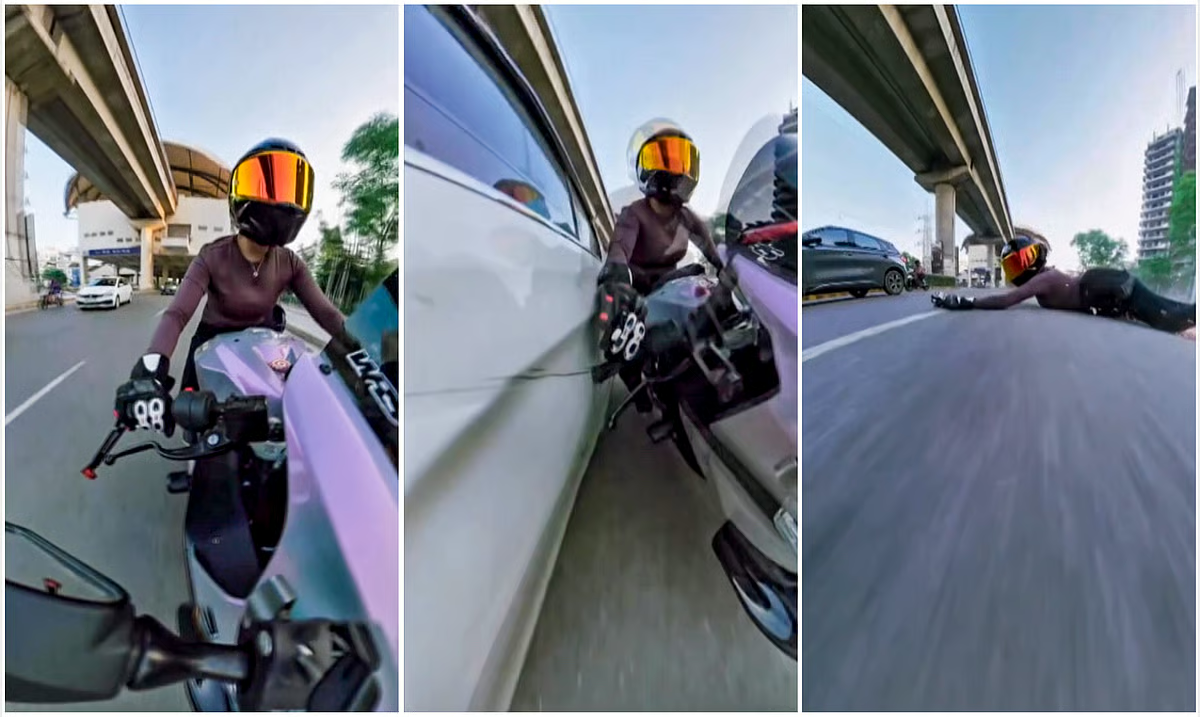
The situation eventually escalated when the sedan moved across the motorcycle’s path and struck it from the side.
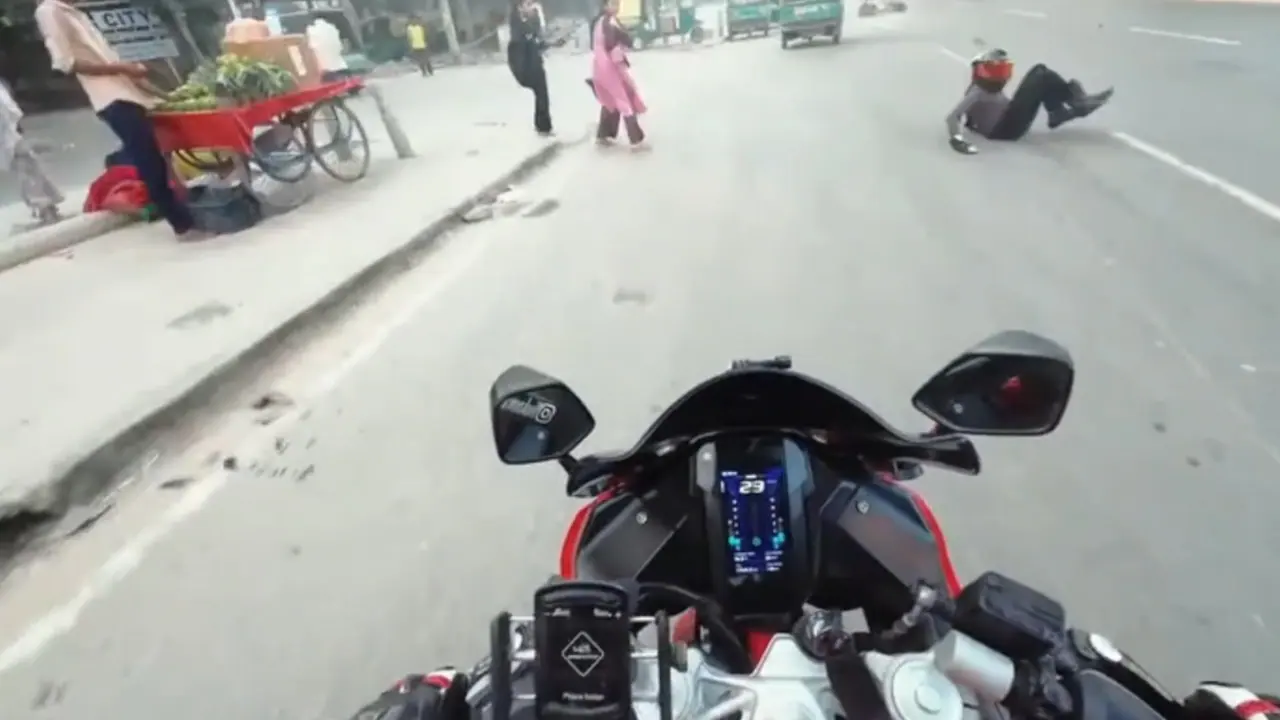
The impact threw Sia off her bike and onto the road. Her motorcycle slid across the surface, with sparks visible in the footage, while she was left dangerously exposed to other vehicles travelling along the road. According to the account emerging from the incident, she narrowly avoided being struck by passing traffic after falling.
The car then allegedly left the scene.
A motorcyclist from the group reportedly pursued the vehicle and caught up with it at a traffic signal. Sia has alleged that the driver was confronted there but still left rather than stopping to check on her condition.
It is this sequence particularly the alleged pursuit before the collision and the subsequent departure from the scene that has become central to the dispute over whether the incident was merely an accident or something more deliberate.
Viral video puts incident under scrutiny
The video recorded from Sia’s motorcycle became the most important piece of publicly available evidence in the case.
Police took suo motu cognisance of the footage and registered a case at Sector 56 police station. The initial case involved allegations related to rash driving and causing injury. The emergence of the accused driver’s identity subsequently brought the matter into sharper focus.
The footage has also become the basis for competing interpretations.
Sia argues that the visuals show the car changing lanes and moving towards her motorcycle before the collision. She has questioned how the incident could be described simply as an accident when, according to her, the car appears to follow her for a distance before making contact.
In her response to Bainsla, she also rejected his suggestion that only a limited portion of the incident had been made public.
She argued that even the available videos are sufficient to establish the seriousness of what happened, pointing out that one angle shows the car moving across lanes before striking her bike while another captures the collision from the front.
For Sia, the central question is not merely how the collision occurred, but what happened immediately before and after it.
“If the driver was genuinely concerned,” her response essentially asks, “why did he not stop?”
That question has become one of the most contentious aspects of the case.
Kalyan Bainsla denies deliberately hitting the biker
Bainsla has strongly denied that he intentionally rammed the motorcycle.
In his account, he was travelling with family members when he encountered a large group of bikers. He claimed that around 20 to 25 motorcycles were repeatedly overtaking his car, slowing down and speeding up.
According to Bainsla, his intention was not to target Sia but to ask the bikers to slow down and ride more carefully.
He has admitted that a collision occurred and accepted that the accident was his fault, but has maintained that he lost control of the vehicle near a U-turn.
Bainsla claimed that Sia suddenly turned while he was also manoeuvring the car, leaving him with insufficient time to avoid the collision.
He has also denied deliberately fleeing the scene.
His explanation for leaving was that he feared being attacked by the group of bikers. According to his account, he initially considered stopping after the crash but became concerned that the situation could turn violent because of the number of riders around him.
He has claimed that he later stopped at a traffic signal and spoke to the bikers, but eventually drove away after being advised by a family member to leave because of fears of confrontation.
Bainsla has also questioned the completeness of the viral footage, arguing that the publicly circulated clips do not necessarily show everything that happened before the collision.
His lawyer has similarly placed responsibility on the bikers, claiming that the group was travelling aggressively and repeatedly overtaking the car.
The defence has alleged that Sia was travelling at a very high speed and that the collision happened when she moved right while the car moved left. The lawyer has argued that the car was attempting to avoid the footpath and that the collision resulted from the movements of both vehicles.
These claims, however, remain part of the defence version and are subject to investigation.
Sia rejects the “accident” explanation
Sia has directly challenged the explanation that Bainsla simply lost control of the car.
In her video response, she questioned why the driver would allegedly continue following her if the bikers were merely riding too fast or slowing down repeatedly.
She also rejected his claim that he did not know a woman was riding the motorcycle.
According to Sia, the driver had come close enough to her motorcycle to see her and had allegedly signalled for her to stop. She said this made the claim that he was unaware of her identity or gender difficult for her to accept.
Her response also focused heavily on the aftermath.
Sia said the impact could have had fatal consequences and that even a delay of a few seconds could have resulted in much more serious injuries.
She pointed out that after being thrown from the bike, she was on the road with moving traffic around her.
Her argument is that the seriousness of the situation should have prompted the driver to stop immediately, regardless of who was at fault for the collision.
Instead, she alleges, the car left the scene.
That is why she has described the incident as more than a conventional road accident.
Family demands attempt-to-murder action
The dispute over the driver’s intent intensified when Sia’s father demanded that an attempt-to-murder case be registered.
He said the family initially did not know the full details of the incident. Sia reportedly contacted her brother after the crash, while her parents learned about it later.
Her brother said she initially described the incident as an accident, before explaining that another vehicle had allegedly followed and hit her.
The family has alleged that the occupants of the car were behaving aggressively and that the driver had attempted to make Sia stop.
Her father argued that the nature of the incident warranted stronger legal action, particularly because the collision could potentially have resulted in a fatality.
The demand eventually gained legal significance as the police added an attempt-to-murder charge to the case.
The development marks a major escalation from the initial rash-driving and injury allegations. It also means the investigation will have to examine not only the fact of the collision, but the circumstances surrounding it and whether the evidence supports an inference of deliberate intent.
An attempt-to-murder allegation is considerably more serious than a case based solely on negligent or rash driving, and the final determination will depend on the evidence gathered during the investigation and subsequent legal proceedings.
Accused’s lawyer blames the biker
The defence has not accepted the narrative that Bainsla deliberately targeted Sia.
His lawyer has instead argued that the bikers were responsible for creating a dangerous situation on the road.
According to the defence version, the group repeatedly overtook the vehicle and behaved unpredictably. The lawyer has claimed that such behaviour creates risks for other road users and contributed to the collision.
The defence has also suggested that Sia’s social-media presence may have influenced how the incident was presented publicly, alleging that the controversy could be generating attention and followers.
Sia, however, has rejected the broader attempt to shift responsibility onto her.
The competing narratives now leave investigators with several questions: What happened during the minutes before the collision? How long did the car remain behind the bikers? Was the vehicle deliberately attempting to intercept Sia’s motorcycle? What exactly happened at the traffic signal afterward? And does the complete video evidence support one account over the other?
Those questions are likely to be central to the investigation.
Why the video evidence matters
The case highlights an increasingly important reality of modern road-safety investigations: cameras can dramatically alter the way an alleged road-rage incident is investigated.
Without the footage, the case could have depended largely on statements from the people involved.
Instead, investigators have access to visual material showing at least part of the sequence.
Sia has repeatedly emphasised that the footage demonstrates the car’s movements before the collision. Bainsla, meanwhile, has argued that the available clips may not show the complete context.
That distinction is crucial.
A viral video can establish what happened during the seconds it captures, but determining criminal intent requires investigators to examine the entire sequence, including additional CCTV footage, eyewitness accounts, vehicle movements and other evidence.
The police investigation will therefore be important in establishing whether the collision was the result of loss of control, dangerous driving, road rage or a deliberate act.
A wider concern for women on roads
Beyond the legal battle between the two sides, the Gurugram incident has sparked a broader conversation about how women experience road harassment.
Sia has said the incident made her feel unsafe on Gurugram and Delhi-NCR roads. Her account has resonated particularly because she was not alone on the road; she was riding with other bikers and had a camera recording the incident.
The case also illustrates how quickly an ordinary road interaction can escalate.
A disagreement over speed or lane movement can turn dangerous when drivers begin chasing, overtaking aggressively or attempting to force another vehicle to stop.
For two-wheeler riders, the consequences can be especially severe. A car weighing substantially more than a motorcycle can cause devastating injuries even at relatively moderate speeds. A rider thrown onto a busy road can also face a second danger from approaching traffic.
In Sia’s case, the fact that she survived with comparatively minor injuries has been viewed by her family as a matter of luck rather than an indication that the incident was harmless.
What happens next?
With the attempt-to-murder charge now added, the focus will shift to the police investigation and the evidence supporting the allegations.
The viral videos will likely remain an important component, but investigators may need to establish the complete sequence through additional CCTV footage, witness statements and other available material.
The conflicting accounts of Sia and Bainsla also mean that the question of intent will remain central.
Bainsla says he lost control and never intended to hit her. He maintains that he left because he feared an attack from the bikers.
Sia says the car followed her, attempted to force her to stop, moved aggressively around her motorcycle and ultimately struck her before leaving the scene.
Both versions cannot simultaneously explain every aspect of the incident.
What can be established is that a serious collision occurred, that Sia was thrown from her motorcycle, that the incident was captured on video and that the accused has acknowledged the collision while disputing any deliberate intent.
The addition of the attempt-to-murder charge signals that authorities are treating the allegations with greater seriousness. But the charge itself is not a finding of guilt. The evidence collected during the investigation and the judicial process will ultimately determine what happened and whether the accused is criminally liable for the more serious allegation.
For now, the Gurugram hit-and-run case remains a stark reminder of how quickly road disputes can turn potentially fatal and how a few seconds captured on camera can become the centrepiece of a criminal investigation.
With input from agencies
Image Source: Multiple agencies
© Copyright 2026. All Rights Reserved. Powered by Vygr Media.