 By

Hours after the oil company put out a post to rebut Karnataka’s E20 allegations, social media users pointed to the test image itself, and the post disappeared.
Bharat Petroleum Corporation Limited (BPCL) deleted a social media post on Sunday that said a test at a petrol pump in Mysuru showed the fuel met the mandated 20 per cent ethanol limit. The post was taken down within hours, after users pointed out that the test image appeared to show ethanol content of about 33 per cent. The deletion has added fresh fuel to a row between the Karnataka government and the country’s oil marketing companies over the E20 petrol programme.
What the Tweet Said and Why It Was Deleted
The post was shared on X under BPCL’s “Let the Facts Speak” campaign. It said that a test at a petrol outlet in Mysuru confirmed the petrol met the E20 standard, meaning petrol blended with 20 per cent ethanol. The post carried photographs of the test.
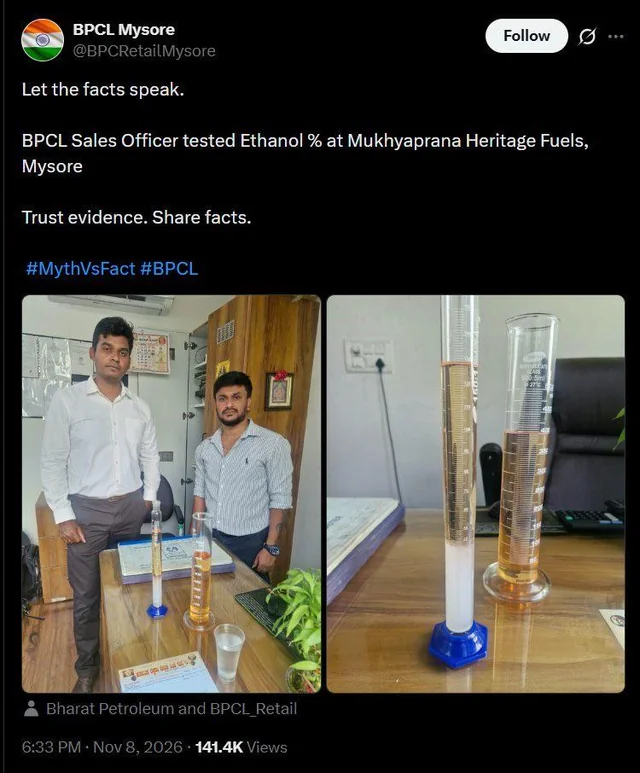
Users who looked closely at the image said the reading was well above 20 per cent, closer to 33 per cent. Screenshots circulated widely even after the post was removed. Some users described the episode as an embarrassment for the company.
It should be noted that the claim that the image shows roughly 33 per cent ethanol has not been independently verified. BPCL has not publicly explained why the post was removed or what the image actually showed. Field tests of this kind are also different from laboratory analysis, which is the basis on which fuel samples are formally certified.
How the Row Began
The controversy began when the Congress-led Karnataka government said laboratory tests on petrol samples from several districts found ethanol well above the 20 per cent limit. The state reported readings of up to 31.2 per cent in a sample from an Indian Oil Corporation (IOC) outlet and 30.5 per cent in one from a Hindustan Petroleum Corporation (HPCL) outlet. Reports differ slightly on how many outlets were sampled, with figures of 63 and 67 locations being cited.
Chief Minister DK Shivakumar said his government had received thousands of complaints from motorists about reduced mileage, engines stalling while moving and vehicles failing to cover expected distances. He said officials had inspected petrol pumps as well as facilities where ethanol is blended and distributed, and had informed the Union government.
The Oil Companies and the Centre Push Back
IOC, BPCL and HPCL jointly rejected Karnataka’s findings. They said their E20 petrol complies with the Bureau of Indian Standards specification IS 17021, and they questioned the state’s sampling and testing methods. They argued that the prescribed procedures were not followed and that the laboratories used were not those specified under the order. The companies also asked for joint sampling and independent verification.
The Union Petroleum and Natural Gas Ministry backed them. It said on November 7 that all 893 samples tested across 27 states and Union Territories had ethanol content within the permitted range of 19 to 21 per cent. In Karnataka, it said, all 56 samples tested between 19 and 20 per cent, with an average of 19.30 per cent.
Karnataka Stands Its Ground
On Monday, November 9, the Karnataka government rejected the joint statement. In a detailed rebuttal issued by the Department of Food, Civil Supplies, Consumer Affairs and Legal Metrology, under Minister Rizwan Arshad, the state said the companies’ statement was long on technicalities and silent on the one question that matters: how much ethanol is in the petrol at the pumps.
The state said none of the test reports provided by the companies gave the actual ethanol percentage. It also accused industry bodies and companies of softening or withdrawing earlier concerns about E20 under pressure, and said that Karnataka would not step back. The government referred to the Attorney General’s submission to the Supreme Court describing E20 as still an experiment, followed by a clarification from his office.
Kerala Begins Checks
The row has spread to neighbouring Kerala. The state’s Food and Civil Supplies Department ordered random inspections at petrol pumps in Thiruvananthapuram, Ernakulam, Kozhikode and Kannur following public concern about fuel quality and alleged vehicle damage. Minister Anoop Jacob said samples will be sent to government laboratories, with results expected within 10 days. He warned that outlets found violating standards could be sealed and face legal action, and clarified that no confirmed case of excess blending has been reported in Kerala so far.
What E20 Means
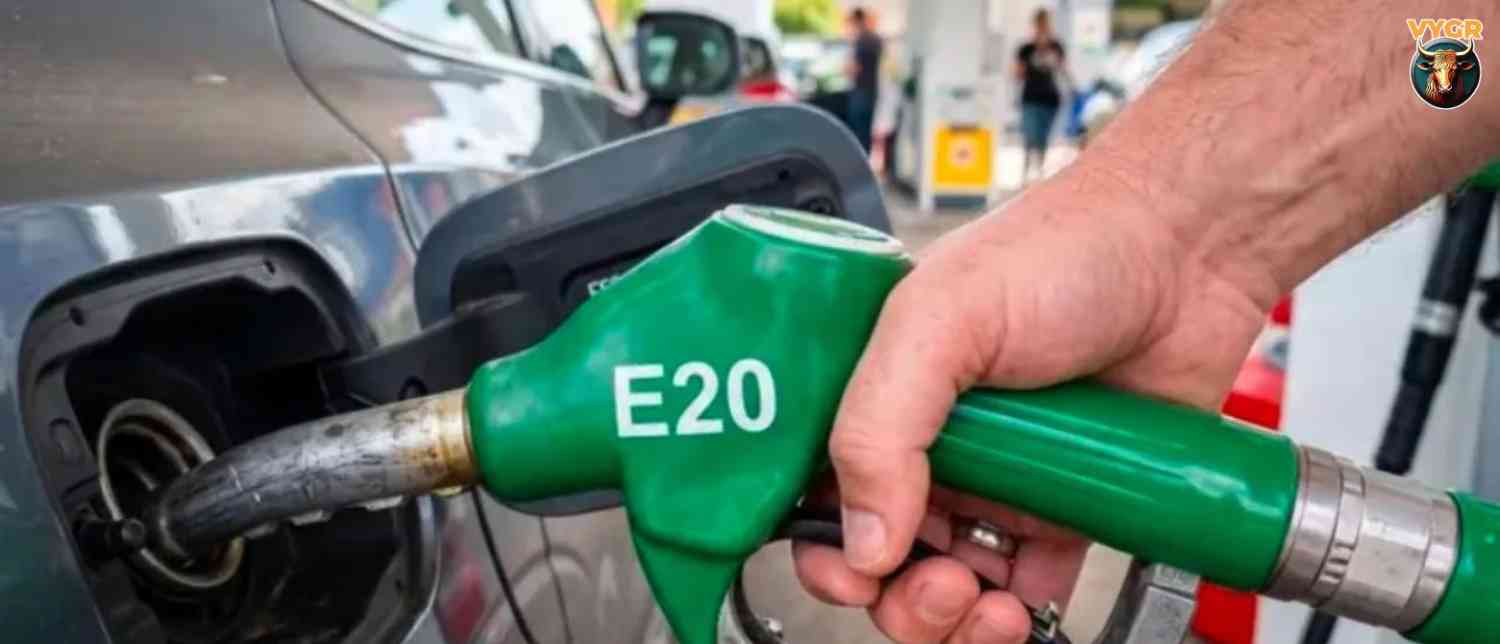
Under the E20 programme, petrol is blended with 20 per cent ethanol, an alcohol-based fuel made from agricultural feedstocks. The national standard allows a small tolerance, which is why the official range is 19 to 21 per cent. The government promotes the blend as a way to cut crude oil imports and support farmers, while motorists and some critics have raised questions about mileage and compatibility with older vehicles.
Why the Deleted Tweet Matters
The disagreement is, at its core, about measurement. Karnataka says its lab results show blending far above the limit. The oil companies and the Centre say their testing, using the prescribed method, shows compliance. A post meant to settle the argument with a visible test then became a talking point itself, leaving the public with two conflicting sets of numbers and no joint test.
What to Watch Next
The key developments will be whether the oil companies and Karnataka agree to joint sampling at an accredited laboratory, the results of Kerala’s tests, and the detailed report Karnataka’s food minister is expected to present. Whether BPCL explains the deleted post will also matter to how the public reads the dispute.
© Copyright 2026. All Rights Reserved. Powered by Vygr Media.