 By
By 
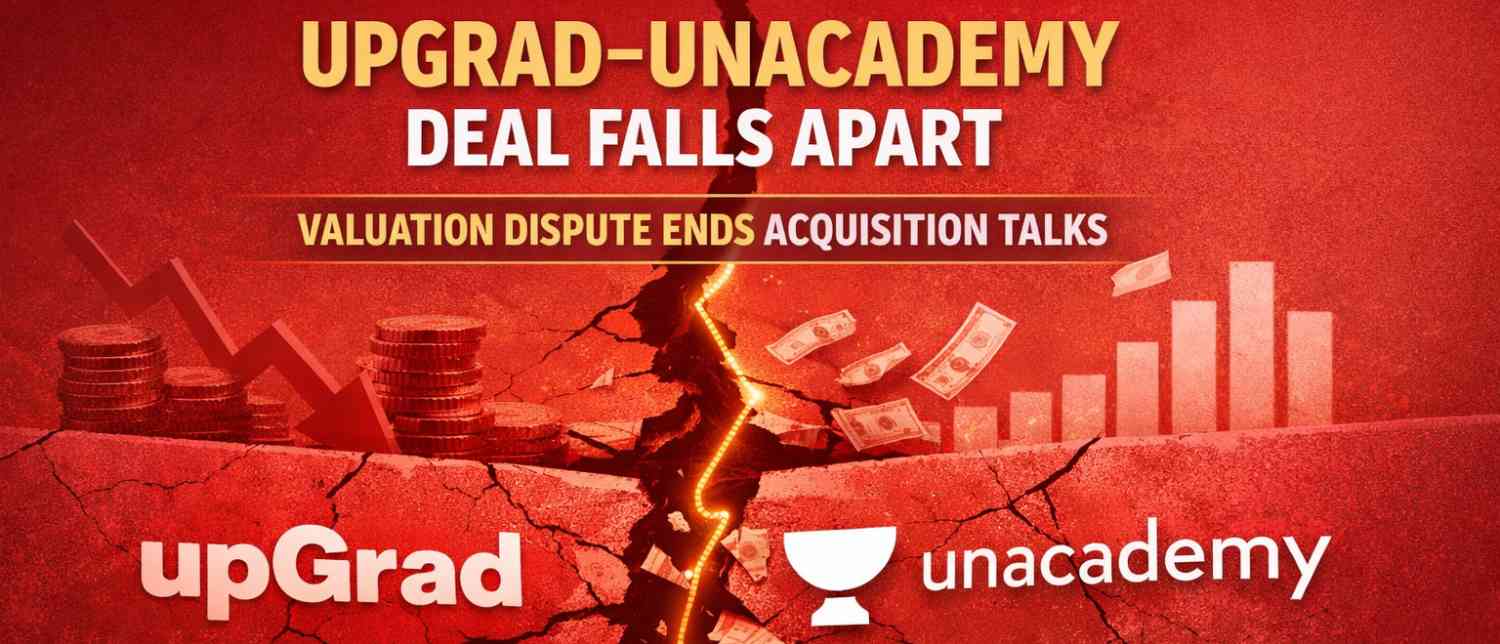
Talks between Indian edtech heavyweights upGrad and Unacademy for a potential acquisition have officially fallen apart, bringing an end to months of speculation and behind-the-scenes negotiations. The proposed deal, which was expected to be one of the largest consolidation moves in India’s struggling edtech sector, collapsed after the two sides failed to agree on valuation, according to multiple people familiar with the matter.
Sources told Moneycontrol that valuation disagreements ultimately proved insurmountable. While the negotiations had progressed over several months and involved various deal structures, the gap between what Unacademy expected and what upGrad was willing to offer could not be bridged.
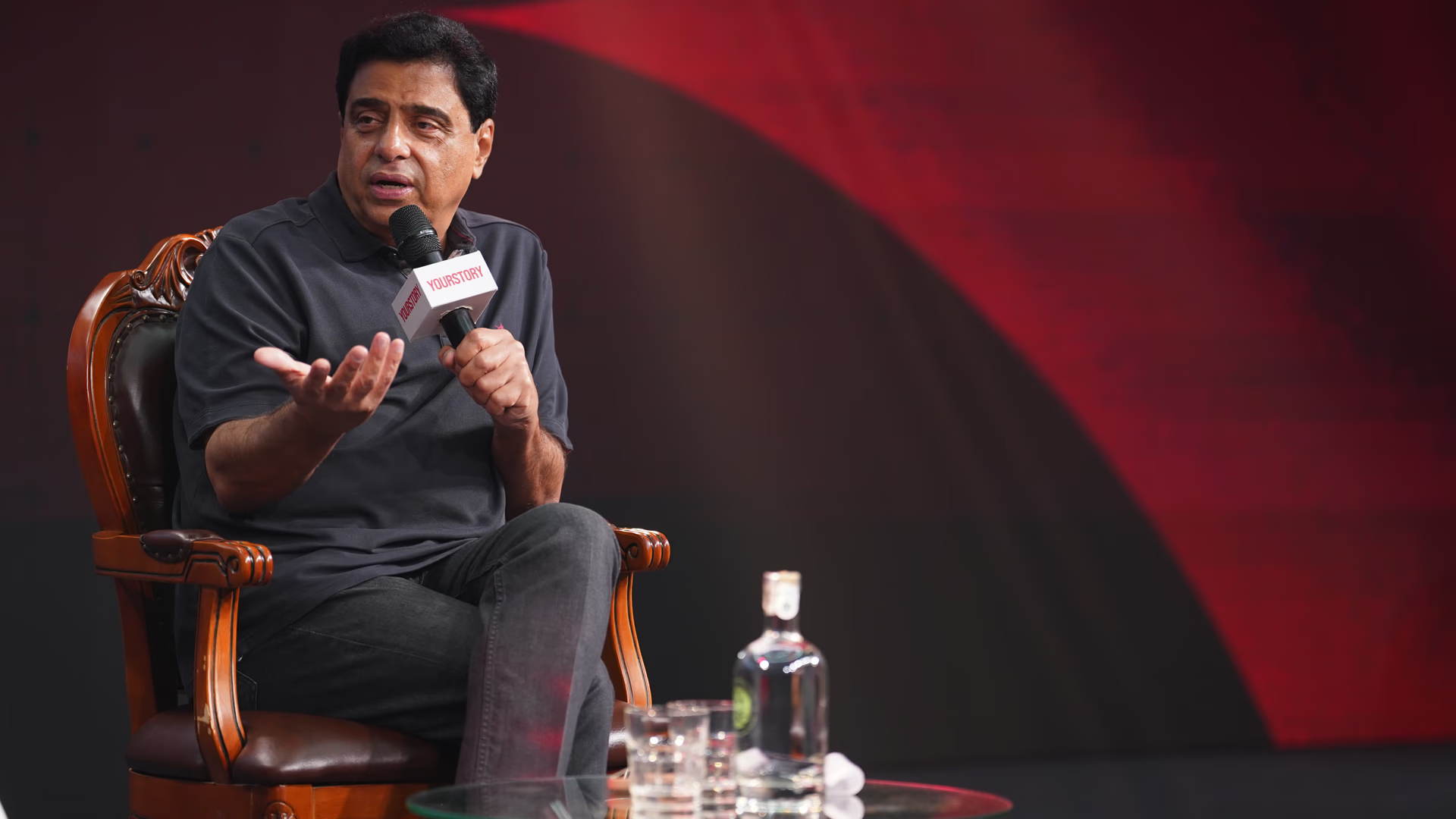
“Yes, we are not proceeding due to valuation differences,” upGrad co-founder Ronnie Screwvala confirmed to multiple publications. “While we cannot comment on what numbers were, it is fair to say that we were unable to arrive at a mutually agreeable valuation.”
Unacademy co-founder and former CEO Gaurav Munjal did not respond to media queries on the development at the time of publication.
What the upGrad–Unacademy Deal Was Expected to Look Like
Moneycontrol was the first to report that upGrad, founded by media entrepreneur Ronnie Screwvala, was in talks to acquire Unacademy at a valuation in the range of $300 million to $400 million. This represented a dramatic markdown from Unacademy’s peak valuation of $3.4–3.5 billion during the funding boom of 2021.
Under the proposed structure, Unacademy’s investors were expected to receive a minority stake in upGrad, which was valuing itself at approximately $2 billion, sources said. The deal was reportedly structured as an all-stock or share-swap transaction, rather than a cash-heavy acquisition.
For upGrad, the transaction offered strategic advantages at a time when capital remains scarce. It would have provided immediate entry into the test preparation segment, access to Unacademy’s strong brand in competitive exams, and control over Unacademy’s sizable ₹1,000–1,200 crore cash reserves. Unacademy currently holds around ₹1,100 crore in cash on its balance sheet.
Despite these synergies, valuation expectations remained the central sticking point throughout negotiations, eventually leading to the collapse of talks.
A Sharp Turn From Earlier Denials
The failure of the deal comes barely a month after Munjal publicly confirmed, for the first time, that Unacademy was exploring mergers and acquisitions. This marked a significant shift from his earlier stance.
In December 2024, reports had suggested that Kota-based coaching giant Allen was in talks to acquire Unacademy for $800 million. At the time, Munjal categorically denied the possibility of any sale, dismissing such reports as rumours.
However, speaking last month, Munjal acknowledged that Unacademy was open to a transaction if it resulted in a “stronger entity.” He also admitted that the company’s valuation had likely fallen to below $500 million, roughly 14% of its peak valuation during the pandemic-driven funding frenzy.
Unacademy’s Long Struggle After the Pandemic Boom
Founded in 2015 by Gaurav Munjal, Roman Saini, Hemesh Singh, and Sachin Gupta, Unacademy operates an online learning platform focused on test preparation for a wide range of competitive exams. The startup raised more than $848–880 million from marquee investors including SoftBank, Tiger Global, Peak XV Partners (formerly Sequoia Capital India), Temasek, WaterBridge Ventures, and Meta.
Once one of the most celebrated unicorns of India’s edtech boom, Unacademy’s fortunes began to decline sharply after pandemic restrictions eased and offline learning centres reopened. Several acquisitions undertaken during the expansion phase failed to deliver expected results, while competition from entrenched offline coaching institutes intensified.
The company also invested heavily in building an offline learning network, a strategy that drained capital but failed to scale meaningfully. Meanwhile, revenues stagnated and losses mounted.
In FY24, Unacademy reported a 2.3% year-on-year decline in operating revenue to ₹716 crore. While the company managed to reduce losses by 82.09% year-on-year to ₹285 crore, the improvement came largely through aggressive cost-cutting rather than growth.
Leadership Changes and Strategic Retrenchment
The acquisition talks with upGrad unfolded against the backdrop of significant internal changes at Unacademy. Earlier this year, co-founders Gaurav Munjal and Roman Saini stepped back from operational roles as part of a leadership transition plan.
Subsequently, the company appointed co-founder Sumit Jain as CEO of its core test-prep business, consolidating leadership around its largest and most stable revenue-generating vertical.
Over the past two years, Unacademy has also rolled back its earlier ambitions of operating across multiple education categories. The company narrowed its focus to core offerings and implemented several rounds of workforce reductions since 2022, aligning its operations with post-pandemic demand realities.
Reports also indicated that Munjal and Saini were exploring options to separately run Airlearn, Unacademy’s artificial intelligence-driven language learning vertical, even as the parent company pivoted more decisively toward offline test preparation.
ESOP Controversy Adds to Uncertainty
As negotiations with upGrad continued, Unacademy faced backlash from former employees over proposed changes to its employee stock option plan (ESOP). In December, the company moved to shorten the ESOP exercise window for former employees to 30 days, a move widely interpreted as an attempt to manage share conversions ahead of a potential transaction.
The proposal triggered criticism from ex-employees, prompting Unacademy to put the ESOP amendments on hold earlier this week while it reviewed feedback.
Why the Deal Mattered for upGrad
For upGrad, the proposed acquisition aligned with its broader inorganic growth strategy as it prepares for a planned IPO in 2027. According to Mint, upGrad could raise $350–400 million through the public offering.
Unlike many of its peers, upGrad has achieved operational profitability and reported gross revenue of ₹1,650 crore in FY25. The company has also been in discussions to acquire select assets from BYJU’S, as consolidation accelerates across the battered edtech landscape.
Acquiring Unacademy’s test-prep business would have significantly expanded upGrad’s footprint while strengthening its revenue base ahead of listing.
What Lies Ahead for Unacademy and upGrad
With the talks now formally called off, both companies face diverging paths. upGrad retains the flexibility to pursue other acquisitions and continue preparing for its IPO, while selectively scouting assets that align with its long-term strategy.
For Unacademy, the collapse of the deal underscores the difficult reality of valuation resets sweeping through the edtech sector. The company will now need to manage stakeholder expectations, address lingering employee concerns, and evaluate alternative strategic options—whether that involves engaging with other potential buyers or charting an independent turnaround.
This is not the first time Unacademy’s sale discussions have fallen through. Over the past two years, multiple conversations with prospective acquirers have reportedly collapsed due to valuation mismatches, reflecting the widening gap between founder expectations shaped by the 2021 boom and today’s market realities.
A Broader Signal for India’s Edtech Sector
The breakdown of the upGrad–Unacademy talks highlights how the post-pandemic correction continues to reshape India’s edtech industry. Once flush with capital and lofty valuations, many startups are now grappling with consolidation, cost controls, and difficult choices about survival and scale.
Whether upGrad and Unacademy revisit negotiations on different terms in the future remains uncertain. For now, the most immediate casualty is a deal that many believed could have redefined the competitive dynamics of online learning in India.
As valuation resets continue to ripple through the sector, the failed merger stands as a reminder that the era of easy capital and billion-dollar price tags is firmly in the rear-view mirror.
With inputs from agencies
Image Source: Multiple agencies
© Copyright 2025. All Rights Reserved. Powered by Vygr Media.