 By
By 
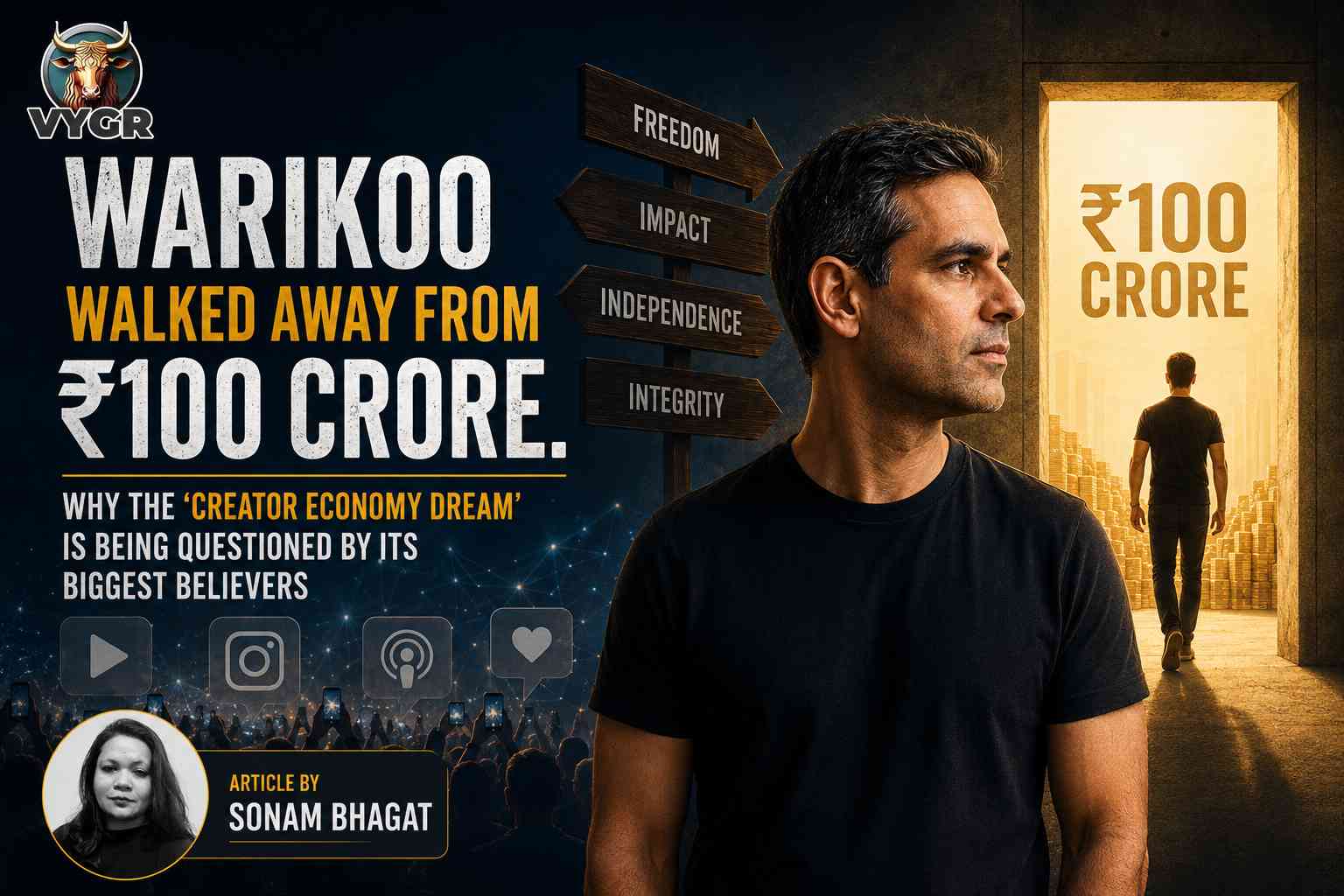
On a typical Thursday evening in May, Ankur Warikoo surprised India’s creator economy with a bold announcement. In a brief video shared on X and LinkedIn, he looked into the camera and stated he was closing his online courses business. This venture had over five lakh students, brought in ₹100 crore in sales, and earned ₹25 crore in profits within just five years.
“Continuing it makes no sense,” he wrote, promising to elaborate on his choice in a longer video later.
In an industry fascinated by growth snapshots and revenue goals, it seemed almost unimaginable for a leading creator to leave behind a profitable, established business. As the founder of a hyperlocal news platform and someone who frequently speaks with small creators outside major cities, I wasn’t surprised. Warikoo’s statement didn’t shatter the creator economy; it simply voiced what many had been thinking.
The dream vs. the data
In popular belief, the creator journey looks like this: you start sharing content, attract followers, launch a course or a brand, and soon you're “making money in your sleep.”
Warikoo was one of the few Indian creators who had actually succeeded with this approach on a large scale: a well-known personal brand, a range of courses under WebVeda and Make Epic Money, and an audience willing to pay. According to his numbers, the business represented everything the ecosystem tells aspiring creators to aim for: it was profitable, product-based, and independent of platform algorithms.
And yet, he chose to shut it down.
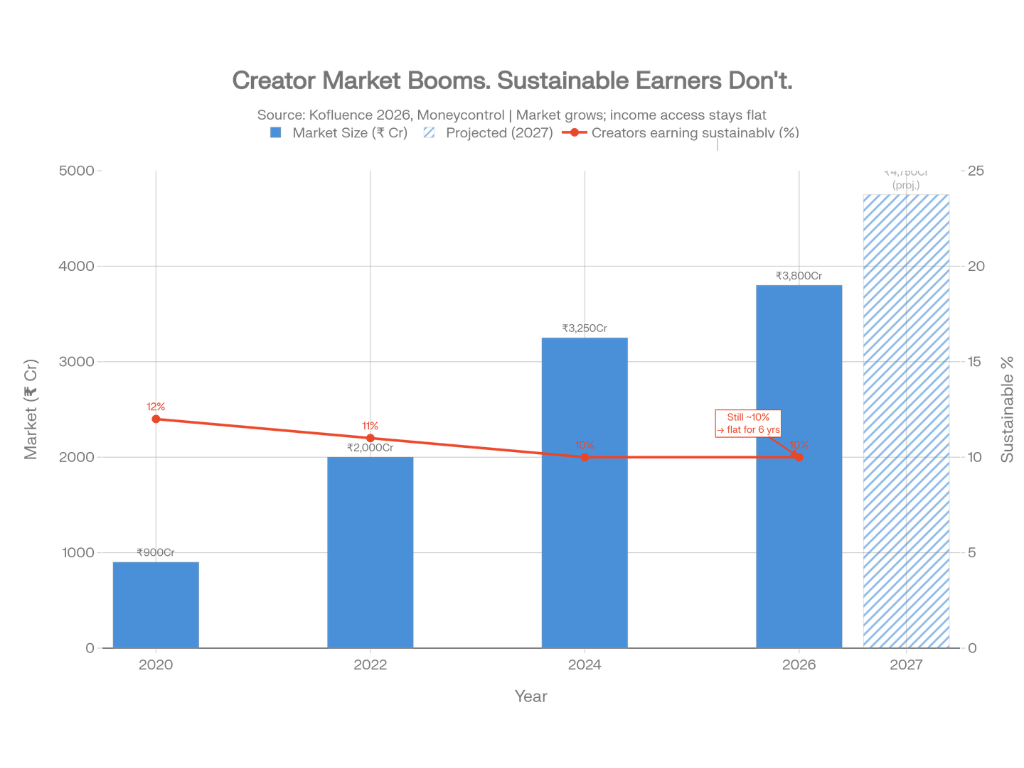
Contrast this with what’s happening at the bottom of the pyramid. A recent study of India’s creator economy, using data from influencer-marketing platform Kofluence, found that nearly nine out of ten influencers still can’t make a sustainable living online. India may now have about four million creators, but only an estimated 8–10% earn enough to work full-time; for many, monthly incomes stay below ₹18,000. In other words, the “dream” has always been unevenly distributed. Warikoo’s departure doesn’t signal the end of a golden era; it simply highlights how narrow that golden era has always been.
AI, obsolescence, and the “creator’s trap”
One remark from Warikoo’s discussions stood out: when asked if artificial intelligence influenced his decision, he answered with one word — “huge.” He later shared what many creators secretly acknowledge: the worry that AI can copy, remix, or undercut your best-selling strategy faster than you can innovate. For businesses based on courses, the pressure is even greater. When AI can summarize, translate, and personalize content on demand, static video modules start to feel outdated immediately after they launch. A creator who built their business around “evergreen” content soon finds that “evergreen” has a limited lifespan. But a quieter, secondary influence is the “creator’s trap.” The business model that generates the most revenue may not be the one that fulfills your passion. Over time, you may end up generating what the sales funnel demands, instead of what your artistry desires.
For some creators who initially entered this field as storytellers or educators, this trap can be stifling. Shutting down a profitable business may seem irrational if you only consider the financials. However, it starts to make sense once you consider the person behind the numbers.
_1779991321.png)
The institutional age meets a crisis of faith The paradox is this: structurally, India’s creator economy has never appeared stronger. Kofluence’s 2026 report estimates the influencer marketing sector will be valued at ₹3,000–3,500 crore in 2025, with estimates potentially reaching ₹4,500–5,000 crore by 2027. Almost 15.2% of creators are now registered as GST entities or businesses, indicating rapid formalization.
Additionally, a wave of policies and platform initiatives reinforces this sense of progress.
The government has announced a $1 billion fund to support the creator ecosystem. Budget 2026 has set aside funds for content creator labs in 15,000 schools, and YouTube claims it has paid more than ₹21,000 crore to Indian creators in the last three years, while pledging another ₹850 crore to enhance its “Creator Nation” initiative. On paper, this is the institutional age of the Indian creator — where creators are no longer merely side-hustlers but recognized economic players, with investments and policies supporting them.
Yet, during this same period, we’ve witnessed:
- a prominent finfluencer shutting down a profitable ₹100 crore course business because “continuing it makes no sense”;
- a leading brokerage, Zerodha, dismantling its creator-driven Zero1 network, citing “regulatory uncertainty” and opting to bring all content back in-house;
- data showing that 70% of brand spending goes to just 1–5% of creators, while the long tail struggles for scraps.
It’s hard not to view these together as a silent crisis of trust — not in the concept of digital creation itself, but in the primary business models that have developed around it.
What this means for the “next crore” creators
As a founder of a small, resource-limited newsroom, I see Warikoo’s choice less as a shock and more as an early warning. If one of the country’s most successful and knowledgeable creators believes that a profitable path is no longer worthwhile, younger creators should view that as valuable information, not mere gossip.
Three points arise from this:
- First, courses and short-term info products are no longer a sure bet.
- AI will continue to compress information, and audiences will increasingly expect more for less.
- If your only advantage is “I recorded it before GPT did,” that edge will quickly disappear.
Second, true power might come from owning your format and community, not just from revenue screenshots. For some creators, this could mean closing ventures that are effective on paper but unfulfilling in reality — exactly what we are seeing now. For others, it might involve remaining small, focused, and local, rather than chasing the idea of infinite growth. Third, government and platform funding will not automatically resolve deep-rooted inequality. A ₹1 billion fund and ₹21,000 crore in payouts sound impressive in press announcements. However, on the ground, unless discovery, revenue sharing, and bargaining power change, the top tier will continue to expand while the base remains fragile. The creator economy isn’t dying.
If anything, it is becoming more authentic — less about fantasies and more about trade-offs. Warikoo stepping away from ₹100 crore does not close the book on this narrative.
It may just be the first honest chapter in a new story, where the most committed voices are finally willing to admit: some dreams need to be revised.
About the Author
Sonam Bhagat - Founder, Vygr News & Vygr Media
She is the founder of Vygr News, a hyperlocal digital news platform committed to telling stories from the ground up — the kind that rarely make it to national front pages but shape how millions of Indians actually live, work and earn. She covers the intersection of technology, media, and the creator economy with a particular focus on what the numbers look like outside Mumbai and Delhi. She has spent years tracking India's digital economy from the inside — as a storyteller, a platform founder, and someone who understands both the promise and the pressure of building in public. Her work asks the questions that polished press releases don't answer.
Follow her work on Vygr News and connect with her on LinkedIn and Instagram.
Views expressed are the author's own. Data sourced from publicly available industry reports. This article is for informational purposes only.