 By
By 
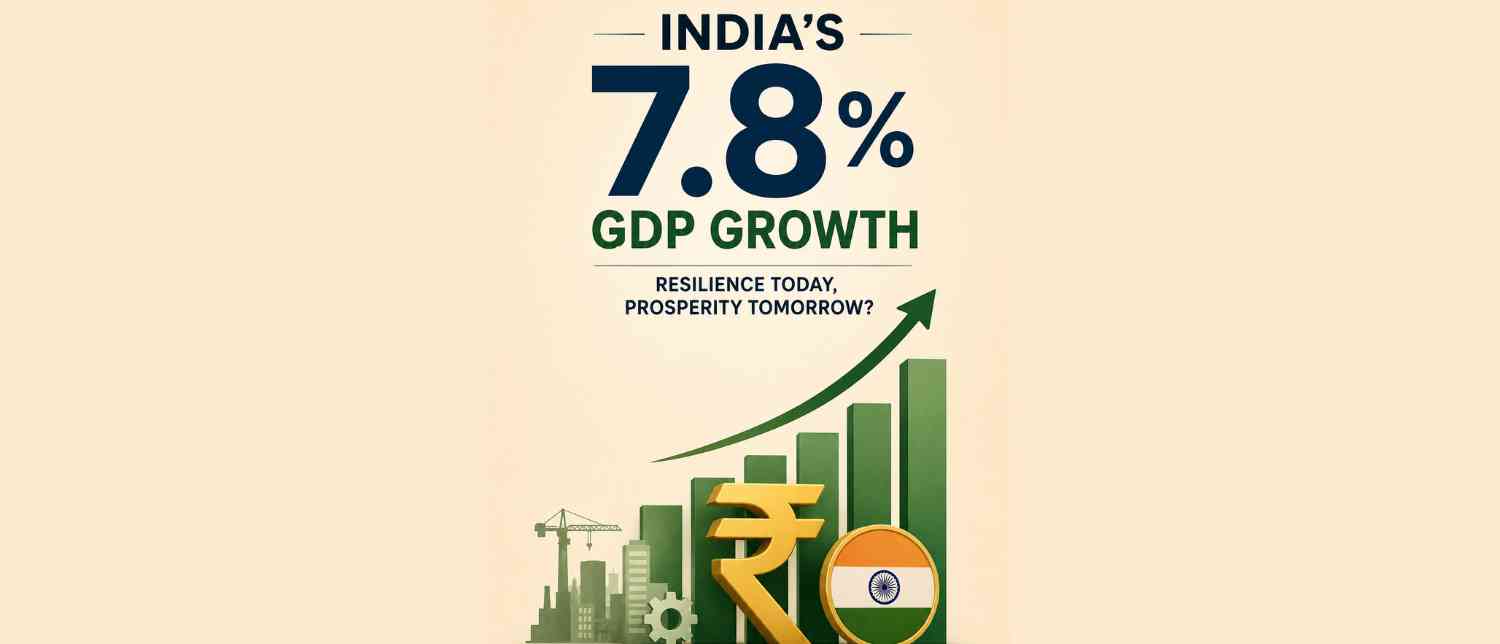
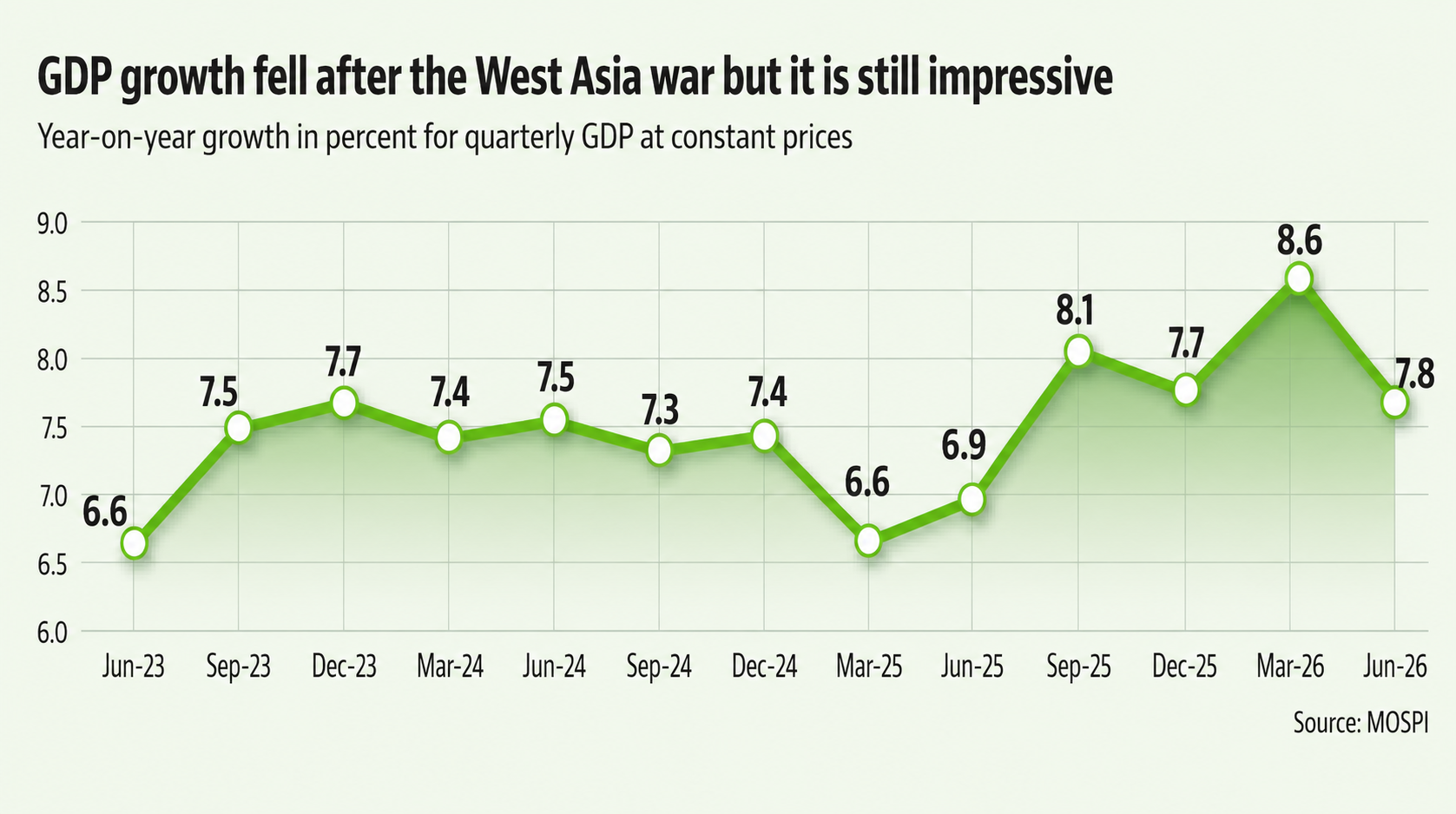
India’s economy has delivered a number that is difficult to ignore: 7.8% GDP growth in the April-June quarter of FY2026-27. The figure not only exceeded expectations but also marked a significant improvement over the 6.9% growth recorded in the same quarter a year earlier. More importantly, it came at a time when the global economy was dealing with war, disrupted supply chains, volatile energy markets and a sharp rise in crude oil prices.
That makes the latest GDP number more than just another quarterly statistic. It is evidence that India’s domestic economy has developed a degree of resilience that would have been harder to imagine a decade ago.
But there is a danger in celebrating the number too simplistically.
A 7.8% growth rate is undoubtedly good news. It deserves recognition. Yet GDP growth is not the same thing as universal prosperity, nor does one strong quarter guarantee that the economy will sustain the same momentum. The more important question is what is driving this growth, how widely its benefits are spreading and whether the forces supporting it can survive the challenges ahead.
In other words, India has cleared an important hurdle. It has not yet reached the finish line.
A Strong Number Arriving At A Difficult Time
The timing of the growth is perhaps more significant than the number itself.
India entered the April-June quarter facing a particularly uncomfortable external environment. Oil prices surged, the Strait of Hormuz witnessed severe disruption, the rupee came under pressure and geopolitical tensions threatened global trade and supply chains. Brent crude touched around $120 a barrel during the quarter, while the producer price index for crude petroleum rose sharply.
For an economy that imports a substantial portion of its energy requirements, a crude oil shock is never a minor problem. Expensive oil can increase transportation costs, raise input prices, widen the import bill and eventually put pressure on household purchasing power.
Yet the Indian economy expanded at 7.8%.
The resilience was not confined to a single sector either. Real gross value added grew 8.2%, while manufacturing expanded 9.2%, construction 7.7% and services 10%. Private consumption increased 7.1%, while gross fixed capital formation rose 11.9%.
That combination matters.
An economy growing because of one temporary factor is vulnerable. An economy where manufacturing, construction, services, consumption and investment are simultaneously contributing has a stronger foundation.
India’s latest performance appears closer to the second category.
The Government Did More Than Simply Watch The Crisis Unfold
Another important part of the story is policy.
During the oil shock, domestic petrol and diesel prices were kept relatively insulated from the international surge. That helped prevent the immediate transfer of the entire energy shock to consumers. At the same time, foodgrain reserves provided a buffer against food-price pressures, while measures supporting household incomes had already put additional purchasing power into the economy.
The central bank also played a role in containing financial instability. A special foreign-currency deposit mechanism attracted substantial overseas funds and helped prevent pressure on the rupee from becoming even more disruptive.
This is an important lesson about economic management.
Resilience does not happen automatically. It is partly created by institutions that have enough room to absorb shocks.
When households are protected from the immediate impact of an oil spike, when food stocks prevent shortages from turning into runaway prices and when monetary authorities prevent currency stress from becoming a financial crisis, the domestic economy gets breathing space.
India appears to have used that breathing space effectively.
But there is also a cost.
Shielding consumers from international oil prices does not make the shock disappear. It merely shifts some of the burden elsewhere — in this case, towards government finances. Subsidy expenditure has increased while excise collections have fallen, creating a fiscal challenge that cannot be ignored indefinitely.
That is why the next phase of economic policy will be harder than the last.
The Biggest Question: Can Private Investment Take Over?
Perhaps the most encouraging feature of the latest GDP data is investment.
Gross fixed capital formation grew nearly 12% in real terms during the quarter, pushing the investment rate higher. Capital goods output also rose strongly, while machinery imports increased substantially.
This could be a sign that the long-awaited transition from public-investment-led growth towards broader private investment is finally beginning.
For several years, government capital expenditure has played a crucial role in supporting economic activity. Roads, railways, logistics networks, urban infrastructure and other public projects have helped create demand while also improving the productive capacity of the economy.
But the government cannot be expected to carry the investment cycle forever.
At some point, private companies must believe that demand will remain strong enough to justify building factories, purchasing machinery, expanding capacity and hiring workers.
The latest numbers offer some evidence that this handover may be underway.
That would be far more consequential than the 7.8% headline itself.
If private investment continues to strengthen, India could enter a more durable phase of expansion. If it fails to do so, the government may once again find itself carrying too much of the burden.
Consumption Is Still The Other Half Of The Story
Investment alone cannot sustain a large consumer-driven economy.
Household consumption remains critical, and the 7.1% increase in private consumption is encouraging.
This is where the relationship between macroeconomic statistics and ordinary Indians becomes complicated.
GDP can rise strongly while individual households continue to feel financial pressure. A family does not experience GDP growth directly. It experiences it through wages, employment, food prices, fuel costs, housing expenses, education costs and purchasing power.
That is why inflation remains important even when headline growth is impressive.
One reason the latest growth story looks relatively comfortable is that core inflation has remained contained. But food prices remain vulnerable to weather conditions, particularly with concerns surrounding the monsoon. A prolonged rainfall deficit could put pressure on agricultural output and push up prices of food items such as vegetables, meat, eggs, spices and pulses.
This is where India's growth story could become uneven.
Urban consumption can remain strong while rural households struggle. Services can grow rapidly while labour-intensive manufacturing faces external trade pressures. Corporate profits can rise while smaller businesses continue to battle high input costs.
A healthy economy must eventually narrow these gaps.
“Vocal For Local” Is Economic Policy, But It Cannot Be The Whole Policy
Against this backdrop, the government's renewed push for Swadeshi and “Vocal for Local” has an economic logic.
The appeal to Indians to spend more on domestic goods and services, holiday within the country, consider Indian destinations for weddings and avoid unnecessary gold purchases is ultimately about keeping more economic activity within India. It is also connected to reducing pressure on foreign exchange and limiting avoidable imports during a period of geopolitical uncertainty.
There is merit in that argument.
If an Indian family chooses a domestic destination instead of spending heavily abroad, the expenditure can support Indian hotels, airlines, restaurants, transport operators and local businesses. If consumers increasingly choose competitive Indian products, domestic manufacturers can benefit.
But there is an important distinction between encouraging domestic consumption and discouraging global engagement.
India cannot become a major economic power by turning inward.
The country needs exports, foreign investment, global technology, international tourism and access to overseas markets. The objective should therefore be greater domestic capability, not economic isolation.
Self-reliance works best when it makes Indian businesses more competitive — not when it protects inefficient businesses indefinitely.
The Political Fight Over GDP Misses The Larger Point
Unsurprisingly, the 7.8% number has also become political ammunition.
The government has presented the growth figure as evidence that critics underestimated the economy's resilience. The Prime Minister has contrasted the strong performance with the pessimism and criticism surrounding India's economic outlook.
That is predictable politics.
But GDP should not become a scoreboard where one side is declared permanently correct and the other permanently wrong.
Opposition parties are right to ask whether growth is translating into enough jobs, whether rural India is benefiting adequately and whether inequality remains a concern. The government, meanwhile, is justified in pointing to the economy's strong expansion despite extraordinary external shocks.
Both questions can be true at the same time.
India can be growing rapidly and still have serious employment challenges.
India can attract investment and still have millions of small businesses struggling.
India can become one of the world's fastest-growing major economies and still need much faster improvements in per-capita income.
This is why political arguments over whether the GDP figure is “good” or “bad” are ultimately less useful than examining the quality of that growth.
The Next Three Quarters Will Tell The Real Story
There is another reason for caution.
The 7.8% figure is being compared with a 6.9% growth rate in the same quarter last year, but the economy is also coming off strong growth in the preceding quarters. The previous quarter recorded 8.6% growth, meaning the latest figure represents a sequential moderation even though it remains comfortably above expectations.
More importantly, some of the support provided by earlier tax relief and public spending will eventually fade.
That means future growth must increasingly come from private consumption, private investment, exports and productivity improvements rather than temporary fiscal support.
There are also external risks.
Trade barriers have already begun affecting labour-intensive export sectors such as garments, gems and jewellery, leather and ceramics. At the same time, the rupee remains under pressure and higher oil prices could again threaten India's import bill.
The monsoon is another wildcard.
A weak agricultural season could hurt rural incomes and push food inflation higher, forcing policymakers to balance growth against price stability.
And then there is the question of credit. Bank credit is expanding rapidly, but deposit growth is not keeping pace. That can support investment in the short term, but excessive credit expansion can eventually create financial vulnerabilities if not monitored carefully.
India Should Celebrate — But Not Become Complacent
The 7.8% GDP growth is a genuine achievement.
It came amid an oil shock, geopolitical instability and disrupted supply chains. Manufacturing and services performed strongly. Investment accelerated. Consumption remained healthy. India's economy grew faster than the expectations set at the beginning of the quarter.
There is no reason to downplay that.
But there is equally no reason to turn one quarter into a declaration of economic victory.
The real measure of success will be whether India can sustain growth above 7% without excessive fiscal stress, whether private investment replaces extraordinary government support, whether exports become more competitive, whether rural demand strengthens and whether the benefits of expansion reach a wider share of the population.
The government has demonstrated that it can help the economy absorb a major external shock.
Now comes the more difficult task: ensuring that the economy does not need a crisis to demonstrate its strength.
India's economic story is increasingly one of resilience. The next chapter needs to be about quality, inclusiveness and durability.
A 7.8% quarter is a reason for confidence.
It is not a reason for complacency.
The number has answered one question: Can India withstand a major global shock and still grow rapidly?
The next few quarters must answer a much bigger one:
Can India turn that resilience into sustained, broad-based prosperity?
With input from agencies
Image Source: Multiple agencies
© Copyright 2026. All Rights Reserved. Powered by Vygr Media.