

 By
By 
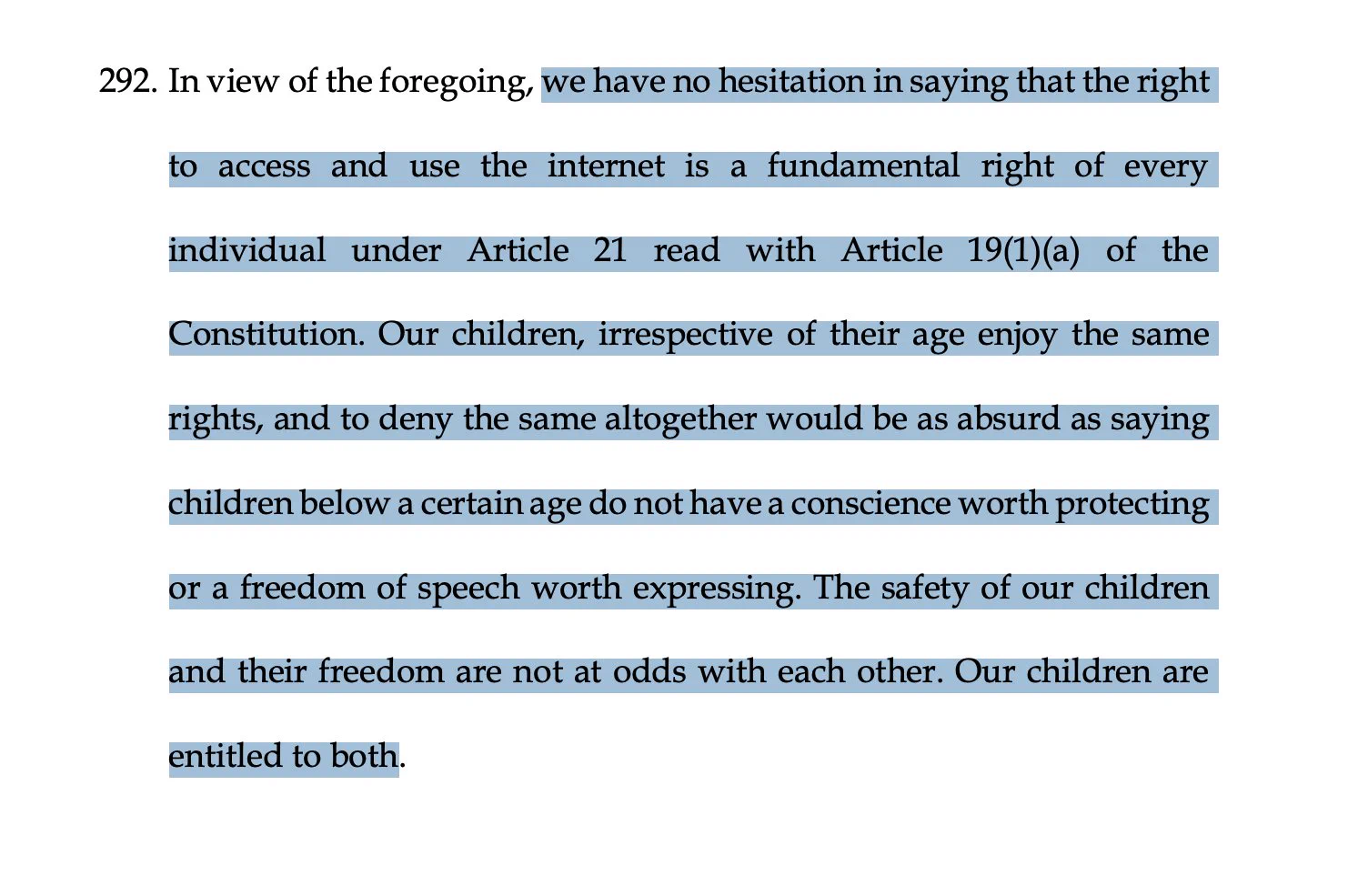
The Supreme Court of India has delivered a significant ruling on children's digital rights, declaring that access to and use of the internet is a fundamental right for every individual, including children, regardless of age. The court rejected the idea of imposing a blanket ban on children's internet access, emphasising that protecting young users from online dangers must not come at the cost of their constitutional freedoms.
A bench comprising Justices JB Pardiwala and K Vinod Chandran observed that children's safety and freedom are not contradictory. Instead of excluding minors from the digital world, the court called for stronger measures to detect and remove child sexual abuse material (CSAM), improve social media safety and hold online platforms accountable.
The ruling comes amid growing discussions in India about restricting children's access to social media, strengthening parental controls and making the internet safer for young users. It also places renewed responsibility on the government, technology companies and regulatory authorities to address online abuse without undermining children's fundamental rights.

Supreme Court Recognises Internet Access as a Fundamental Right
In its observations, the Supreme Court linked the right to access and use the internet to Article 21 and Article 19(1)(a) of the Indian Constitution. Article 21 protects life and personal liberty, while Article 19(1)(a) guarantees freedom of speech and expression.
The bench made it clear that these protections extend to children as well as adults. A child's age, by itself, cannot justify completely denying access to a medium that plays an increasingly important role in education, communication, creativity and the exchange of information.
The court's reasoning reflects how deeply the internet has become embedded in everyday life. For many children, particularly those living in remote areas, online resources provide access to educational material, information and learning opportunities that may otherwise be difficult to obtain.
The internet can also offer an important space for children with special needs to connect with others who share similar experiences. In such circumstances, a blanket restriction could limit not only entertainment or social media use but also access to learning, support and meaningful social interaction.
The ruling builds on earlier constitutional developments concerning digital access and online freedoms. In the 2020 Anuradha Bhasin case, the Supreme Court recognised constitutional protection for freedom of speech and expression exercised through the internet. In 2025, the court also recognised digital access as a fundamental right under Article 21 in the Pragya Prasun case.
The latest observations take this constitutional discussion further by expressly addressing the right of children to access and use the internet.
Why the Supreme Court Rejected a Blanket Internet Ban for Children
The court acknowledged that the internet, in its current form, is not entirely safe for children. Exposure to sexual exploitation, harmful content, online manipulation and contact with potentially dangerous individuals remains a serious concern.
However, the bench questioned whether excluding children from the internet would genuinely solve these problems. It reasoned that children do not necessarily stop accessing online services simply because a law prohibits them from doing so.
Instead, strict age-based restrictions could push young users towards unregulated websites and less secure platforms, where harmful material may be harder to identify and report. A measure intended to protect children could therefore expose some of them to greater risks.
The court also highlighted a less obvious consequence of blanket bans: children experiencing online threats, grooming or exploitation might hesitate to seek help. If they fear punishment for using the internet against the rules, they may be less willing to tell their parents, guardians or other trusted adults about abusive encounters.
Such hesitation can make it harder to identify offenders, protect victims and prevent further exploitation.
The bench also raised concerns about the privacy implications of strict age-verification systems. Determining the age of every internet user could require the continuous collection and monitoring of sensitive personal information, creating additional risks involving data misuse and surveillance.
The court's position does not suggest that children should have unrestricted access to every website or online service. Rather, it challenges the effectiveness and proportionality of a complete age-based ban as a solution to online safety problems.
The central question, therefore, is how to make digital spaces safer without depriving children of legitimate access to information and communication.
Supreme Court Calls for Stronger Social Media Safety Measures
While rejecting a blanket ban, the Supreme Court stressed that proportionate safeguards are necessary to protect children online. It pointed towards practical measures that could reduce exposure to harmful content while allowing age-appropriate access to digital services.
These measures include parental consent and supervision, dedicated child-mode accounts, private profiles by default, restrictions on messages from unknown adults and stronger moderation of advertisements and content shown to young users.
Such protections could help reduce unwanted contact and make it more difficult for strangers to approach children through social media. Private-by-default settings, for instance, could limit the visibility of children's personal information, while restrictions on unsolicited messages could reduce opportunities for online grooming.
The court also indicated that safeguards could be designed specifically for pre-teens, with reasonable and proportionate methods of verifying parental consent. The Union government has been left to determine the appropriate framework and implementation details.
Importantly, the court clarified that its observations do not prevent the government from restricting children's access to specific categories of content or services that are inherently harmful, including adult-content websites.
This distinction is central to the ruling: targeted restrictions and age-appropriate safety mechanisms remain possible, even though a blanket denial of internet access is not considered an appropriate solution.
Supreme Court Flags Failure to Remove Child Sexual Abuse Material
Alongside its observations on children's internet rights, the Supreme Court expressed serious concern about the continued circulation of child sexual exploitation and abuse material (CSEAM) across social media platforms and other online services.
The proceedings were prompted, in part, by reports alleging that such material was being promoted through paid advertisements, redirect links and websites associated with social media platforms. The court questioned why abusive content continued to circulate despite existing guidelines and mechanisms intended to protect children.
The bench criticised regulatory authorities and online intermediaries for failing to take sufficiently effective steps to safeguard victims. It stressed that the responsibility for addressing online sexual abuse cannot rest solely on individual users reporting harmful content.
Under existing arrangements, the removal process has often depended heavily on complaints. Furthermore, when one platform identifies and removes abusive material, the same content may not automatically be flagged on other services. This creates opportunities for the material to reappear or continue circulating elsewhere.
The court called for a more coordinated approach, under which confirmed abusive material can be identified and removed more efficiently across platforms. Its observations underline the need for technology companies to improve their detection systems, cooperate with law enforcement and respond promptly when child safety is threatened.
The Union government has also been pressing technology companies to report cases involving child sexual abuse material directly to Indian law enforcement agencies rather than routing reports through a US-based nonprofit organisation first. Google and Meta agreed to shift towards direct reporting following discussions with the government.
National Database to Help Identify and Remove Abusive Content
To strengthen enforcement, the Supreme Court directed the Centre to frame guidelines for creating national databases of perceptual hashes and URLs associated with child sexual abuse material.
Perceptual hashing is a technology that generates digital identifiers for images or videos, allowing systems to recognise matching or substantially similar material without relying only on filenames. When appropriately implemented, these identifiers can help platforms detect previously identified abusive content, even when it is uploaded again.
A coordinated database could make it easier for different platforms to identify known material and prevent repeated circulation. URL-based records could also help identify links associated with confirmed abusive content.
The court called for guidelines and standard operating procedures covering hash matching, URL listing and other technological measures for detecting and removing such material.
However, it also emphasised that these systems must include safeguards against errors and misuse. Content should not automatically be deleted or added to a database merely because of a single complaint. Verification and appropriate checks must precede such action.
The court further clarified that databases created for identifying child sexual abuse material must not be repurposed to detect or remove unrelated categories of content.
These safeguards are important because efforts to combat online abuse must remain accurate, accountable and consistent with legitimate rights. A system designed to protect children should not become a mechanism for arbitrary censorship or unjustified content removal.
Online Safety Education Must Begin in Primary Schools
The Supreme Court also called for extensive awareness and sensitisation programmes beginning at the primary school level.
The aim is to help children recognise online dangers, understand appropriate digital behaviour and know when to seek assistance. Early education can teach young users how to respond to suspicious messages, inappropriate requests, threats and attempts at manipulation.
Parents, teachers and guardians also have an important role in creating an environment in which children feel comfortable discussing uncomfortable online experiences. Children who fear immediate punishment or the loss of internet access may be less likely to disclose abuse.
A more effective approach combines digital literacy with supportive supervision, clear reporting channels and timely intervention. Schools can help children understand online privacy and consent, while parents can establish age-appropriate boundaries without making internet use a source of secrecy or fear.
The court's emphasis on awareness recognises that technology alone cannot eliminate online exploitation. Effective protection also requires children to know how to identify risks and where to turn when something goes wrong.
Ruling Comes Amid Debate Over Social Media Age Restrictions
The judgment arrives at a time when governments and policymakers are debating whether children should face stricter limits on social media use.
Earlier in October 2026, the Union government indicated that it was considering amendments to the Information Technology intermediary rules to restrict internet access for children under 18. The Supreme Court had also previously raised the question of whether children below 18 should be prohibited from creating social media accounts without parental consent.
Separately, Andhra Pradesh minister Nara Lokesh had said that the state government was considering a ban on social media use by children under 16. The debate has also drawn attention to Australia's move to restrict social media accounts for children.
These discussions reflect widespread concerns about online exploitation, harmful content and the effects of social media on young users. However, the Supreme Court's observations establish an important distinction between regulating access to particular services and denying children access to the internet altogether.
The government can still consider proportionate measures to protect minors, but any framework must account for constitutional freedoms, privacy concerns and the practical consequences of restrictions.
The ruling also places greater scrutiny on social media companies. If platforms fail to identify and remove abusive material effectively, imposing restrictions on children alone risks leaving the underlying problem unresolved.
What the Supreme Court Ruling Means for Children and Parents
The ruling does not mean children can access every online service without safeguards, nor does it remove the role of parental supervision. Instead, it reinforces the principle that children's fundamental rights must be considered alongside their need for protection.
For parents, the emphasis is likely to remain on age-appropriate supervision, safer account settings, open communication and helping children navigate digital spaces responsibly. For social media companies, the court's directions highlight the need for stronger content moderation, faster reporting mechanisms and better coordination in removing confirmed abusive material.
For the government, the challenge is to develop rules that protect minors without creating disproportionate restrictions or unnecessary surveillance. Any new system will need to balance child safety, digital privacy, freedom of expression and access to information.
The effectiveness of these measures will depend on how quickly the authorities establish clear procedures and how consistently platforms implement them. National databases, cross-platform detection and accessible grievance mechanisms could strengthen enforcement, provided that they include reliable verification and safeguards against misuse.
Ultimately, the Supreme Court has placed responsibility on the institutions best positioned to address online risks rather than treating children's presence on the internet as the problem itself.
The message is clear: protecting children and preserving their fundamental rights must go hand in hand. As digital access becomes increasingly important for education, communication and participation in society, India's approach to online child safety will need to move beyond blanket prohibitions towards targeted protections, stronger accountability and greater awareness.
The ruling marks a significant moment in the debate over internet access as a fundamental right in India. Its lasting impact will depend on whether the government, technology companies, schools and families can turn the court's principles into practical safeguards that make the digital world safer without shutting children out of it.
© Copyright 2026. All Rights Reserved. Powered by Vygr Media.