
 By
By 
India loves a good paradox. It celebrates being the world’s fastest-growing major economy while quietly confronting a steady hum of investor hesitation. It boasts of a booming startup ecosystem, a digital public infrastructure that the world admires, and a young, tech-hungry population. And yet, when it comes to capital—especially global capital—the enthusiasm is no longer unconditional.
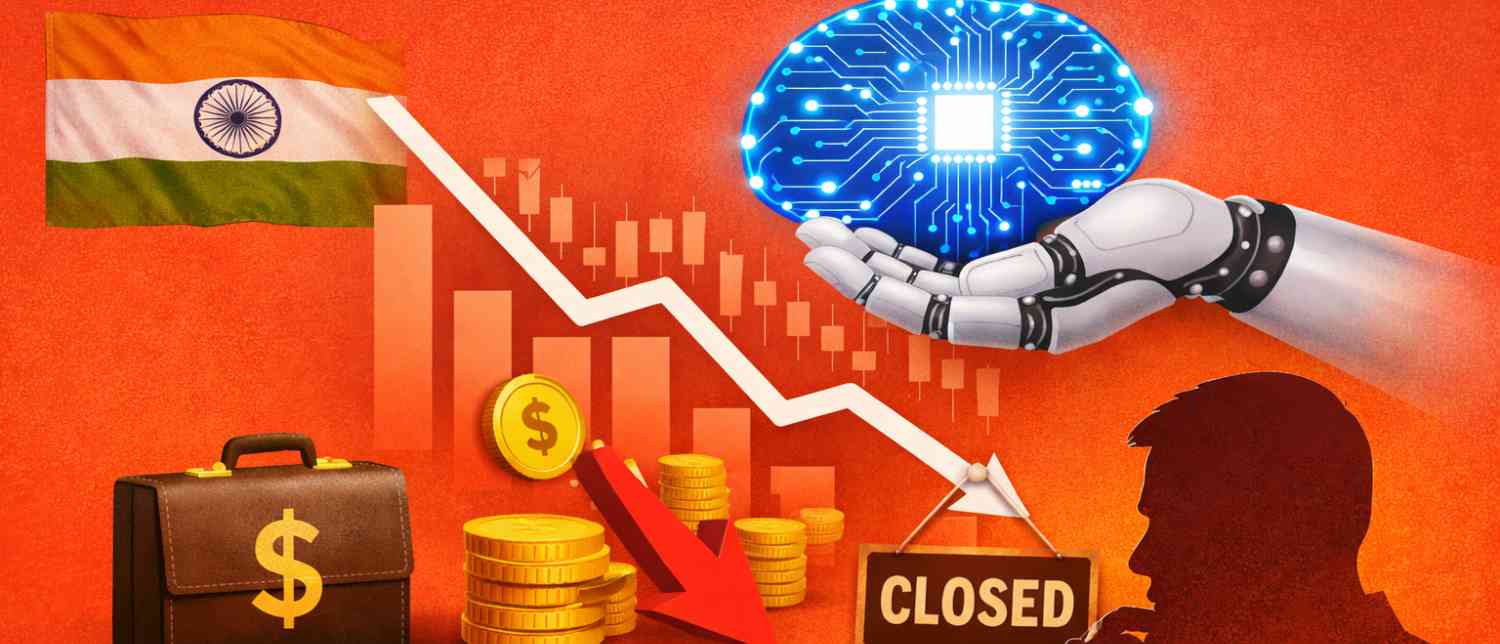
Nowhere is this contradiction more visible than in India’s artificial intelligence (AI) narrative. AI is, by all accounts, India’s “next big thing.” But if that were entirely true, the money would already be pouring in. It isn’t—at least not at the scale or speed many expected. And that gap between promise and participation tells a deeper story about India’s investment climate.
The AI Hype vs The Capital Reality
AI is undeniably India’s hottest buzzword. Startups are pivoting toward it, enterprises are integrating it, and policymakers are invoking it as the next engine of economic growth. From generative AI tools to enterprise automation, the breadth of ambition is staggering.
Yet, investors—particularly venture capitalists and foreign institutional investors (FPIs)—are approaching this wave with caution rather than conviction.
The hesitation isn’t about AI itself. Globally, AI is attracting unprecedented capital. The issue is India’s positioning within that global race. Investors are asking a difficult question: does India have the infrastructure, ecosystem depth, and monetization pathways to truly compete in AI—or is it still largely a services-led story repackaged in a new vocabulary?
Many Indian AI startups remain heavily dependent on external foundational models, particularly those built in the US. That raises concerns about defensibility and long-term value creation. If the core technology isn’t owned locally, investors worry the upside may be capped.
The Missing Depth in India’s Tech Stack
A recurring theme across investor commentary is India’s lack of deep-tech infrastructure. While the country has excelled in software services and application-layer innovation, it has lagged in building foundational technologies—semiconductors, advanced computing systems, and proprietary AI models.
This gap matters more than ever in the AI era.
Training large language models and deploying advanced AI systems require massive computational resources and capital expenditure. Without domestic capabilities in these areas, Indian startups often rely on foreign cloud providers and platforms, which erodes margins and strategic control.
The result? Investors see risk where they should ideally see opportunity.

Global Investors Are Pulling Back And Not Quietly
The caution is not limited to venture capital. Foreign portfolio investors have been actively reducing their exposure to Indian markets. This trend has been noticeable over recent months, with consistent outflows raising eyebrows.
The reasons are layered.
Valuations in India remain relatively high compared to other emerging markets. For global investors managing diversified portfolios, India no longer looks like the obvious bargain it once did. Instead, it appears expensive—especially when compared to markets offering similar growth at lower entry points.
At the same time, global macroeconomic conditions are tightening. Higher interest rates in developed markets are pulling capital back home. In such an environment, emerging markets like India must compete harder for every dollar.
And right now, India is not winning that competition as convincingly as before.
What Nithin Kamath Is Warning About
Few voices have captured this concern as bluntly as Nithin Kamath, the co-founder of Zerodha. He has pointed out that foreign investor interest in India is waning—and not without reason.
Kamath highlights structural issues that go beyond short-term market cycles. These include:
-
Market valuations that appear stretched
-
Limited depth in certain sectors
-
Regulatory complexities that can deter long-term capital
His argument is simple but uncomfortable: India cannot rely solely on its growth narrative. It must fix underlying inefficiencies to remain attractive.
This perspective aligns with broader investor sentiment. Growth alone is no longer enough. Investors want clarity, predictability, and scalable opportunities.
“No AI, No FPI”: A Harsh but Telling Reality
One of the more striking observations emerging from recent analyses is the idea that “no AI means no FPI.” While this may sound exaggerated, it captures a real shift in investor priorities.
Global capital is increasingly chasing technology-led growth stories. Countries and markets that demonstrate leadership in AI, semiconductors, and advanced manufacturing are attracting disproportionate attention.
India, despite its strengths, is still seen as catching up in these areas.
This perception has tangible consequences. Sectors that are not aligned with the global AI narrative are struggling to attract fresh foreign capital. Even within tech, companies that lack a clear AI strategy are finding it harder to excite investors.
In other words, AI is no longer optional—it is becoming central to investment theses.
The Emerging Markets Context
India’s challenges are also tied to its position within the broader emerging markets landscape.
Global investors allocate capital comparatively, not in isolation. And in that comparison, India faces stiff competition. Countries offering cheaper valuations, commodity exposure, or stronger currency dynamics are becoming attractive alternatives.
Moreover, geopolitical uncertainties and shifting trade dynamics are influencing capital flows. Investors are diversifying their bets, and India is no longer the singular focus it once was.
This doesn’t mean India is losing relevance—but it does mean it must work harder to justify its premium.
The Valuation Conundrum
One of the most persistent concerns is valuation.
Indian equities are trading at higher multiples compared to many emerging market peers. While this premium reflects strong growth expectations, it also creates a high bar for performance.
If earnings growth fails to match expectations, the downside risk increases. Investors are acutely aware of this imbalance.
In the startup ecosystem, a similar pattern is visible. Funding rounds are becoming more selective, with investors scrutinizing business models, unit economics, and scalability more rigorously than before.
The era of easy money is over—and India is feeling that shift.
Structural Issues That Can’t Be Ignored
Beyond AI and valuations, there are deeper structural issues influencing investor sentiment:
Regulatory unpredictability remains a concern. While reforms have been introduced, consistency in implementation is still evolving.
Infrastructure gaps, particularly in advanced technology sectors, limit scalability.
Dependence on global supply chains for critical components creates vulnerabilities.
And perhaps most importantly, there is a need for stronger alignment between policy ambition and execution.
These challenges are not new—but they are becoming harder to overlook in a more competitive global environment.
India’s Strengths Still Matter
Despite the caution, it would be a mistake to interpret this moment as a decline in India’s prospects.
The fundamentals remain strong. A large domestic market, a growing middle class, and a vibrant entrepreneurial ecosystem continue to provide a solid foundation.
India’s digital public infrastructure—UPI, Aadhaar, and beyond—remains a global benchmark.
And in AI, while the country may not yet lead in foundational models, it has significant potential in applied AI, particularly in sectors like healthcare, education, and financial services.
The opportunity is real. The question is whether India can convert that opportunity into sustained investor confidence.
The Way Forward: From Promise to Proof
If there is one clear takeaway from the current investor sentiment, it is this: India needs to move from narrative to execution.
In AI, this means investing in foundational capabilities—compute infrastructure, research, and talent development.
In markets, it means addressing valuation concerns through consistent earnings growth and improved transparency.
In policy, it means reducing friction and enhancing predictability.
And in the broader economy, it means building depth—ensuring that growth is not just fast, but also resilient and inclusive.
A Moment of Reckoning, Not Retreat
India stands at an inflection point.
The world is watching, but it is also evaluating more critically than before. The enthusiasm that once came easily must now be earned.
AI may be India’s hottest bet—but unless backed by structural strength and strategic clarity, it risks becoming just another buzzword.
Investors are not turning away from India entirely. They are simply asking harder questions.
And perhaps that is exactly what India needs.
With inputs from agencies
Image Source: Multiple agencies
© Copyright 2025. All Rights Reserved. Powered by Vygr Media.