

 By
By 
Artificial intelligence is often framed as a battle between generations. Gen Z is portrayed as the AI-native workforce, Millennials as enthusiastic adopters, and Baby Boomers as cautious skeptics struggling to keep pace with technological change. Yet this narrative overlooks a crucial reality: the generation most likely to determine whether AI becomes a force for meaningful progress or a catalyst for widespread misinformation, poor decision-making, and workplace disruption is Generation X.
Born roughly between 1965 and 1980, Gen X occupies a unique position in today's workforce. They are old enough to remember a world before the internet, yet young enough to have adapted through every major technological revolution of the modern era—from personal computers and email to smartphones, cloud computing, and now generative AI. More importantly, they currently hold many of the senior leadership, management, and mentorship positions that shape how organizations adopt new technologies.
As AI accelerates, Generation X faces a responsibility that extends beyond simply learning new tools. Their role is becoming that of a bridge—connecting technological innovation with human judgment, business wisdom, ethical accountability, and authentic leadership.
The Authenticity Crisis AI Has Created
One of the most significant challenges emerging from the AI revolution is not technical but philosophical. AI can now generate articles, presentations, images, videos, code, and business recommendations at extraordinary speed. The problem is that fluency is increasingly being mistaken for quality.
The danger is not that AI produces bad content. It often produces content that sounds convincing enough to pass initial scrutiny. The real risk lies in the growing volume of technically correct but contextually hollow information flooding workplaces, classrooms, media platforms, and decision-making processes.
This is where Gen X's lived experience becomes invaluable.
Unlike younger generations that have grown up surrounded by algorithmic recommendations and AI-assisted interfaces, Gen X developed professional judgment before automation became ubiquitous. They learned to distinguish expertise from presentation, substance from style, and insight from noise.
An opinion piece published by NDTV argues that Generation X must become the guardians of authenticity in the AI era, serving as a filter between human judgment and machine-generated output. That responsibility is becoming increasingly important as organizations rush to deploy AI tools across every function.
The challenge is not whether AI can create content. It is whether someone can recognize when AI-generated content lacks originality, strategic value, or ethical consideration. Taste, discernment, and restraint are becoming scarce resources in a world where synthetic content can be produced infinitely.
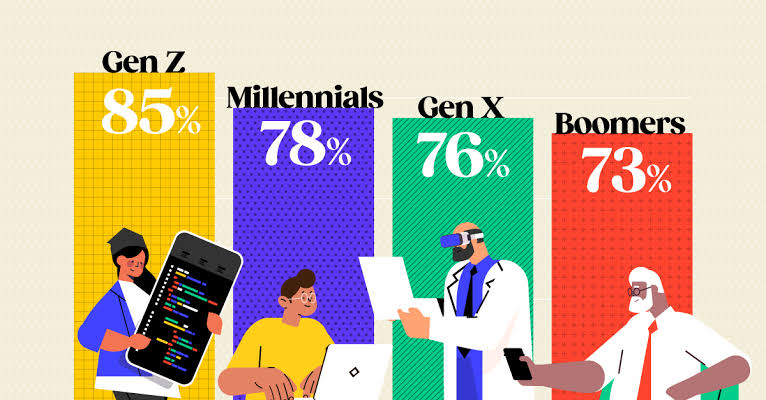
The Generational AI Divide Is More Complex Than It Appears
Conventional wisdom suggests younger workers naturally possess an advantage in AI because they are digital natives. However, research increasingly reveals that AI readiness is far more nuanced.
According to Business Plus AI's analysis of generational AI readiness, Gen Z employees excel in comfort with AI interfaces, rapid experimentation, and adaptability. They readily adopt tools such as ChatGPT and AI-powered assistants and are often willing to learn through trial and error. However, they frequently lack deeper understanding of AI limitations, governance frameworks, ethical concerns, and strategic implementation.
Their familiarity with AI as consumers does not automatically translate into business competence.
Millennials, meanwhile, occupy a middle ground. Having witnessed the rise of the internet, social media, and cloud computing, they generally demonstrate strong technology adoption skills and cross-functional thinking. Yet many still lack specialized AI expertise, prompt engineering capabilities, and change-management skills necessary for organization-wide AI transformation.
Gen X presents a different profile altogether.
Research highlights several strengths that make Gen X uniquely valuable in AI adoption: deep process knowledge, business judgment, risk awareness, institutional memory, and mentorship capacity. Their primary challenges are often technical confidence and hands-on AI experience rather than strategic understanding.
In other words, Gen X frequently understands where AI should be applied before they fully understand how to apply it.
That distinction matters.
Why Gen X May Hold the Keys to AI Employment
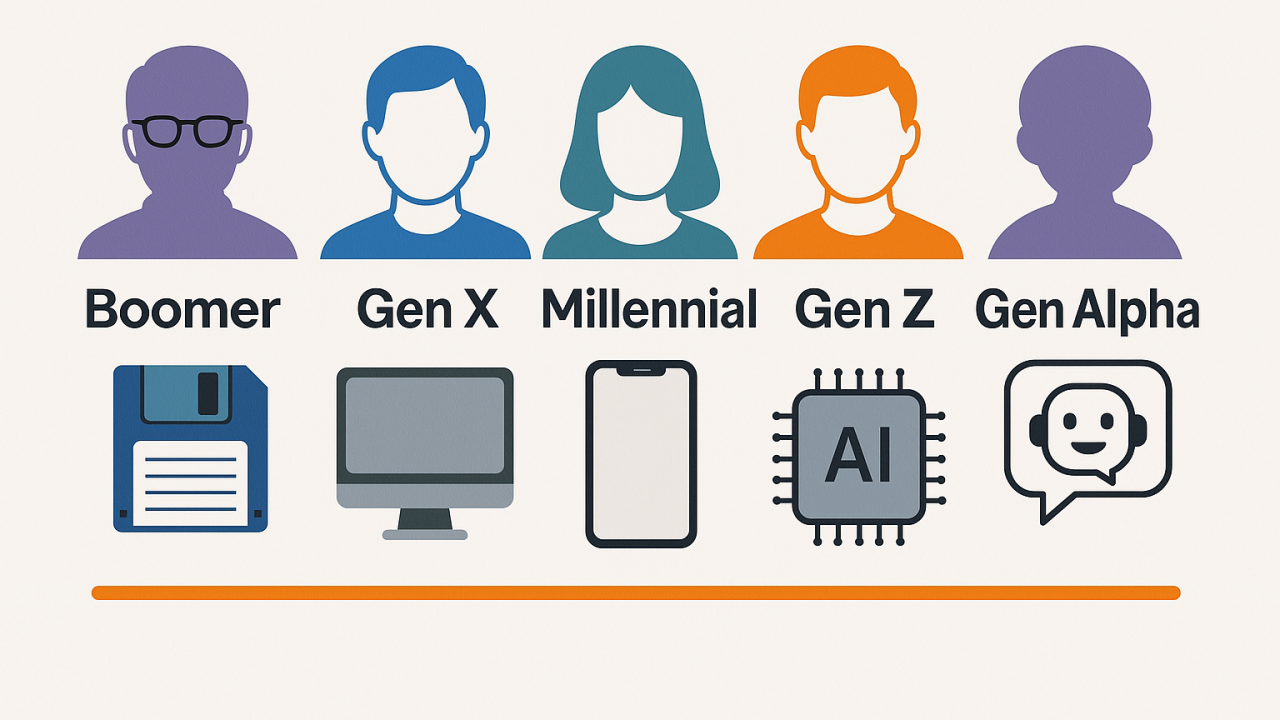
Jon Walkenhorst's LinkedIn essay argues that Gen X may ultimately hold the keys to AI-era jobs not because they are the most technically advanced generation, but because they possess a rare combination of practical business experience and adaptability.
Over decades of economic upheaval, Gen X has navigated globalization, outsourcing, the internet revolution, social media disruption, remote work, and digital transformation. They have repeatedly learned how to reinvent themselves in response to technological shifts.
This adaptability may prove more valuable than raw AI proficiency.
As automation increasingly handles repetitive tasks, employers are likely to place greater value on skills that machines cannot easily replicate: judgment, leadership, contextual understanding, relationship management, negotiation, and ethical reasoning.
AI can generate recommendations. It cannot fully understand organizational politics.
AI can summarize customer data. It cannot genuinely build trust.
AI can draft strategy documents. It cannot assume accountability for strategic decisions.
These are areas where Gen X's accumulated professional experience becomes a competitive advantage.
The Rise of Reverse Mentorship
The AI era is also creating an unusual workplace dynamic: reverse mentorship.
Historically, knowledge flowed downward from senior employees to junior staff. AI is changing that model.
Research and workplace trends increasingly show younger employees teaching AI tools and prompt engineering techniques to older colleagues. In some organizations, Gen Z workers are becoming informal AI coaches for managers and executives.
But the relationship works both ways.
While younger generations can demonstrate how AI tools function, Gen X provides the business context necessary to determine when those tools should be used, how outputs should be evaluated, and where risks exist.
This exchange creates a powerful partnership.
Gen Z contributes experimentation.
Millennials contribute implementation.
Gen X contributes judgment.
Boomers contribute strategic perspective and institutional wisdom.
Organizations that encourage this collaboration will likely outperform those that allow generational silos to form around AI adoption.
Human Judgment Must Remain Central
Perhaps the greatest misconception about AI is that it should replace human decision-making.
In reality, AI is most effective when used as an analytical partner rather than an autonomous authority.
This distinction places significant responsibility on Generation X leaders.
Many Gen X professionals occupy positions where AI-generated insights increasingly influence hiring, marketing, customer service, forecasting, and strategic planning. Their challenge is ensuring that data informs decisions without replacing human accountability.
Business Plus AI identifies risk awareness as one of Gen X's defining strengths. While younger workers may embrace experimentation and older leaders may focus on long-term strategy, Gen X often acts as the practical evaluator asking critical questions:
Is this recommendation accurate?
What biases might exist?
What consequences are being overlooked?
Should humans remain in the loop?
These questions become increasingly important as AI systems grow more sophisticated and persuasive.
Protecting Families From AI's Dark Side
Gen X's responsibilities extend beyond the workplace.
Often referred to as the "sandwich generation," many Gen X adults simultaneously care for aging parents and support children entering adulthood.
As AI-generated scams, voice cloning, deepfakes, and misinformation campaigns become more convincing, Gen X occupies a critical defensive position.
Their familiarity with both analog and digital worlds makes them uniquely equipped to educate vulnerable family members about emerging risks.
The challenge is no longer simply teaching internet safety. It is teaching reality verification in an era when audio, video, and written content can be fabricated at scale.
Authenticity is becoming a survival skill.
Future-Proofing Themselves While Leading Others
Despite their advantages, Gen X cannot rely solely on experience.
AI will automate significant portions of knowledge work, and Gen X professionals still face pressure to adapt before retirement.
The most effective response is neither resistance nor blind adoption.
It is practical integration.
Gen X workers who learn to use AI for forecasting, administrative efficiency, research, content drafting, and decision support can significantly amplify their productivity while maintaining human oversight.
Research suggests that organizations often see rapid progress once Gen X employees gain hands-on exposure to AI tools and overcome initial hesitation. Their business acumen enables them to translate AI capabilities into tangible outcomes more effectively than many younger adopters.
The Generation Built for Balance
The AI conversation often focuses on who will build the technology or who will use it most aggressively.
A more important question may be who will ensure it is used responsibly.
Generation X sits at the intersection of experience and adaptation, skepticism and curiosity, technology and humanity. They understand life before algorithms but remain engaged with the digital future.
That perspective is increasingly rare.
The future of AI will not be determined solely by engineers, startups, or algorithms. It will be shaped by leaders capable of balancing efficiency with ethics, automation with accountability, and innovation with authenticity.
In that sense, Generation X may have the most important role of all.
Not because they invented AI.
Not because they use it the most.
But because they are uniquely positioned to ensure humanity remains at the center of it.
With inputs from agencies
Image Source: Multiple agencies
© Copyright 2026. All Rights Reserved. Powered by Vygr Media.