 By
By 
After a week of pointed posts from Elon Musk, Reliance Industries has finally answered in public. Its message is short and carefully balanced: bring on the competition, but follow the rules, and by the way, our own satellite business is also waiting for clearances.
What Reliance said
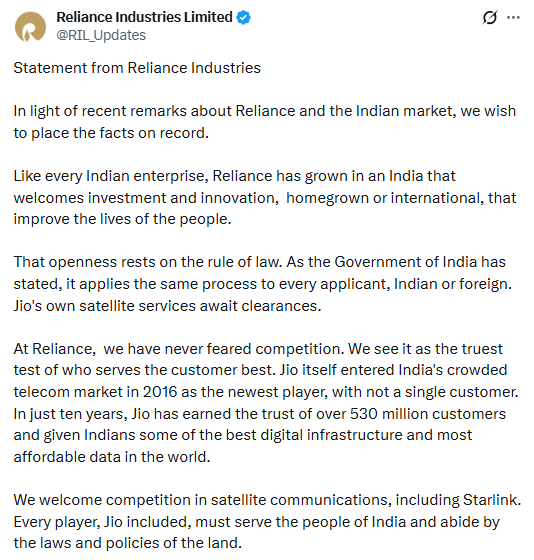
In a statement posted on X on Friday, Reliance said it has never feared competition and sees it as the truest test of who serves the customer best. The company pointed to its own history, noting that Jio entered India’s crowded telecom market in 2016 as the newest player, with not a single customer. Reliance says Jio has since built a base of more than 530 million customers.
On satellite communications, it said: “We welcome competition in satellite communications, including Starlink.” It added that every player, Jio included, must serve the people of India and abide by the laws and policies of the land, and that this openness “rests on the rule of law”.
“Jio’s own satellite services await clearances”
The most pointed part of the statement came near the end. Reliance said India’s rules apply equally to domestic and foreign companies in the field, and that Jio’s own satellite services are still waiting for clearances. In other words, it was answering the accusation that it is holding Starlink back by saying that it is in the same queue. Reliance did not, in what we have seen, address Musk’s specific allegation that it is blocking Starlink.
What Musk said
The statement follows a series of posts from Musk. Last week he accused unnamed “oligarchs” of blocking Starlink, and he then asked on X whether Mukesh Ambani is the “real boss of India”. In one post, he wrote “Dear Prime Minister Ambani” and apologised sarcastically for not realising Ambani was the real boss, saying he would prefer to keep a “monopolistic exploitation” of the Indian people, and asking whether he would nonetheless consider letting Starlink compete. These are Musk’s claims, and no report we have seen has established that Reliance or anyone else is blocking Starlink.
What the government says
The government has rejected Musk’s claim, calling India’s framework fair and non-discriminatory. According to the reports, Communications Minister Jyotiraditya Scindia said India is close to a final decision on the pricing framework for satellite communication services, and that all licensed operators, including Starlink, must meet security requirements before commercial operations begin. Starlink, Eutelsat OneWeb and Jio Satellite Communications each hold a licence, and the security assessments for all three are under way.
The older fight behind the new one
This is not the first time the two companies have clashed. In 2024, they took opposite positions on how satellite spectrum should be awarded. Reliance argued for an auction, saying it was needed for a level playing field, while Starlink argued that administrative allocation is the global norm. The government sided with administrative allocation. Then, in March 2025, Jio signed a deal with SpaceX to retail Starlink equipment in its stores, a deal that depended on Starlink getting its own authorisations. So the relationship has been competitive and cooperative at different times, which makes the current exchange all the more striking.
Reading the statement
Reliance’s answer is carefully worded. By welcoming Starlink and putting itself in the same regulatory position, it presents itself as a fellow applicant and not a gatekeeper. It also turns Musk’s demand for openness back on him, with the phrase about every player abiding by the law. Whether that satisfies critics will depend on whether the regulatory process moves quickly and visibly, which is a matter for the government and the regulator and not the companies.
What happens next
The next milestones are the completion of the security assessments, the final decision on satellite pricing, and spectrum assignment for each licensed operator. None has a confirmed date.
© Copyright 2026. All Rights Reserved. Powered by Vygr Media.