 By
By 
An IndiGo aircraft operating a flight from Navi Mumbai to Srinagar came into contact with a parking-stand pole at Srinagar International Airport on Friday morning, September 4, shortly after landing. The incident damaged the aircraft but ended without injuries to any passenger or crew member.
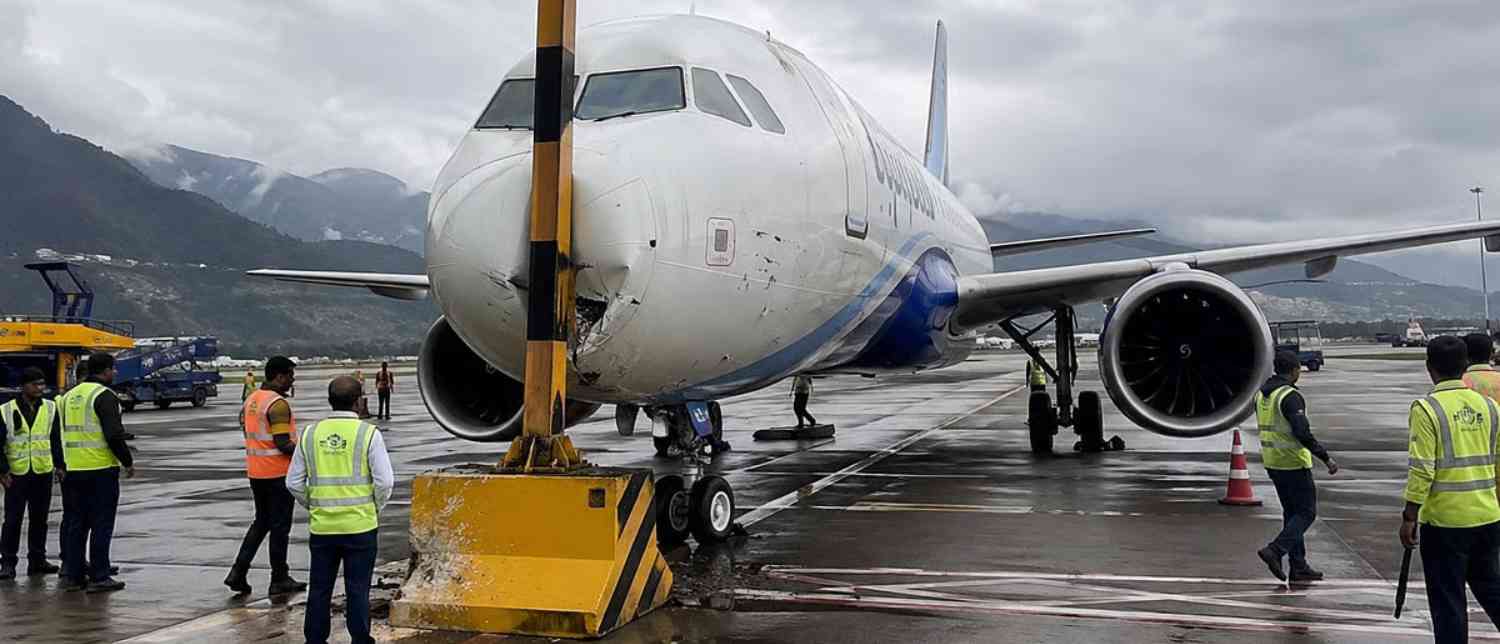
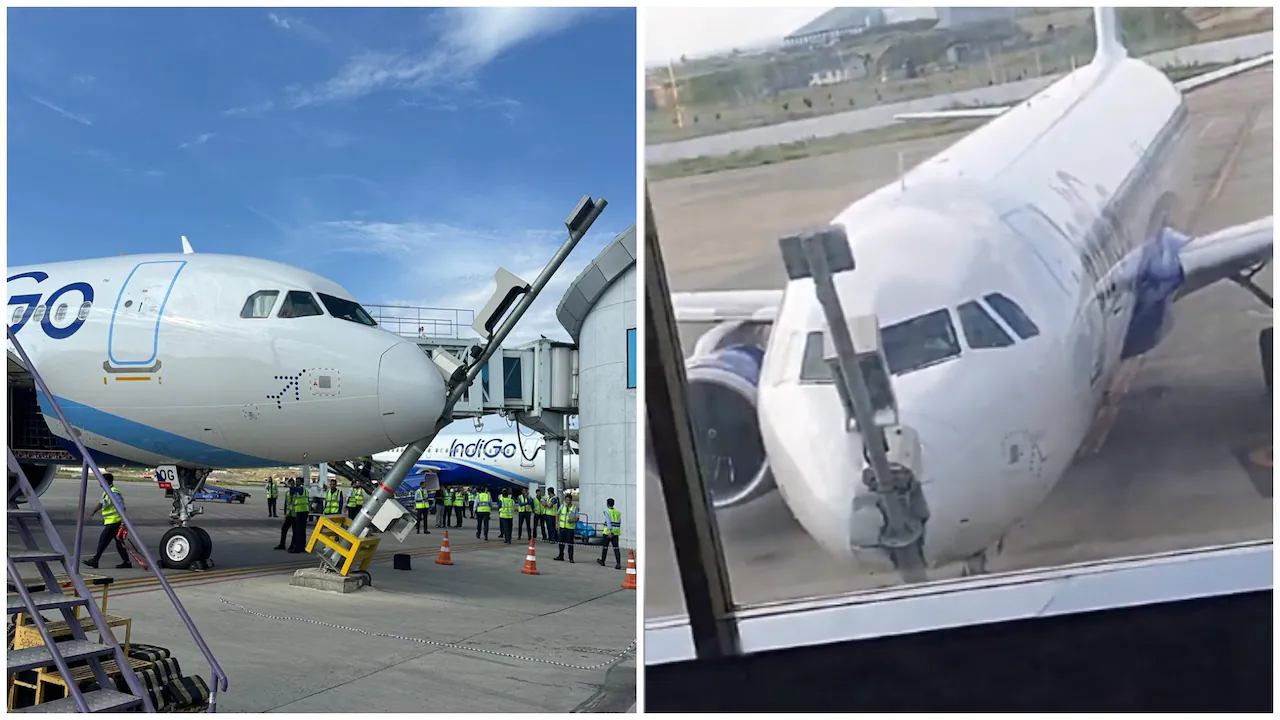
The aircraft, operating as IndiGo flight 6E 225 and registered as VT-NOG, was being positioned at Bay No. 6 when it struck a Visual Docking Guidance System (VDGS) pole at around 9:02 am. The aircraft had already completed its flight safely and the contact occurred during the parking process rather than during the landing itself.
All passengers and crew members were safely deboarded using manual aircraft stairs. The airline subsequently grounded the aircraft for necessary maintenance and said it would return to service only after obtaining the required clearances.
What happened to the IndiGo aircraft at Srinagar airport?
Flight 6E 225 was travelling from Navi Mumbai to Srinagar on Friday morning. After landing safely at Srinagar, the aircraft was moved towards its assigned parking bay.
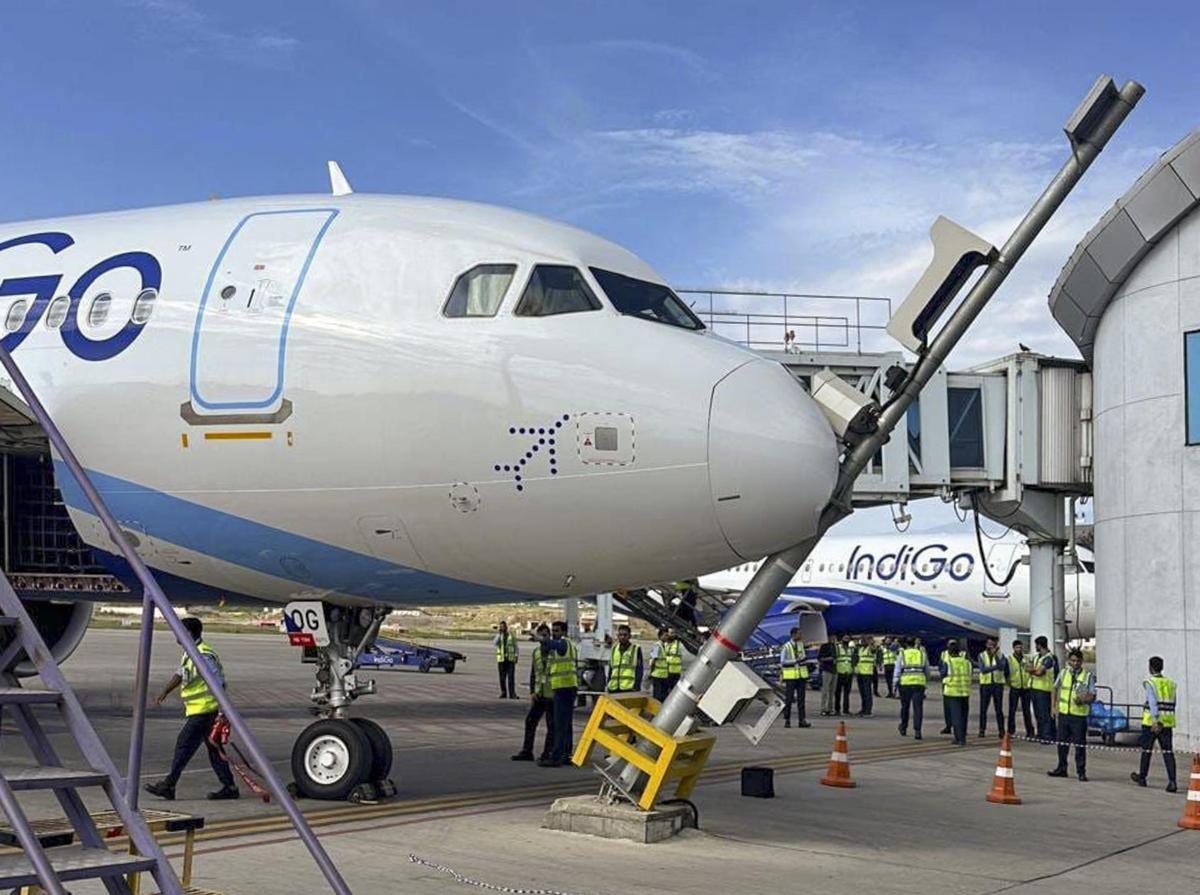
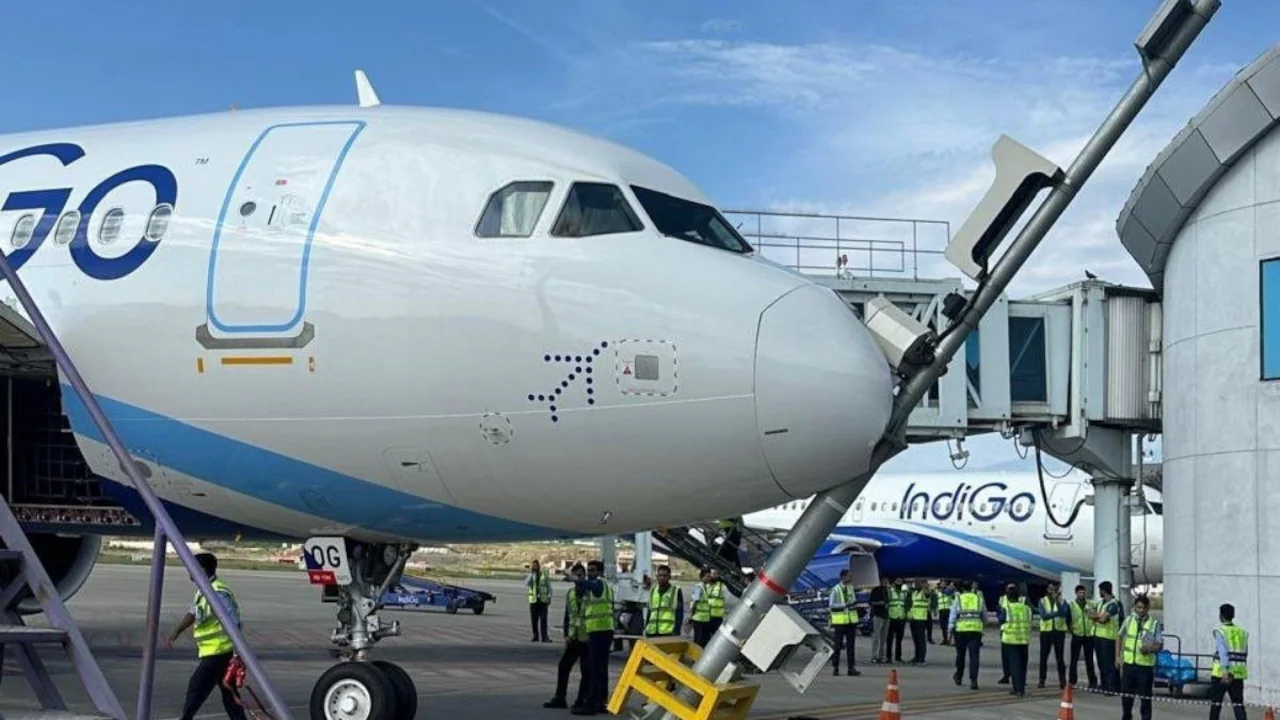
It was while the aircraft was being positioned at Bay No. 6 that its nose came into contact with the VDGS pole. Images from the airport showed the metal structure knocked sideways following the impact, with the aircraft's forward section close to the damaged pole.
The incident took place at approximately 9:02 am. Initial reports described the object as a parking or docking guidance pole. The VDGS is an airport system designed to provide visual guidance to pilots as an aircraft approaches its designated parking position, helping the crew align the aircraft accurately with the stand.
Importantly, the aircraft had already landed safely before the collision. There was therefore no reported emergency during the flight itself, and no injuries were reported among those on board.
Passengers and crew safe, aircraft grounded for inspection
The immediate priority following the incident was to safely evacuate everyone from the aircraft. Passengers and crew were deboarded using manual aircraft stairs rather than the normal passenger boarding bridge arrangement.
The airline said all customers and crew were safe and that the relevant authorities were informed in accordance with established procedures. An investigation was launched to examine what happened and determine the circumstances surrounding the contact with the pole.
The aircraft itself was grounded for maintenance. It will be allowed to resume operations only after the necessary inspections, repairs and regulatory clearances are completed.
This step is significant because damage to the forward section of an aircraft cannot be assessed solely from what is visible externally. Even a relatively limited ground collision can require detailed inspection of structural components, sensors, antennas and other equipment before an aircraft is cleared to fly again.
Why is the aircraft's nose important?
The collision has also drawn attention to a part of an aircraft that passengers rarely think about: the nose.
The pointed front section of a modern passenger aircraft is not simply an aerodynamic cover. A major component in this area is the radome, a protective structure designed to shield the aircraft's weather radar antenna while allowing radar signals to pass through. Weather radar helps flight crews identify areas of precipitation and potentially hazardous weather ahead of the aircraft.
Because the radome has to allow radio-frequency energy to pass through, it is generally made from specialised non-metallic composite materials rather than conventional metal. Its design has to balance several requirements, including aerodynamic efficiency, protection of sensitive equipment and minimal interference with radar signals.
The forward section can also be associated with various sensors and systems involved in an aircraft's operation. Air-data systems rely on pressure measurements to calculate important parameters such as airspeed, altitude, Mach number and vertical speed. Pitot-static systems provide pressure inputs that are used by these aircraft systems and can also feed information to equipment such as autopilot systems.
Not every component associated with aircraft navigation and flight data is physically located inside the nose cone itself. Some equipment and processing computers are installed elsewhere in the forward fuselage or avionics compartments, while sensors and antennas may be positioned at different points on the aircraft.
That is why damage around the nose can lead to a detailed technical inspection even when there is no immediate sign of a serious structural problem.
What is a VDGS pole and why is it installed near an aircraft?
The pole involved in the Srinagar incident was part of the Visual Docking Guidance System, or VDGS.
The system assists pilots while they manoeuvre an aircraft into a parking stand. Unlike the aircraft's weather radar, which is designed for airborne weather awareness, VDGS is an airport-side system intended to help an arriving aircraft reach the correct stopping position.
Parking an aircraft is a highly controlled operation. A large commercial jet has limited visibility immediately around certain portions of its fuselage, particularly during low-speed manoeuvring on the ground. Pilots therefore rely on a combination of cockpit instruments, airport markings, ground personnel and guidance systems while entering a stand.
The incident at Srinagar demonstrates how even the final few metres of an otherwise uneventful flight can require considerable precision.
Inquiry launched; cause not yet established
While the collision itself has been confirmed, authorities have not yet established why the aircraft came into contact with the pole.
The Airport Authority of India said the details and circumstances leading to the incident would be examined according to prescribed procedures. It also made clear that no conclusion about the cause should be drawn until the inquiry is complete.
That distinction is important. At this stage, it would be premature to attribute the incident to pilot error, ground-handling procedures, visibility, equipment malfunction or any other specific factor.
Investigators would typically need to establish the precise sequence of events surrounding the aircraft's movement into the bay. Depending on the scope of the inquiry, this could involve examining operational records, aircraft condition, airport equipment, available surveillance or other relevant information.
The condition and position of the VDGS pole following the impact will also form part of the factual picture, but its damage alone does not establish what caused the aircraft to make contact with it.
No disruption to Srinagar airport operations
Despite the aircraft being damaged, the incident did not lead to a reported shutdown of Srinagar airport.
Airport operations continued normally, with arrivals and departures proceeding as scheduled.
This means the incident was contained to the aircraft and the affected parking area rather than developing into a wider operational disruption at the airport.
For passengers travelling through Srinagar, the most immediate concern was whether the incident would cause delays or cancellations. The available information indicated that normal airport operations continued following the incident, although the affected aircraft itself remained grounded pending maintenance and clearance.
A safe landing followed by a ground incident
The Srinagar incident is a reminder that aviation safety does not end once an aircraft touches down.
Flight 6E 225 completed its journey from Navi Mumbai to Srinagar and landed safely. The problem occurred afterward, during the comparatively routine but technically demanding process of moving the aircraft into its parking position.
No passengers or crew members were injured, which is the most important outcome. However, the damage to the aircraft and the decision to ground it underline why even ground-contact incidents are treated seriously.
For an airline, an aircraft is not considered ready for its next flight simply because it remains operational after a collision. Maintenance teams must establish that the aircraft is structurally and technically fit to return to service. Only after the required checks, repairs and clearances can normal operations resume.
For now, the exact cause of the IndiGo aircraft's contact with the VDGS pole at Srinagar airport remains under examination. Until the inquiry is completed, the incident is best understood as a ground-handling or parking-area collision involving an aircraft that had already landed safely.
The key facts remain clear: IndiGo flight 6E 225, operating from Navi Mumbai to Srinagar, struck a VDGS pole while being positioned at Bay No. 6 at around 9:02 am on September 4. The aircraft suffered damage, all passengers and crew were safely evacuated without injuries, airport operations continued normally, and the aircraft was grounded for inspection and maintenance.
With input from agencies
Image Source: Multiple agencies
© Copyright 2026. All Rights Reserved. Powered by Vygr Media.