 By
By 
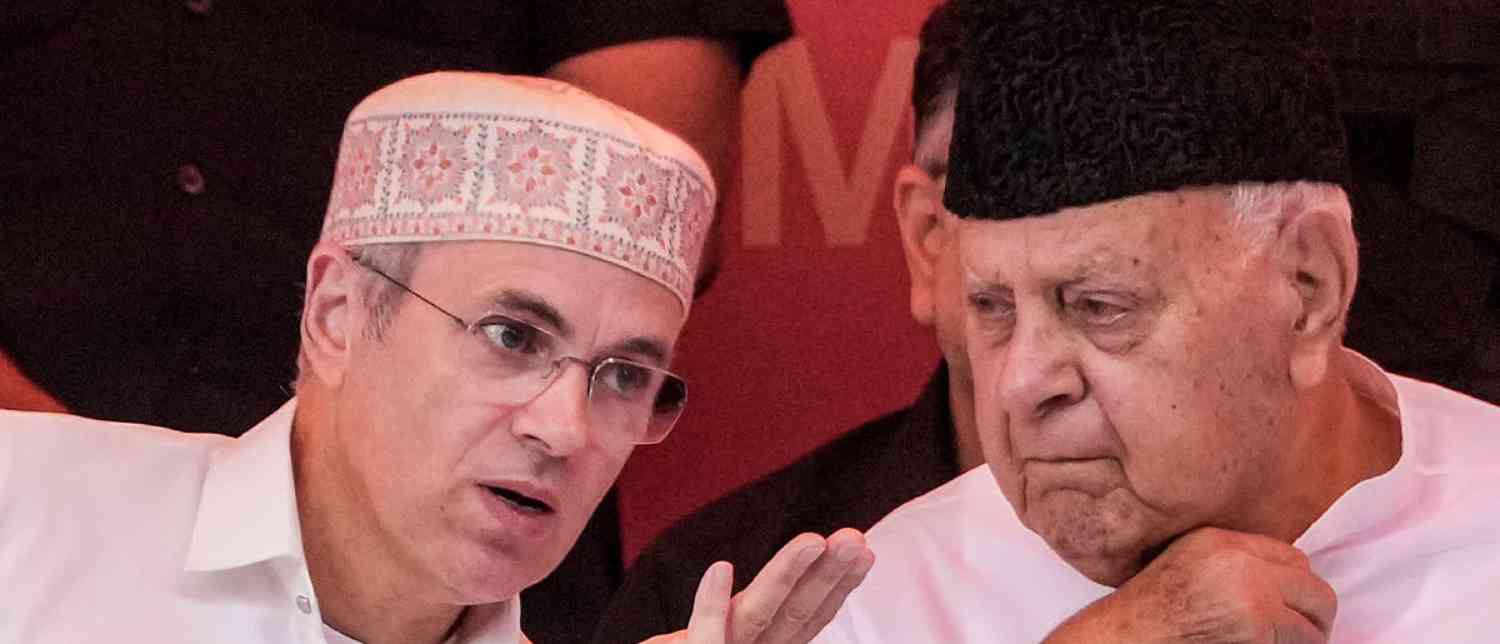
A fresh political controversy has erupted over Vande Mataram after Jammu and Kashmir Chief Minister Omar Abdullah and National Conference president Farooq Abdullah stood through the complete rendition of the national song at an event in Srinagar, prompting objections from their alliance partner Congress.
The episode has brought an existing disagreement over the national song into sharper focus, exposing differences within the INDIA bloc at a time when political parties are already divided over questions of nationalism, secularism and the interpretation of national symbols.
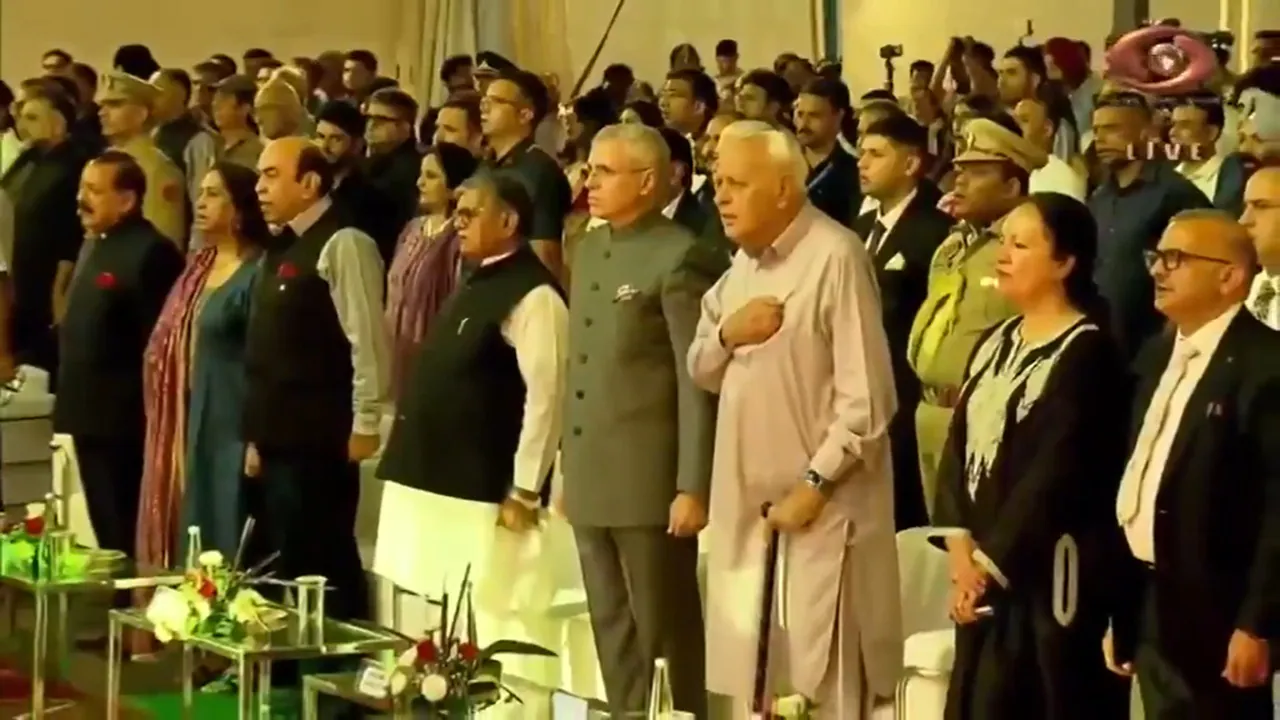
The controversy began at the inaugural ceremony of the International Film Festival in Srinagar, where all six stanzas of Vande Mataram were performed. Omar Abdullah, Farooq Abdullah and other dignitaries remained standing during the rendition, which lasted around three minutes and 10 seconds.
What might otherwise have remained a ceremonial moment quickly turned political after a video of the event emerged and Congress general secretary K C Venugopal publicly questioned the decision to perform the complete version.
Congress objects to full version of Vande Mataram
Venugopal argued that the complete version of Vande Mataram does not fit comfortably with what he described as India's syncretic and pluralist ethos.
In a social media post, he urged Congress's alliance partners to follow the version of the song adopted during the freedom movement. He invoked the collective judgment of several prominent leaders of India's independence struggle, including Mahatma Gandhi, Jawaharlal Nehru, Sardar Vallabhbhai Patel, Subhas Chandra Bose, Rajendra Prasad, Maulana Abul Kalam Azad, Sarojini Naidu and J B Kripalani, while also referring to the influence of Rabindranath Tagore.
Congress maintains that only the first two stanzas of Vande Mataram should be sung at its official programmes. The party's position is rooted in a 1937 resolution, when Congress adopted the shorter version in the context of concerns over maintaining an inclusive national movement.
Venugopal also argued that the two-stanza version was deliberately chosen to prevent the song from becoming communalised and to preserve what Congress considers its secular and inclusive character.
The Congress Working Committee reiterated this position last month, deciding that only the first two stanzas would be sung at official party events. The move came amid criticism from the BJP over Congress leaders' approach to the national song.
National Conference hits back at Congress
The objection did not go unanswered.
The National Conference, a Congress ally, rejected the suggestion that the party should dictate how its alliance partners approach Vande Mataram.
National Conference leader Bashir Ahmed said that while Venugopal was entitled to express his opinion, Congress could not impose its position on an alliance partner. He maintained that the decision over whether to sing the complete song, and how much of it to sing, could not simply be dictated by another party.
The National Conference also stressed that it was opposed to forcing people to sing the song.
The party's response added another layer to the controversy because the disagreement is not merely between two political camps. It is unfolding between parties that are formally part of the same opposition alliance.
National Conference spokesperson Tanvir Sadiq offered a different explanation for the Srinagar event, saying the Jammu and Kashmir government was fulfilling its official obligation. He argued that following legislative action by Parliament, standing for and singing Vande Mataram had become a statutory duty irrespective of the ideological position of an individual political party or alliance.
Sadiq further pointed out that Congress-ruled states had also participated in performances of the complete song at official events, despite Congress maintaining its separate political position on the issue.
At the same time, he clarified that the National Conference had not adopted either the two-stanza or six-stanza version as a party resolution and reiterated its opposition to imposing the song on people.
The full version of Vande Mataram sits uneasily with the syncretic and pluralist ethos that our freedom fighters envisioned and nurtured for India.
For us, the considered judgment of Mahatma Gandhi, Pandit Nehru, Sardar Patel, Subhash Chandra Bose, Rajendra Prasad, Acharya… pic.twitter.com/VngmVUmevz— K C Venugopal (@kcvenugopalmp) September 8, 2026
Congress escalates attack on alliance partner
The disagreement soon became more direct.
Congress leaders accused Omar Abdullah and Farooq Abdullah of failing to respect the position taken by their alliance partner. One Congress leader said the National Conference leaders should follow the Congress decision rather than what he described as an RSS-driven position.
The comments underline the growing difficulty within the opposition alliance of maintaining a common position on issues involving national identity and cultural symbolism.
For Congress, the issue is tied to the historical decision of the freedom movement and its interpretation of secularism. For the National Conference, the question is increasingly being framed around individual choice, official duty and the inability of one alliance partner to dictate the conduct of another.
The Srinagar event therefore became more than a disagreement over a song. It exposed a broader ideological fault line running through the opposition camp.
BJP seizes on Congress-NC disagreement
The BJP quickly entered the controversy, turning Congress's objection into a broader political attack.
BJP leaders accused Congress of isolating itself by opposing the complete rendition of Vande Mataram even as one of its own alliance partners participated in it.
BJP spokesperson and Rajya Sabha MP Sudhanshu Trivedi launched one of the sharpest attacks, accusing Congress of effectively becoming the "Muslim League" of the 21st century. Other BJP leaders similarly questioned why Congress continued to object to the full version of the national song.
The BJP's argument is that Vande Mataram is an important part of India's national heritage and that opposition to its complete rendition reflects what the party characterises as appeasement politics.
The controversy thus gives the BJP an opportunity to attack Congress from two directions: politically, by highlighting the disagreement with the National Conference, and ideologically, by portraying Congress's position as inconsistent with national sentiment.
Why the two-stanza versus six-stanza debate matters
At the heart of the dispute is the history of Vande Mataram and the decision to use only selected portions of the song during the freedom movement.
Congress continues to regard the 1937 decision as an important historical compromise. Its argument is that the first two stanzas were considered appropriate for a diverse India, while the subsequent portions raised concerns about their religious imagery and their suitability as a unifying national song.
That historical interpretation remains central to Congress's current position.
The BJP, however, has increasingly argued that the complete song should be respected as part of India's national heritage. The disagreement has consequently evolved from a question of ceremonial practice into a political argument over the meaning of nationalism itself.
The Centre earlier this year mandated the playing of all six stanzas of Vande Mataram before Jana Gana Mana at government events, schools and official ceremonies. This has further intensified the political debate over the song's appropriate rendition.
The issue has also acquired particular political significance in Jammu and Kashmir, where Omar Abdullah's participation in the complete rendition carries an added symbolic dimension.
Omar Abdullah's stance adds another twist
The Srinagar episode is significant because Omar Abdullah has previously expressed support for singing Vande Mataram in its entirety.
His decision to remain standing throughout all six stanzas therefore appears consistent with that position rather than being an abrupt departure from his earlier views. Farooq Abdullah's presence and participation alongside his son made the moment even more politically prominent.
For Congress, however, the optics were difficult. Two prominent leaders from an important alliance partner were publicly seen participating in precisely the practice that the party leadership had asked its allies to avoid.
That has made the disagreement impossible to treat as a minor difference of opinion.
A larger challenge for the INDIA bloc
The Vande Mataram controversy highlights a familiar challenge for the INDIA bloc: its constituent parties share opposition to the BJP on several political issues but do not necessarily share the same ideological position on questions of nationalism, culture, religion or national symbols.
Regional parties often have political calculations and historical positions that differ substantially from those of Congress. The National Conference's response in Srinagar demonstrates how quickly those differences can surface when an issue touches on identity and national sentiment.
For Congress, insisting on its historical position may be important for protecting its secular credentials. But attempting to persuade alliance partners to follow the same line carries its own political risks if those partners refuse.
For the National Conference, resisting what it sees as an attempt by Congress to dictate terms reinforces its political independence while allowing it to present the issue as one of choice rather than ideological confrontation.
Meanwhile, the BJP is likely to continue using the dispute to portray Congress as out of step with broader public sentiment.
Political battle likely to continue
The Srinagar incident has ensured that Vande Mataram will remain a politically charged issue well beyond the event where the song was performed.
What began with Omar and Farooq Abdullah standing through the complete rendition has now become a three-way political contest involving Congress, the National Conference and the BJP.
Congress is defending the historical two-stanza position in the name of pluralism and the judgment of freedom-era leaders. The National Conference is asserting that Congress cannot dictate the conduct of its allies and that government officials must fulfil official obligations. The BJP is using the disagreement to attack Congress's ideological credibility and accuse it of appeasement.
The immediate disagreement may have been triggered by a song, but the political stakes are much larger.
The Vande Mataram row has once again placed questions of nationalism, secularism, historical legacy and opposition unity at the centre of Indian politics. And with Congress and the National Conference now openly disagreeing over an issue that carries considerable symbolic weight, the episode could become another test of how much ideological space the INDIA bloc can accommodate while remaining politically united.
With input from agencies
Image Source: Multiple agencies
© Copyright 2026. All Rights Reserved. Powered by Vygr Media.