 By

India’s fashion retail market is entering a new phase, and the rules that once guaranteed success are beginning to change. For years, international fashion brands attracted Indian consumers with global trends, affordable styles, and the promise of looking fashionable without paying luxury prices. Today, however, shoppers are asking a more fundamental question: Is this garment actually worth buying?
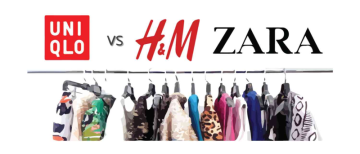
The changing fortunes of Zara and H&M, alongside the remarkable growth of Uniqlo, offer a compelling answer. Fashion retailers can no longer rely on brand recognition, frequent collections, or aggressive expansion alone. Consumers are becoming more selective, balancing style with comfort, quality, durability, functionality, and price.
This shift is particularly important in India, where a rapidly expanding middle class, digitally connected younger consumers, and increasingly competitive domestic retailers are reshaping purchasing decisions. The next chapter of the Indian apparel industry will not necessarily belong to the brand selling the most clothes. It may belong to the one that understands what consumers genuinely want from their wardrobes.
The Zara vs H&M Rivalry Is About More Than Fashion
For decades, Zara and H&M have represented two influential approaches to fast fashion. Both have made international trends accessible to ordinary shoppers, but their strategies differ in important ways.
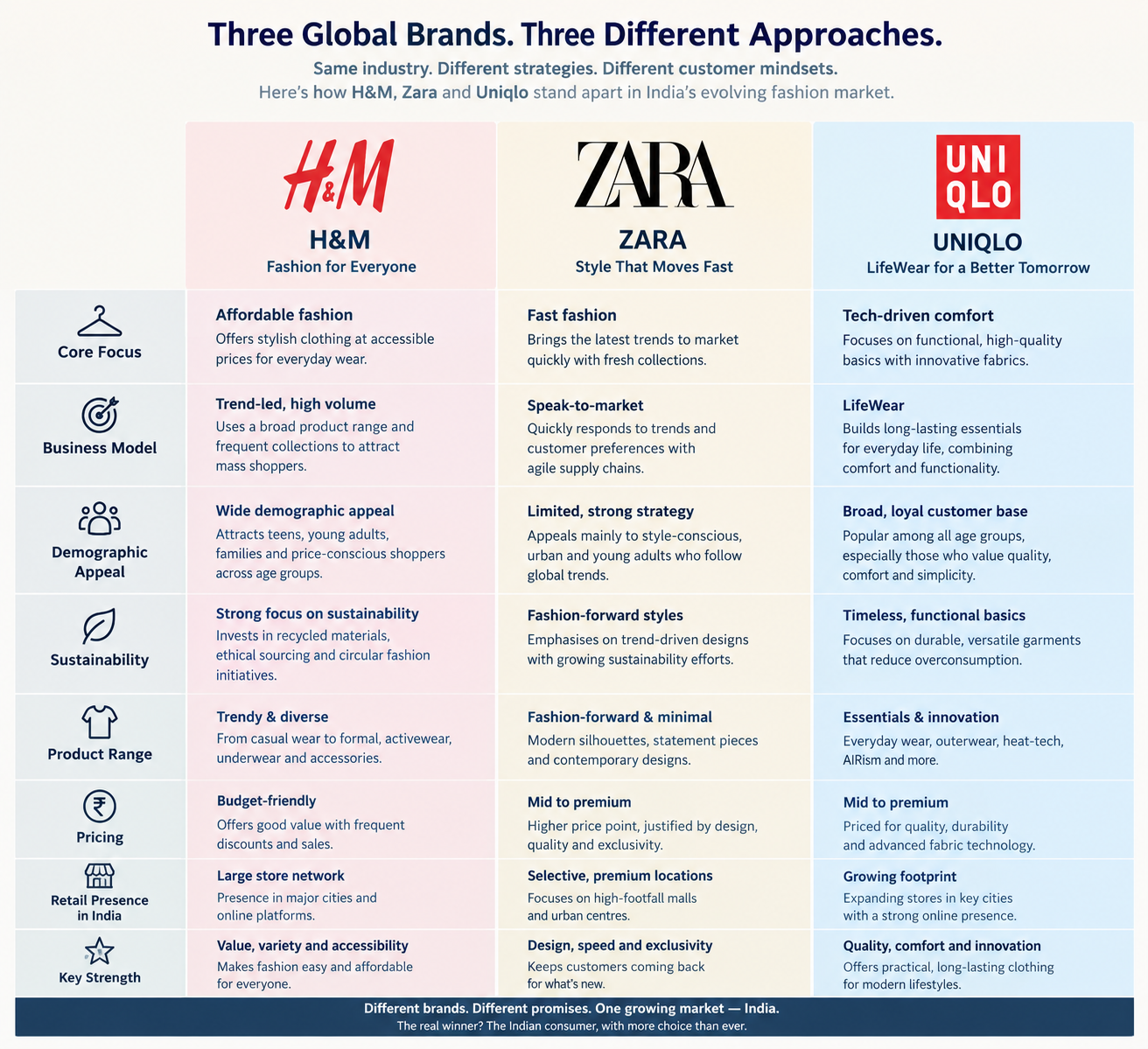
Zara has built its identity around trend responsiveness, distinctive designs, and a relatively premium position within the fast fashion segment. Its collections often reflect contemporary runway influences, tailored silhouettes, and statement pieces. The brand's ability to refresh merchandise quickly helps create a sense of novelty, encouraging customers to visit stores regularly.
H&M, by contrast, has traditionally emphasised affordability, broad product selection, and accessibility. From everyday clothing to seasonal collections and collaborations, it serves consumers who want fashionable products without consistently paying premium high-street prices.
In India, this distinction is reflected in their financial and retail footprints. During FY2025, H&M India reported revenue of approximately ₹3,595 crore, compared with Zara India's roughly ₹2,782 crore. Zara, however, demonstrated stronger profitability in its reported FY2025 results, illustrating that higher revenue and stronger store-level economics are not necessarily the same thing.
The latest figures also complicate the picture. Zara India reported revenue of ₹2,749 crore for FY2026, a 1.2% year-on-year decline, while Uniqlo India recorded 44% revenue growth to ₹1,724 crore during the same financial year.
These figures do not establish that one business model will permanently outperform another. They do, however, reveal an increasingly competitive market in which brand positioning, operational efficiency, and changing consumer preferences matter as much as expansion.
The real question is no longer simply Zara vs H&M. It is whether either brand can continue meeting the expectations of India's evolving fashion consumer.
Why Zara's Strategy Still Has an Advantage
Zara's strength lies in its ability to combine trend awareness with a recognisable design identity. Instead of competing exclusively on low prices, it offers shoppers a more fashion-forward proposition.
Its operating model also supports this positioning. Faster product development, frequent inventory updates, and relatively controlled production quantities allow the brand to respond to emerging trends without committing every collection to enormous volumes in advance.
This approach can reduce the risk of excess inventory and excessive discounting. It also gives shoppers a reason to return: the merchandise they see today may not be available in the same form on their next visit.
In an environment saturated with similar-looking garments, differentiation matters. When multiple retailers offer basic T-shirts, neutral trousers, and everyday shirts, consumers need a stronger reason to choose one brand over another.
Zara's emphasis on statement pieces, distinctive styling, and contemporary silhouettes helps create that reason.
Nevertheless, the brand faces a challenge in India. Its relatively premium pricing limits its appeal among shoppers who want fashionable clothing but remain highly conscious of value. A compelling design cannot automatically justify a higher price, particularly when domestic brands offer attractive alternatives.
Moreover, Zara's recent Indian revenue performance suggests that a strong international reputation does not guarantee uninterrupted local growth.
Its future success will depend on maintaining its design advantage while adapting merchandise, pricing, and retail experiences to Indian consumers.
H&M's Challenge: Affordability Is No Longer Enough
H&M's proposition has historically been straightforward: deliver fashionable clothing at accessible prices. That formula helped the brand establish a substantial international presence and build a strong customer base in India.
However, affordability alone has become a less reliable competitive advantage.
Consumers now encounter an overwhelming number of alternatives, including online fashion platforms, local labels, value-fashion chains, and social-commerce sellers. Many offer similar silhouettes, colours, and trend-inspired products at competitive prices.
When merchandise begins to look interchangeable, the cheapest option becomes increasingly attractive. This can put pressure on brands positioned between low-cost mass fashion and more distinctive premium retailers.
H&M's global FY2025 performance illustrates the challenges of this environment. Although operating profitability improved, reported net sales declined by approximately 3%, while the company continued to rationalise its store network.
Cost reductions can improve short-term financial results, but they do not necessarily solve the underlying problem of product relevance.
For H&M, the opportunity lies in strengthening the reasons customers should choose its clothing beyond the price tag. Better fits, more distinctive collections, reliable quality, versatile designs, and clearer product identities could help the brand stand apart from competing mass-market labels.
Affordability remains important in India, particularly outside the largest metropolitan markets. But consumers increasingly want affordable clothing that feels considered rather than generic.
The lesson for fast fashion brands in India is clear: low prices can attract shoppers, but meaningful differentiation gives them a reason to return.
Uniqlo's Rise Reveals What Indian Consumers Want Next
Perhaps the most interesting development in India's fashion retail market is the growing appeal of Uniqlo.
Unlike brands built primarily around rapidly changing fashion trends, the Japanese retailer focuses on everyday essentials, functional clothing, comfort, and versatility. Its proposition is less about constantly reinventing an outfit and more about improving the garments people wear repeatedly.
Its FY2026 results provide a strong indication that this approach has commercial potential. Uniqlo India's revenue rose 44% to ₹1,724 crore, while net profit increased 41% to ₹253 crore.
The brand's growth does not prove that Indian consumers are abandoning trend-led fashion. Instead, it suggests that a larger opportunity exists for retailers that address practical wardrobe needs alongside style.
Consider how people actually use their clothes. A well-fitting shirt may be worn to work, on a casual outing, and while travelling. Comfortable trousers can serve multiple purposes. A lightweight jacket or breathable T-shirt may offer more long-term value than a trend-driven purchase worn only a handful of times.
For consumers managing household expenses, versatility matters because it increases the usefulness of each purchase.
This is especially relevant in India, where climate, commuting conditions, workplace expectations, and regional preferences influence clothing choices. Breathable fabrics, practical layering, comfortable fits, and easy-care materials can be just as important as visual appeal.
Uniqlo's success highlights a broader opportunity: functional fashion can be aspirational without depending on constant novelty.
For Zara and H&M, this is a competitive warning. For the wider apparel industry, it is evidence that consumers can support multiple models when each delivers a clear and credible value proposition.
Indian Fast Fashion Brands Are Changing the Competitive Landscape
International brands are not competing only against one another. India's domestic fashion retailers are becoming formidable players in their own right.
Brands such as Zudio have demonstrated the potential of a value-focused, store-led model that prioritises accessibility, rapid inventory refreshes, and expansion into neighbourhoods beyond premium shopping malls.
Its large store network reflects a fundamentally different growth strategy from Zara's selective retail footprint. Rather than relying primarily on premium locations and a relatively elevated fashion proposition, value-fashion retailers seek to make inexpensive, trend-conscious clothing available to a much wider customer base.
This distinction matters because India's apparel market is not a single, uniform market.
A shopper in a metropolitan luxury mall may prioritise design differentiation and brand prestige. A family shopping in a smaller city may focus on price, durability, and the ability to purchase several garments within a fixed budget. An urban professional may be willing to pay more for comfortable clothing that works across office and leisure settings.
Domestic brands often have an advantage in understanding local price sensitivities, shopping habits, regional demand, and the practical realities of Indian consumers.
The competitive pressure is particularly intense in the middle of the market, where brands can be too expensive to compete with value-fashion chains yet insufficiently differentiated to justify premium pricing.
For global retailers, the answer is not necessarily to imitate domestic competitors. It is to identify the customers they serve best and build a stronger proposition around those needs.
India's expanding apparel market offers opportunities for international and homegrown brands alike, but sustainable growth will require sharper positioning rather than expansion for its own sake.
The New Fashion Consumer Wants Value, Not Just Low Prices
One of the most important changes in consumer behaviour is the growing distinction between cheap clothing and good-value clothing.
The two are not interchangeable.
A low-priced garment that loses its shape, fades quickly, or fits poorly may prove more expensive over time than a better-made alternative. Conversely, a premium-priced product does not automatically represent good value if its quality, comfort, or durability fails to justify the cost.
Consumers are increasingly evaluating fashion purchases through this practical lens.
Research on Indian apparel consumption has also pointed towards a preference for upgrading quality rather than simply increasing the number of items owned. A significant proportion of consumers continue to make essential or occasional purchases instead of shopping impulsively.
This creates opportunities for brands that can demonstrate tangible benefits through their products.
For younger consumers, the equation is particularly complex. Gen Z and millennials remain highly responsive to social media, celebrity styling, and emerging trends, but they are also exposed to an enormous range of competing products. They can compare prices, read reviews, discover independent brands, and find alternatives within minutes.
Brand loyalty is therefore harder to maintain when the product fails to meet expectations.
Fashion retailers must balance emotional appeal with functional value. Attractive campaigns can generate interest, but consistent quality, fit, comfort, and pricing are what help turn an occasional shopper into a repeat customer.
The most successful brands will understand that consumers do not necessarily want fewer fashionable options. They want greater confidence that the clothes they buy deserve a place in their wardrobes.
Can Sustainability Become a Competitive Advantage?
The growing emphasis on value also raises questions about sustainability in the fast fashion industry.
The traditional model depends on frequent product releases and relatively rapid purchasing cycles. Although this can make fashion more accessible, it also creates concerns about textile waste, resource consumption, garment longevity, and overproduction.
Both Zara and H&M have introduced sustainability initiatives, material targets, and programmes intended to improve their environmental performance. Yet the wider industry still faces a fundamental challenge: producing large quantities of frequently replaced clothing while encouraging consumers to buy more responsibly.
For consumers, sustainability is most convincing when it is reflected in the actual product.
Garments that last longer, fabrics that suit their intended use, transparent material information, repair options, and credible recycling systems can help translate environmental commitments into practical benefits.
However, sustainability claims must be supported by evidence. Recycled materials or responsible-sourcing statements alone do not establish that an entire business model is environmentally sustainable.
Indian fashion brands have an opportunity to approach this challenge differently by investing in durable natural fibres, better manufacturing practices, responsible sourcing, and designs that remain useful beyond a single season.
The goal should not simply be to market clothing as sustainable. It should be to make better products, reduce unnecessary waste, and give consumers meaningful reasons to retain and reuse what they buy.
India's Textile Industry Has an Opportunity to Move Up the Value Chain
India's position as a major textile and apparel manufacturing centre creates an opportunity that extends beyond supplying inexpensive garments to international retailers.
The country possesses deep textile knowledge, established manufacturing capabilities, natural-fibre expertise, and diverse artisanal traditions. These strengths could support a more ambitious role in global fashion, particularly as consumers and premium brands explore craftsmanship, distinctive materials, and greater product differentiation.
However, manufacturing capacity alone is insufficient.
To compete in higher-value segments, Indian businesses need stronger design capabilities, product development expertise, modern sampling systems, quality control, and the ability to respond quickly to changing demand.
Greater collaboration among manufacturers, designers, textile institutes, artisans, and international fashion businesses could help bridge the gap between production and original product development.
Digital garment prototyping and advanced fabric-development technologies can also improve collaboration, shorten development cycles, and reduce the cost of physical sampling.
Government initiatives such as the PM MITRA textile parks could contribute to this transformation by strengthening manufacturing infrastructure and connecting different parts of the textile value chain. Their long-term impact, however, will depend on effective implementation and whether businesses can translate infrastructure into commercially competitive products.
India should not abandon its strengths in affordable manufacturing. Instead, it should build on them by moving towards higher-value production, stronger design ownership, and more specialised capabilities.
The opportunity is to create clothing that competes on craftsmanship, material quality, originality, and performance—not price alone.
The Future Belongs to Brands With a Clear Identity
The changing fortunes of Zara, H&M, and Uniqlo point towards a more fragmented but potentially more resilient fashion market.
Zara offers trend responsiveness and distinctive styling. H&M provides affordability and broad choice. Uniqlo demonstrates the appeal of functional essentials. Indian value-fashion retailers show how scale, accessibility, and local market understanding can create a powerful competitive advantage.
None of these approaches is guaranteed to win across every customer segment.
The more important lesson is that a brand must know what it stands for and deliver on that promise consistently. A fashion-led retailer must offer designs that feel relevant and distinctive. A value brand must provide dependable products at accessible prices. A functional-clothing specialist must prove that its garments deliver comfort, versatility, and durability.
For consumers, this competition is ultimately positive. More choice gives shoppers greater freedom to balance price, quality, style, and personal priorities.
For retailers, it demands greater discipline in product development, inventory management, pricing, and brand positioning.
India's fashion industry is growing, but growth alone will not determine its winners. The decisive advantage will come from understanding that fashion is both an emotional expression and a practical purchase.
The brands that succeed will not simply persuade consumers to buy another outfit. They will give them a convincing reason to choose that particular outfit over everything else available.
In the next phase of India's apparel industry, the winning strategy will not be to sell the most fashion. It will be to make fashion that matters.
© Copyright 2026. All Rights Reserved. Powered by Vygr Media.