 By
By 
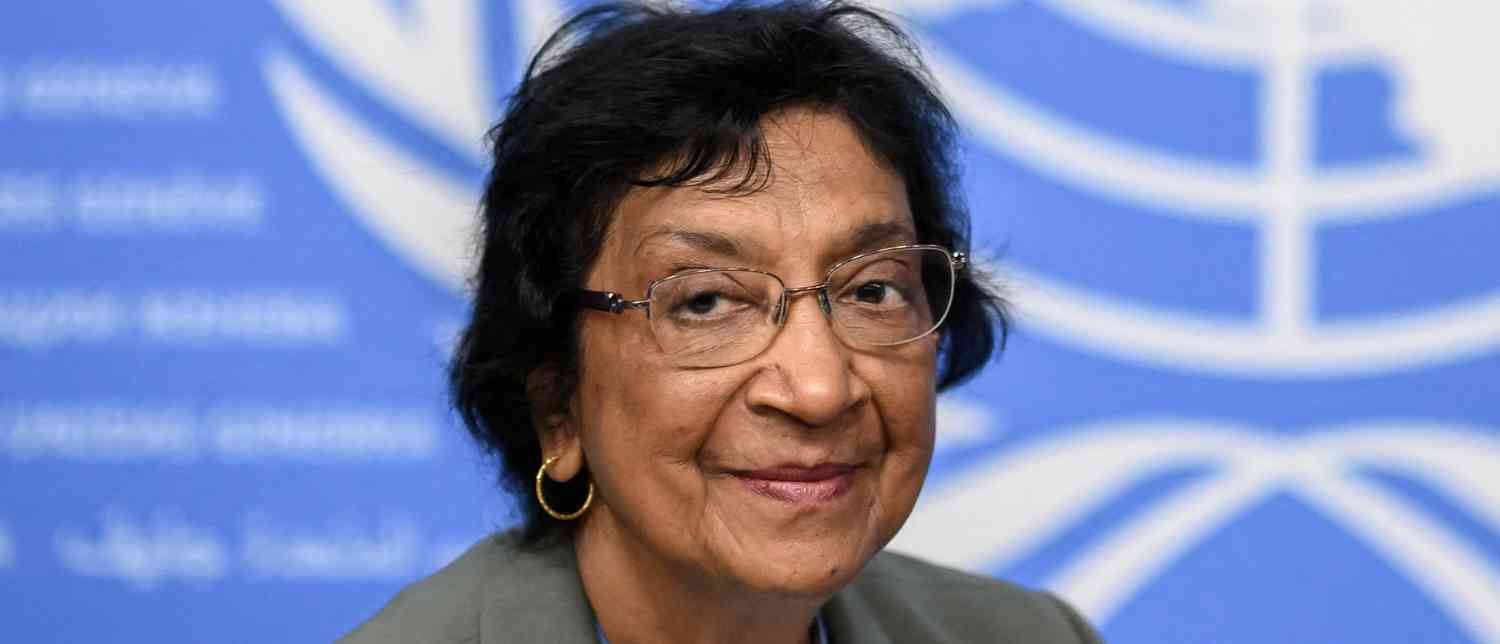
In a world increasingly marked by armed conflicts, political divisions and questions over the enforcement of international law, the 2026 Nobel Peace Prize has recognised a legal pioneer whose career has been shaped by the fight against injustice.
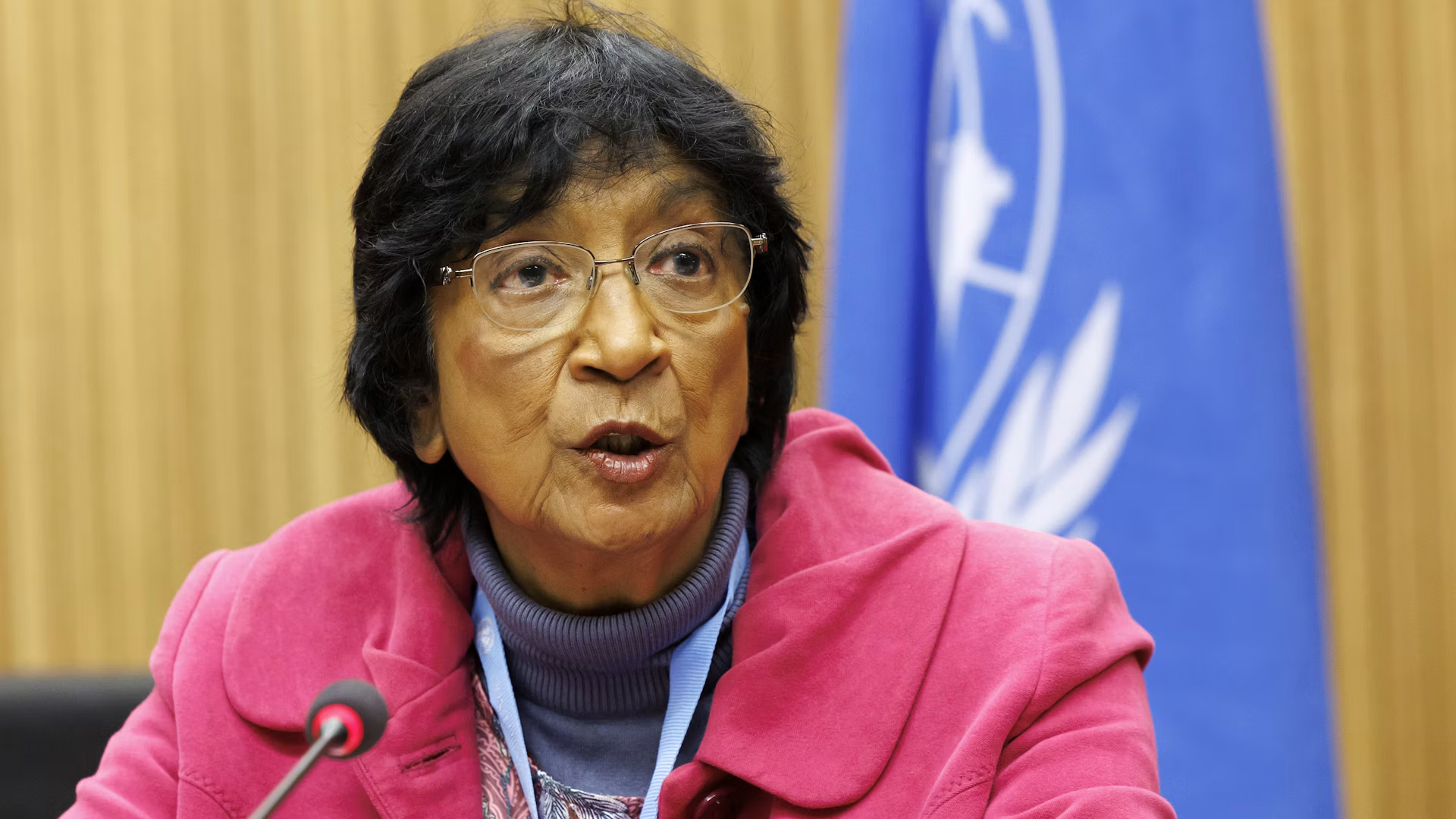
Navanethem “Navi” Pillay, an 85-year-old South African jurist of Indian Tamil origin, was awarded the prestigious honour on October 9, 2026, for her contributions to peace and international law. Her journey from growing up under apartheid in South Africa to serving in some of the world's most influential judicial and human rights institutions reflects a lifelong commitment to equality, accountability and human dignity.
The award recognises not only Pillay's achievements as a judge but also her broader efforts to strengthen the international legal system and ensure that individuals responsible for grave human rights violations can be held accountable.
Her recognition comes at a time when international courts and legal institutions face mounting political pressure, making the Nobel Peace Prize 2026 a powerful reminder of the connection between justice and lasting peace.
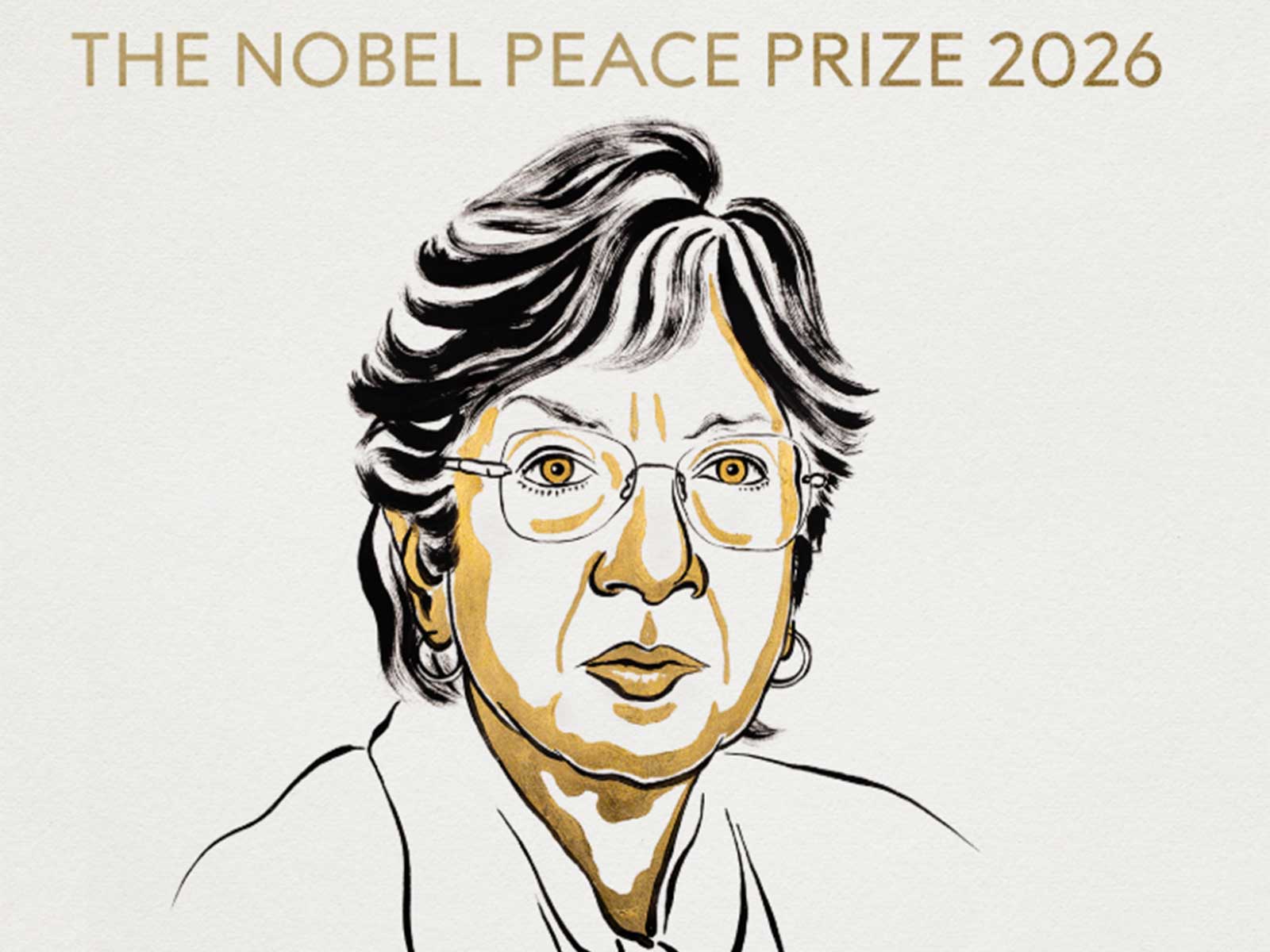
Why Did Navi Pillay Win the Nobel Peace Prize 2026?
The Norwegian Nobel Committee awarded the 2026 Nobel Peace Prize to Navi Pillay for her efforts to promote peace and international law, particularly through the prosecution of war crimes, crimes against humanity and genocide.
Throughout her career, Pillay has worked to strengthen legal mechanisms that protect vulnerable communities and establish accountability for serious abuses. Her contributions span domestic courts, international criminal tribunals and the United Nations human rights system.
The committee highlighted her courage, legal expertise and commitment to universal principles of justice. Her work has helped reinforce the idea that political influence, military power or national authority should not place individuals beyond the reach of the law.
One of her most significant contributions came during her service at the International Criminal Tribunal for Rwanda (ICTR). Her judicial work helped establish important precedents concerning sexual violence, rape and the role of propaganda in crimes against humanity and genocide.
These legal developments broadened the international community's understanding of how mass atrocities can be committed and prosecuted. They also strengthened recognition of the experiences of victims whose suffering had historically been overlooked or inadequately addressed.
By honouring Pillay, the Nobel Committee has drawn attention to the importance of an effective international legal order in preventing violence, resolving disputes and pursuing justice for victims.
Who Is Navi Pillay? A Look at Her Early Life and Indian Roots
Born on September 23, 1941, in Durban, South Africa, Navanethem Pillay grew up in a family of Indian Tamil descent during the apartheid era.
Apartheid was a system of institutionalised racial segregation and discrimination that denied South Africa's non-white population equal rights and opportunities. Growing up under this system exposed Pillay to the inequalities that would later shape her professional life.
Her family background connects her to the Indian diaspora in South Africa, a community whose history includes migration, social exclusion and struggles for equality. Although Pillay built her career in South Africa and on the international stage, her Indian Tamil heritage has also drawn attention following her Nobel Peace Prize win.
Rather than accepting racial discrimination as an unavoidable feature of society, Pillay pursued a legal career that would allow her to challenge injustice through the courts.
In 1967, she established her own law firm in South Africa, becoming a pioneering woman in a profession and society shaped by racial and gender barriers. She took on cases involving political activists and people facing discrimination, using the law to defend individuals whose rights were threatened.
Her commitment to justice extended beyond individual cases. It formed part of a wider struggle to challenge apartheid and establish the principle that every person deserves equal protection under the law.
Pillay later pursued advanced legal studies at Harvard University, where she earned a Doctor of Juridical Science degree in 1988. Her academic achievements strengthened the expertise she would bring to the South African judiciary and international legal institutions.
From Defending Anti-Apartheid Activists to Making Legal History
Pillay's early legal career was closely connected to South Africa's anti-apartheid struggle. She defended Nelson Mandela and other individuals who challenged the country's system of racial segregation and political repression.
Her work during this period established a foundation for a career devoted to protecting fundamental rights, particularly when those rights were threatened by powerful institutions.
In 1995, following the end of apartheid and South Africa's transition towards democracy, Pillay was appointed to the country's High Court. She became the first non-white woman to serve as a judge of the Natal Provincial Division, marking an important milestone in the country's judicial history.
Her appointment represented more than personal achievement. It reflected the changing character of South Africa's legal institutions as the country sought to move beyond decades of racial exclusion.
Pillay subsequently moved into international judicial service, where her expertise would contribute to some of the most consequential legal proceedings of the late 20th and early 21st centuries.
Her progression from a lawyer challenging apartheid to an influential international jurist illustrates how domestic struggles for equality can shape the development of global human rights protections.
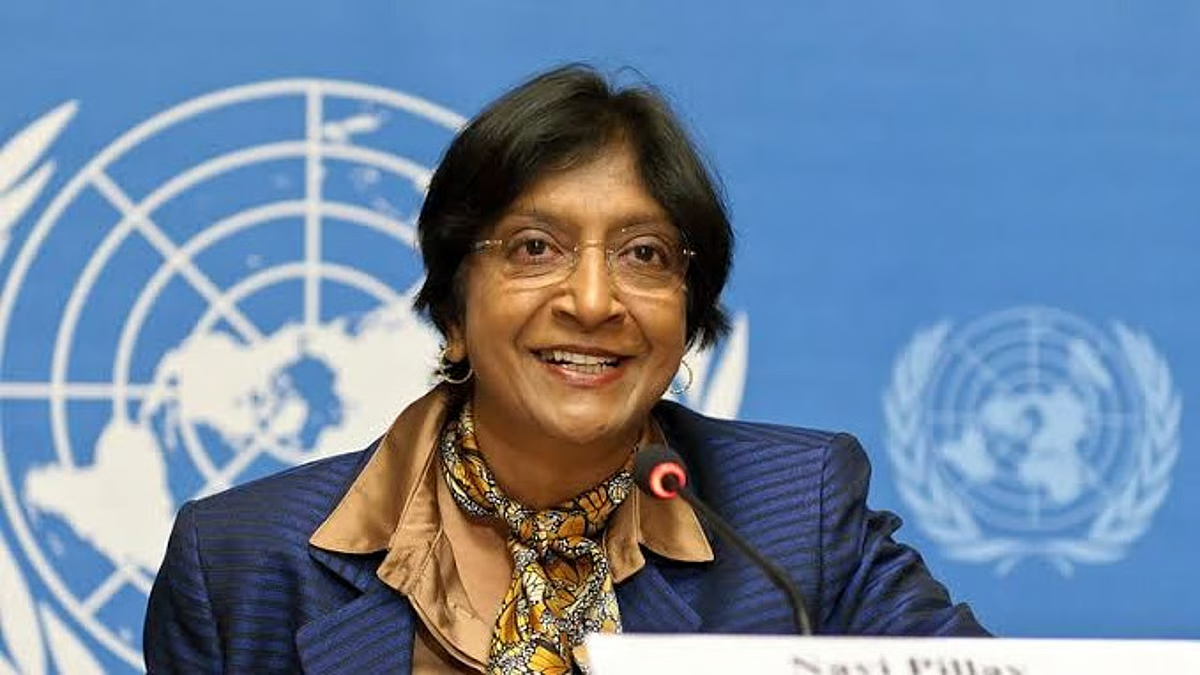
Navi Pillay's Historic Role in the Rwanda Genocide Tribunal
One of the defining chapters of Pillay's career began in 1995, when she joined the International Criminal Tribunal for Rwanda. Four years later, in 1999, she became its president, taking on a central role in a tribunal established to prosecute those responsible for the 1994 Rwandan genocide.
The genocide claimed hundreds of thousands of lives and left survivors confronting devastating physical and psychological consequences. Bringing perpetrators to justice required more than identifying those who had carried out killings. It also meant examining the role of sexual violence, organised propaganda and the incitement of hatred in enabling mass atrocities.
Pillay played an important role in advancing legal recognition of sexual violence as a crime that could constitute genocide and a crime against humanity, depending on the circumstances. The tribunal's landmark jurisprudence helped establish that rape was not merely an incidental consequence of conflict but could form part of a deliberate strategy to destroy a protected group.
The tribunal also advanced the prosecution of individuals who incited genocide through propaganda. These developments expanded the legal understanding of responsibility for mass violence and strengthened the framework for prosecuting crimes that had previously received insufficient recognition.
The implications extended well beyond Rwanda. The legal principles developed through such cases helped shape international criminal justice and offered a foundation for pursuing accountability in future conflicts.
For Pillay, this work demonstrated how judicial decisions could give survivors a formal recognition of their suffering while establishing standards intended to prevent similar atrocities from being repeated.
International Criminal Court and the Fight Against Impunity
After her work at the Rwanda tribunal, Pillay served as a judge at the International Criminal Court (ICC), an institution established to prosecute individuals accused of serious international crimes, including genocide, war crimes and crimes against humanity.
The ICC represents a significant effort to ensure that those responsible for grave abuses can face justice when the conditions for prosecution are met. Its work is particularly important in situations where national judicial systems are unable or unwilling to investigate and prosecute the alleged crimes.
Pillay's judicial experience contributed to the broader development of international criminal law. Her career has consistently focused on the principle that accountability should apply to individuals regardless of their political position, military influence or national standing.
Her work across international courts also highlighted the challenges involved in enforcing legal decisions in a world where governments have different interests and levels of influence.
The recognition of her contributions through the Nobel Peace Prize 2026 underscores the role of international justice in building sustainable peace. Ending active hostilities is essential, but lasting stability can be difficult to achieve when serious crimes remain unaddressed and victims are denied justice.
Former UN Human Rights Chief: Navi Pillay's Global Influence
From 2008 to 2014, Pillay served as the United Nations High Commissioner for Human Rights, becoming one of the most prominent international voices on human rights protection.
The position placed her at the centre of global efforts to address discrimination, political repression, violence against vulnerable populations and violations of fundamental freedoms.
As the UN's top human rights official, she worked to strengthen the international human rights system and emphasised the responsibility of governments to respect their citizens' rights. Her tenure involved confronting difficult questions about state sovereignty, international accountability and the protection of civilians.
The role also required navigating politically sensitive situations in which governments disputed allegations of abuse or resisted international scrutiny.
Pillay's approach reflected a central principle of her career: human rights should not depend on a person's nationality, ethnicity, gender or political circumstances.
Her years at the United Nations reinforced her standing as a jurist whose influence extended beyond courtrooms. They also demonstrated how international institutions can document abuses, promote legal standards and place pressure on governments to address violations.
Navi Pillay's Work on Gaza and the Myanmar Genocide Case
Pillay's recent international work has kept her at the centre of some of the most contentious human rights issues of the present day.
Between 2021 and 2025, she chaired the UN Independent International Commission of Inquiry on the Occupied Palestinian Territory. The commission investigated alleged violations of international law connected to the Israeli-Palestinian conflict.
In 2025, the commission concluded that genocide had occurred in Gaza, a finding that Israel strongly rejected. The issue remains politically and legally contentious, highlighting the difficulties of investigating alleged international crimes amid ongoing conflict and competing claims.
It is important to distinguish the commission's findings from a final judgment by a court. Investigative commissions and international courts have different mandates, procedures and legal powers.
Pillay has also served as an ad hoc judge at the International Court of Justice (ICJ) in proceedings concerning allegations that Myanmar violated the Genocide Convention through its treatment of the Rohingya minority.
The ICJ, the United Nations' principal judicial organ, settles legal disputes between states and provides advisory opinions on legal questions. The case concerning Myanmar illustrates the role international legal proceedings can play in examining allegations of grave abuses and determining state responsibility.
These assignments reflect the continuing relevance of Pillay's expertise in international humanitarian law and human rights. They also demonstrate why her career has attracted attention well beyond South Africa.
Her work on these issues has not been without controversy. Investigations involving powerful states and politically charged conflicts frequently attract criticism from governments and their supporters. Nevertheless, the Nobel Committee's decision places renewed emphasis on the importance of independent legal scrutiny and accountability.
Why Navi Pillay's Nobel Peace Prize Matters Today
The Nobel Peace Prize is often associated with diplomatic negotiations, peace agreements and efforts to end wars. Pillay's selection highlights another dimension of peacebuilding: the institutions and legal principles that make peaceful coexistence possible.
The central message is that peace cannot be sustained through political agreements alone if serious abuses go unpunished and powerful individuals or states are effectively beyond legal scrutiny.
International law provides mechanisms for investigating crimes, resolving disputes and establishing responsibility. However, those mechanisms depend on cooperation, institutional independence and a willingness by governments to respect legal obligations.
These protections face significant challenges in an increasingly divided international environment. Conflicts, geopolitical rivalries and pressure on judicial institutions can weaken efforts to enforce common standards.
Pillay's career offers a reminder that international justice is not simply an abstract legal ideal. It affects whether survivors are heard, whether evidence is preserved, whether perpetrators can be prosecuted and whether future abuses can be deterred.
Her award also recognises the importance of judges, investigators, lawyers and human rights defenders who work to uphold these principles, often amid intense political pressure.
For communities affected by war, persecution and discrimination, accountability may not reverse the damage already suffered. But it can establish an official record of events, acknowledge victims' experiences and help challenge the conditions that allow atrocities to continue.
Navi Pillay: A Legacy of Courage, Equality and Justice
Navi Pillay's journey from a young lawyer in apartheid-era South Africa to a leading figure in international human rights law is a story of persistence against entrenched inequality.
Her career has included defending anti-apartheid activists, breaking barriers in the South African judiciary, helping shape landmark rulings on sexual violence and genocide, serving as a judge at international criminal courts and leading the United Nations' human rights office.
The 2026 Nobel Peace Prize brings these contributions together under a single theme: the pursuit of peace through justice and the rule of law.
For India, her recognition also carries significance because of her Indian Tamil heritage, while her professional achievements remain rooted in South Africa and the international institutions in which she has served.
At 85, Pillay's legacy extends beyond the individual cases she has worked on. It lies in the legal standards she helped advance, the institutions she served and the principle that human dignity deserves protection even when those protections are inconvenient to the powerful.
Her Nobel Peace Prize win is therefore more than a personal milestone. It is a reminder that lasting peace requires courage, credible institutions and a commitment to holding those responsible for serious crimes accountable.
As conflicts continue to test the international community, Pillay's career offers a clear message: justice may not resolve every dispute, but without the rule of law, the foundations of a peaceful world become far more fragile.
© Copyright 2026. All Rights Reserved. Powered by Vygr Media.