
 By

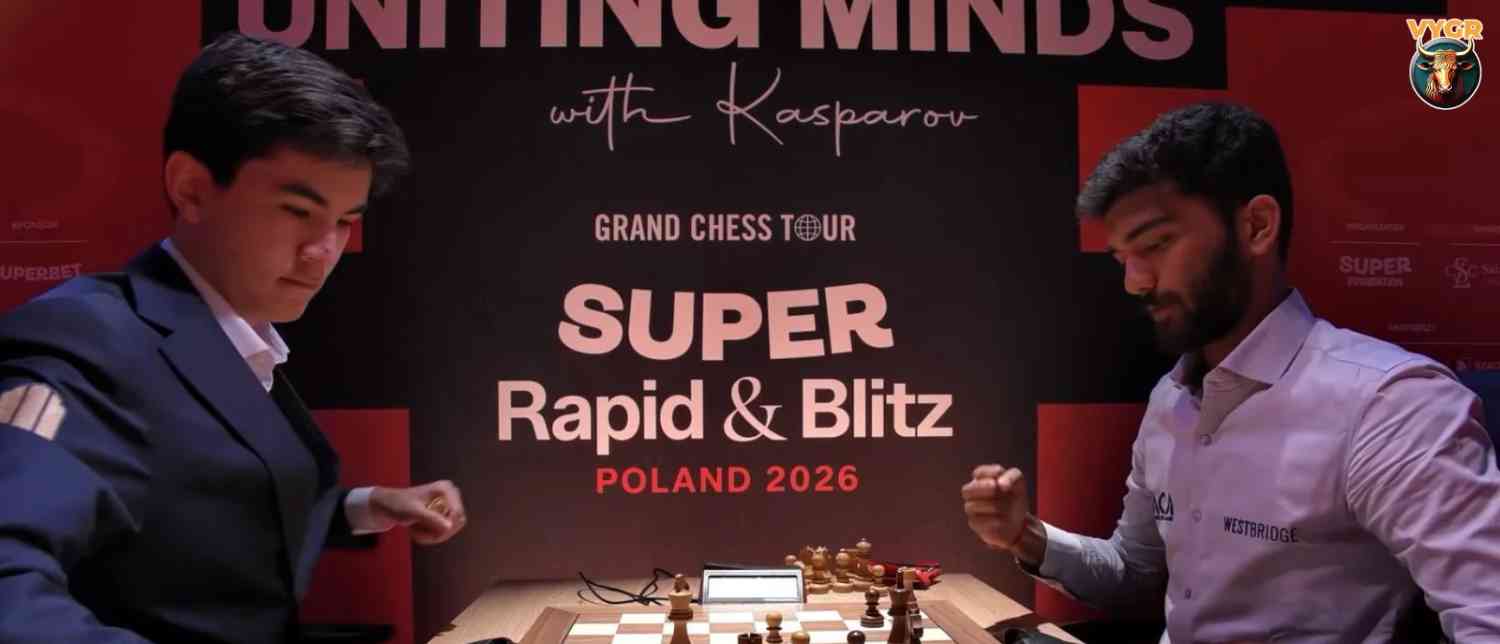
It was long, tense and, in the end, balanced. D Gukesh and Javokhir Sindarov played out a 60-move draw in Game 3 of the World Championship match in Geneva, a contest that stretched across nearly five hours. Gukesh, playing Black, controlled long stretches of the game, but Sindarov found a way to hold. It was the third draw in a row, and the match remains level at 1.5-1.5.
A game that kept you guessing
On paper, three draws can look quiet. This one wasn’t. Game 3 had the feel of a long argument between two players who each believed they had something to say, and neither was willing to give way.
Gukesh, the defending champion, chose a surprise early on. With the Black pieces, he went for the Rio de Janeiro Variation of the Berlin Defence, a sharp and well-known line that rewards deep preparation. The choice paid off on the clock: Gukesh built up a lead of around 50 minutes early in the game, an advantage that would shape the rest of the evening.
The clock told its own story
Time pressure was the quiet drama of the game. Sindarov, playing White, reached move 40, the first time control, with only a handful of seconds left, somewhere under ten. That is an uncomfortable place to be in a world championship game, because every move afterwards demands accuracy with almost no room to think.
Gukesh, by contrast, handled his time far better than in the first two games. That mattered. A player with more time can test his opponent again and again, and for long stretches that is exactly what he did.
Gukesh presses, Sindarov holds
With Black, a draw is usually considered a fair result. Gukesh wasn’t satisfied with that. He built his play around a passed pawn on d3, which stayed a source of pressure throughout, and worked with his bishop to create chances. The pawn was a real thorn, and it kept Sindarov busy.
But the challenger didn’t crack. Even while short of time, he defended carefully, found the resources he needed and kept the balance. Both players threatened to take control at different moments, which is why the game felt like a fight rather than a one-sided squeeze. In the end, neither could find the extra step needed to convert, and the game settled into a draw after 60 moves.
Where the match stands
Here is how the first three games have gone:
- Game 1: Sindarov (White) vs Gukesh, drawn in 38 moves in a Ruy Lopez, ending by repetition
- Game 2: Gukesh (White) vs Sindarov, drawn in 20 moves in a Queen’s Pawn Game
- Game 3: Sindarov (White) vs Gukesh, drawn in 60 moves
That leaves the score at 1.5-1.5 after three games. The match is a 14-game contest, and the first player to reach 7.5 points becomes world champion. The players get two hours for the first 40 moves, then 30 more minutes for the rest of the game, with 30 seconds added after every move from move 41 onward.
With eleven games still to play, there is a lot of chess left.
What this game tells us
Three draws doesn’t mean a lack of fighting spirit. If anything, Game 3 showed how much both players are probing for weaknesses. Gukesh’s opening choice put his rival under early clock pressure, and Sindarov showed he can defend a difficult position while short on time. That is a useful message to send in a match that is expected to be close.
For Gukesh, the encouraging sign is his clock management. In the first two games, time was a concern, and here he flipped that around. For Sindarov, surviving that kind of pressure with Black pressing hard is its own kind of confidence boost.
What to watch next
The next games will show whether either player changes approach. Gukesh will want to keep his clock advantage and keep asking difficult questions, while Sindarov will look to avoid another time scramble and test the champion with his own preparation. Expect more surprises in the opening, and keep an eye on how both players use their White games.
Frequently Asked Questions
What was the result of Gukesh vs Sindarov Game 3?
The game ended in a draw after 60 moves, lasting nearly five hours.
What is the current score in the match?
The score is 1.5-1.5 after three games, all of them drawn.
Who had White in Game 3?
Sindarov played White and Gukesh played Black.
What opening did Gukesh play?
Gukesh went for the Rio de Janeiro Variation of the Berlin Defence, which gave him a big lead on the clock early on.
How does a player win the match?
The match is played over 14 games, and the first player to score 7.5 points wins the title.
Where is the match being played?
The match is being held in Geneva, Switzerland.