
 By

Artificial intelligence is no longer just a race to develop smarter machines. It is increasingly becoming a battle over who gets to control them.
Behind the excitement surrounding increasingly powerful AI models, a significant disagreement is taking shape within the global technology industry. Some of the world's biggest technology companies want AI models to become more accessible, allowing developers, businesses, governments and researchers to download, modify and deploy them independently. Others believe that the most advanced artificial intelligence systems should remain under the control of the companies that develop them, with access provided through regulated platforms and paid services.
What might appear to be a technical disagreement between two approaches to developing artificial intelligence is gradually turning into a much bigger corporate and ideological confrontation.
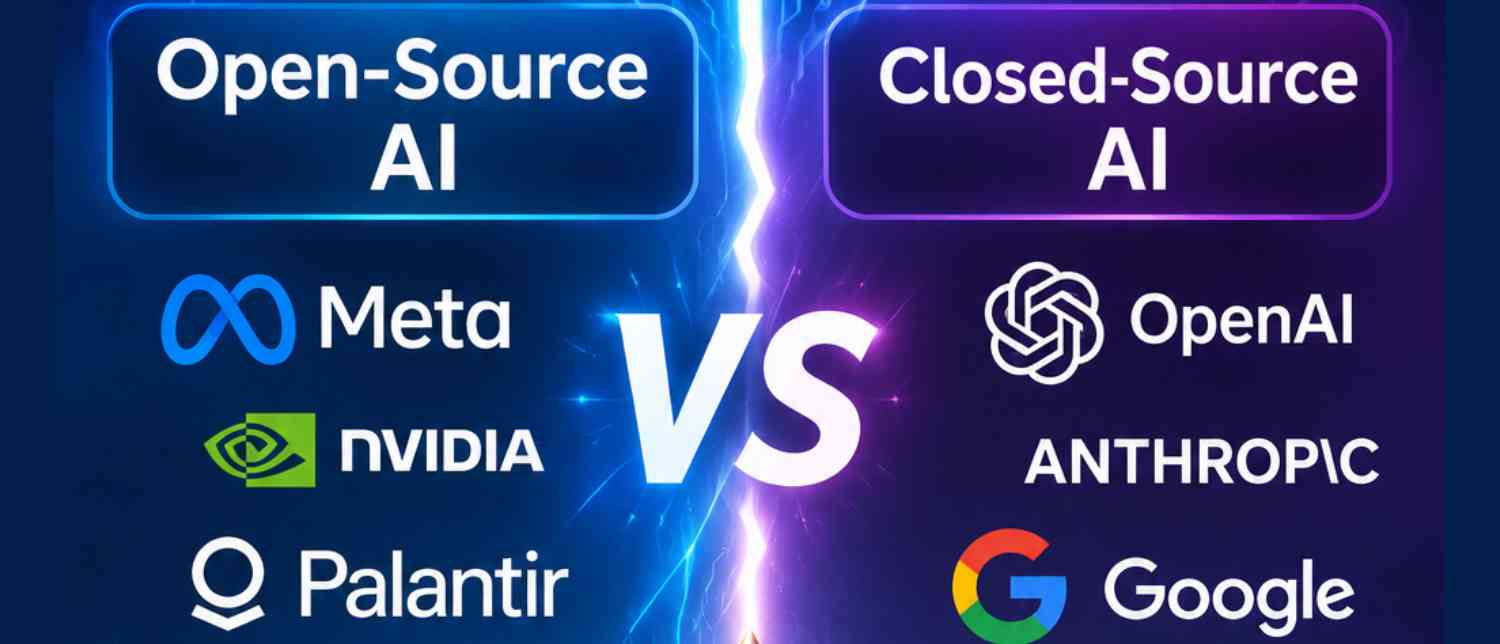
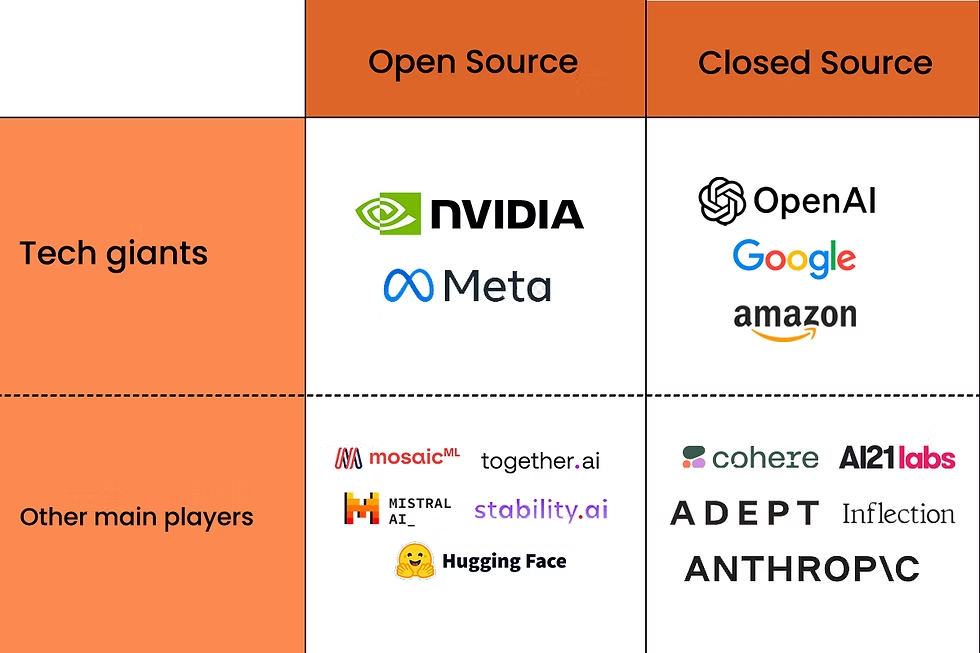
Companies such as Meta, Nvidia, Microsoft and Palantir have increasingly advocated for open-weight AI models, arguing that broader access encourages innovation, competition and technological independence. Meanwhile, companies such as OpenAI and Anthropic have raised concerns about the potential risks of releasing powerful AI systems without sufficient safeguards. Google's position, too, illustrates why the debate cannot be reduced to two rigid corporate camps.
The disagreement raises an important question: should artificial intelligence become a widely accessible technology that anyone can build upon, or should its most powerful capabilities remain in the hands of a relatively small number of technology companies?
The answer could determine not only the future of the AI industry but also who benefits economically and strategically from one of the most transformative technologies of our time.
The Open-Source vs Closed-Source AI Debate: Understanding the Difference
To understand the growing AI industry divide, it is important to understand what separates open-weight AI models from proprietary AI models.
In a conventional proprietary AI model, the company developing the technology retains control over its underlying model weights. These weights are numerical parameters learned during training that determine how an AI model processes information and generates responses. Users typically interact with such models through applications, subscriptions or application programming interfaces (APIs), without receiving unrestricted access to the underlying model.
Open-weight AI models follow a different approach. Their trained weights are made publicly available, allowing developers and organisations to download the models, run them on their own infrastructure, fine-tune them for specific applications and, depending on the licence, redistribute modified versions.
This distinction is important because open-weight does not necessarily mean completely open-source. A model may have publicly available weights while its training data, training process, development methodology or other components remain inaccessible. Licensing restrictions can also limit how it may be used.
Nevertheless, the difference has considerable implications.
A business using a proprietary model generally depends on the developer's infrastructure, pricing structure and service policies. An organisation deploying an open-weight model can exercise greater control over its implementation, potentially reducing dependence on external providers.
Neither approach is automatically superior. They offer different advantages, costs and risks. However, the companies backing these approaches have increasingly different ideas about how the AI economy should develop.
Why Meta, Nvidia and Palantir Are Advocating Open AI Models
The growing support for open-weight AI is not driven by a single motivation. For some companies, it represents a commitment to technological accessibility. For others, it offers significant commercial and strategic advantages.
Nvidia: More Open AI Means Greater Demand for Computing Power
Nvidia occupies a particularly interesting position in this debate.
The company is one of the most influential suppliers of the graphics processing units (GPUs) required to train and operate advanced AI systems. Its commercial success is closely connected to the expansion of artificial intelligence across industries.
Open-weight AI models could accelerate that expansion.
When developers, startups, universities and businesses can access AI models without purchasing expensive proprietary services, more organisations may begin building their own AI applications. However, those models still require computing resources to operate, creating additional demand for GPUs and related infrastructure.
In other words, the wider adoption of open AI models could strengthen the market for the very hardware Nvidia sells.
Nvidia's argument, however, extends beyond commercial interests. Its leadership has maintained that open models can strengthen cybersecurity, encourage innovation and help countries maintain greater technological independence.
Meta: Preventing AI Power From Becoming Concentrated
Meta has another reason to support open-weight AI.
Unlike companies whose primary business involves selling access to proprietary AI models, Meta has a different commercial structure, with advertising remaining central to its revenue.
Making capable AI models available to developers can strengthen Meta's influence across the technology ecosystem without requiring it to depend entirely on subscription or API revenue.
Its Llama models helped establish Meta as a significant contributor to the open-weight AI movement. By encouraging developers to build applications around its models, the company can expand its technological reach and challenge competitors that rely on tightly controlled AI platforms.
There is also a strategic dimension. If a handful of companies control the most capable AI systems, they could gain disproportionate influence over how businesses, developers and governments access artificial intelligence.
Meta has increasingly presented this concentration of power as a concern, arguing that AI development should not become dependent on a small group of corporate gatekeepers.
However, its own strategy has not been entirely consistent. Meta has also experimented with closed flagship models, demonstrating that even companies publicly advocating openness may retain proprietary products where they see a commercial advantage.
Palantir: Businesses and Governments Want Control Over Their AI
Palantir's position introduces another important dimension: organisational control.
Its chief executive, Alex Karp, has publicly criticised the business models of major AI providers, particularly their token-based pricing structures. His argument centres on the growing frustration among businesses that pay continuously for AI services while potentially becoming dependent on external providers.
For enterprises handling sensitive information, the question is not simply whether an AI model produces good results. It is also about where their data goes, who controls the technology and whether they can customise the system according to their requirements.
The concerns become even more significant in government and defence applications, where data confidentiality, operational independence and security are essential.
An organisation that controls the model weights and operates its AI systems within its own infrastructure may have greater flexibility over deployment and access. It can also avoid depending entirely on the commercial decisions of an external AI developer.
For Palantir, therefore, the open-weight debate is closely connected to a larger question: should governments and businesses retain control over the AI systems on which their critical operations increasingly depend?
Why OpenAI and Anthropic Are Cautious About Releasing Powerful AI Models
The arguments supporting open-weight AI are compelling, but they do not eliminate the concerns surrounding unrestricted access to increasingly capable artificial intelligence.
OpenAI and Anthropic have repeatedly highlighted the potential risks associated with releasing powerful AI models without sufficient safeguards.
Their central argument is that once a model's weights become publicly available, the original developer loses much of its ability to control how that model is used.
A company operating a proprietary AI system can introduce security updates, modify safeguards, restrict access to certain capabilities and monitor suspicious activity. If a model is released publicly and downloaded by thousands of independent users, these interventions become considerably more difficult.
The risks could become particularly serious if advanced AI systems acquire capabilities that can be misused for cyberattacks, biological research or other potentially harmful activities.
Consider a situation in which an AI model is modified to remove its original safety restrictions. The organisation that developed the model may have no practical way to prevent its subsequent use or distribution.
This creates a fundamental dilemma.
Making AI accessible can encourage innovation, but unrestricted access to increasingly powerful capabilities could also increase the possibility of misuse.
There is also an obvious commercial consideration. Companies such as OpenAI and Anthropic invest substantial financial and technological resources in developing advanced AI systems. Their proprietary models are central to their business strategies, with revenue generated through subscriptions, enterprise agreements and API access.
Releasing their most advanced model weights could weaken the commercial exclusivity on which these business models depend.
However, it would be inaccurate to suggest that their position is simply an attempt to protect profits. AI safety, cybersecurity and the difficulty of reversing the release of powerful technology are genuine concerns that deserve serious consideration.
Anthropic, in particular, has clarified that it does not oppose all open-weight models. Its position distinguishes between models whose capabilities can be released safely and more powerful systems that may require additional precautions.
The real disagreement, therefore, is not necessarily about whether AI should be open or closed in every circumstance. It is about where the boundaries of openness should be drawn.
The Business Interests Behind the AI Industry Divide
While arguments about safety, accessibility and innovation dominate the public discussion, commercial interests are equally important.
The AI industry is developing into a complex economic ecosystem involving model developers, semiconductor manufacturers, cloud computing providers, enterprise software companies and application developers.
Each group benefits differently depending on how artificial intelligence is distributed.
For semiconductor companies, wider AI adoption can translate into greater demand for computing infrastructure. For cloud service providers, AI expansion creates opportunities to sell processing capacity, storage and related services.
For companies developing proprietary frontier models, maintaining exclusive access to advanced capabilities can help preserve pricing power and customer loyalty.
Meanwhile, companies building enterprise applications may prefer models that offer greater flexibility, predictable costs and control over sensitive information.
This explains why the open-versus-closed debate is not simply a disagreement over technological philosophy. It is also a struggle over which business models will dominate the next phase of artificial intelligence.
There is another important consideration: the competitive position of companies within the AI market.
A company that already leads in proprietary AI may have an incentive to maintain a closed ecosystem. A competitor seeking to challenge that dominance may benefit from making its technology more accessible.
Similarly, a company that profits from selling the infrastructure required to run AI models may welcome an ecosystem in which thousands of organisations develop and deploy their own systems.
In this environment, arguments about what is best for the future of AI cannot be separated entirely from questions about who stands to benefit financially.
The China Factor: Why the Debate Has Become Geopolitical
The disagreement is no longer confined to Silicon Valley.
The rapid development of Chinese AI models has added another layer of complexity to the debate, particularly as the United States seeks to maintain its leadership in artificial intelligence.
Models developed by Chinese companies, including DeepSeek, Alibaba and Moonshot AI, have demonstrated that competitive AI technology does not necessarily have to emerge from the most expensive and tightly controlled development environments.
The availability of powerful open-weight models also creates opportunities for developers and organisations outside the traditional technology power centres.
This has raised concerns among American policymakers and technology companies about the potential transfer of advanced AI capabilities across international borders.
There are competing interpretations of this development.
One argument is that restricting access to powerful open-weight models could prevent sensitive technology from falling into the wrong hands. Another is that excessive restrictions could weaken domestic innovation, limit competition and make it easier for international competitors to establish dominance in the open AI ecosystem.
The geopolitical implications are particularly significant for developing countries.
Nations that cannot afford to build frontier AI models from scratch may benefit from publicly available models that can be adapted to local requirements. They can develop applications for healthcare, education, agriculture, governance and regional languages without depending entirely on foreign AI providers.
For these countries, access to open-weight AI is not merely a technological preference. It could become an important component of digital sovereignty.
The question is whether future AI policies will encourage a competitive global ecosystem or create additional barriers to accessing advanced technology.
Who Benefits From Open AI? The Opportunities and Risks for Businesses and Users
For ordinary users, developers and businesses, the consequences of this debate could be substantial.
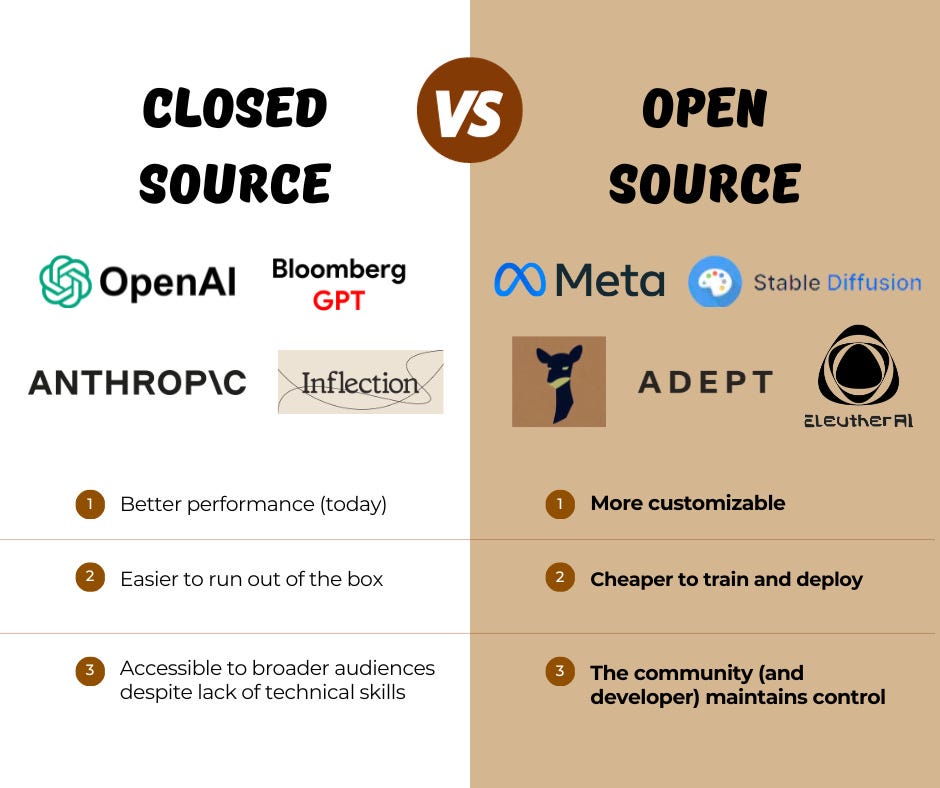
Open-weight AI models can lower the entry barriers for startups, independent researchers and smaller organisations. Instead of negotiating expensive contracts with major AI providers, they can experiment with available models and develop customised solutions.
Businesses may also gain greater control over sensitive data by deploying models on their own infrastructure, although doing so requires appropriate technical expertise and security arrangements.
Researchers can examine model behaviour, investigate biases and explore vulnerabilities more extensively when they have access to the relevant model components.
However, openness also creates challenges.
Publicly available weights do not automatically guarantee transparency, accountability or safety. A model may be accessible without revealing how it was trained or what information influenced its development.
Furthermore, organisations deploying their own models become responsible for maintaining infrastructure, managing cybersecurity threats, monitoring performance and addressing potential misuse.
Proprietary AI models offer a different set of advantages. Users can access sophisticated capabilities without managing the underlying infrastructure, while developers can provide updates, monitoring and centralised security measures.
The trade-off is greater dependence on external providers, their pricing decisions, service availability and usage policies.
Ultimately, neither model offers a perfect solution. The choice depends on the user's requirements, available resources, security considerations and the level of control needed.
The Future of Artificial Intelligence May Not Belong to Either Camp
The growing conflict between open-weight and proprietary AI models may appear to suggest that the industry must eventually choose one approach over the other.
But that assumption could be misleading.
The future of artificial intelligence may be shaped by a combination of both approaches rather than the complete victory of either.
Businesses may use open-weight models for routine tasks, internal applications and operations involving sensitive data, while relying on proprietary frontier models for complex reasoning, advanced research and specialised applications.
Startups may experiment with publicly available models before investing in more sophisticated commercial services. Governments may prefer locally deployed systems for certain applications while using external AI platforms for others.
This hybrid approach could become increasingly attractive as open-weight models improve and the cost of running advanced AI systems changes.
It would also allow organisations to avoid becoming completely dependent on a single provider.
However, the balance between openness and control will require careful consideration. Governments will need to establish sensible AI regulations that address genuine security risks without unnecessarily restricting innovation. Technology companies will need to demonstrate that their claims about safety, transparency and accessibility are supported by responsible practices.
Most importantly, the debate must move beyond corporate rivalries.
The future of AI should not be determined exclusively by which company has the strongest lobbying influence, the largest computing infrastructure or the most profitable business model.
The Real Battle Is Over Who Controls the Future of AI
The growing divide within the artificial intelligence industry reveals something important about the technology's evolution.
AI is no longer simply a product being developed by competing companies. It is becoming a foundational technology with implications for economic power, national security, scientific research and everyday life.
The disagreement between companies advocating open-weight AI and those favouring proprietary models reflects two competing visions of how this technology should be distributed and governed.
One vision emphasises accessibility, experimentation and decentralised innovation. The other prioritises controlled deployment, commercial sustainability and the ability to manage risks associated with increasingly powerful systems.
Both perspectives have legitimate arguments, and both have commercial interests that deserve scrutiny.
The danger lies in allowing either approach to become an unquestioned monopoly. A completely closed AI ecosystem could concentrate enormous technological and economic power in the hands of a few companies. An entirely unrestricted ecosystem could make it increasingly difficult to manage the risks associated with advanced AI capabilities.
The world needs an AI environment that encourages competition without ignoring security, promotes accessibility without abandoning accountability, and rewards innovation without allowing a handful of companies to dictate the terms of technological progress.
Ultimately, the most important question is not whether open AI will defeat closed AI, or whether one technology company will emerge victorious over another.
It is whether artificial intelligence will become a technology that empowers the wider world or one whose most consequential capabilities remain controlled by a select few.
That is the real battle behind the great AI divide.
© Copyright 2026. All Rights Reserved. Powered by Vygr Media.