

 By
By 
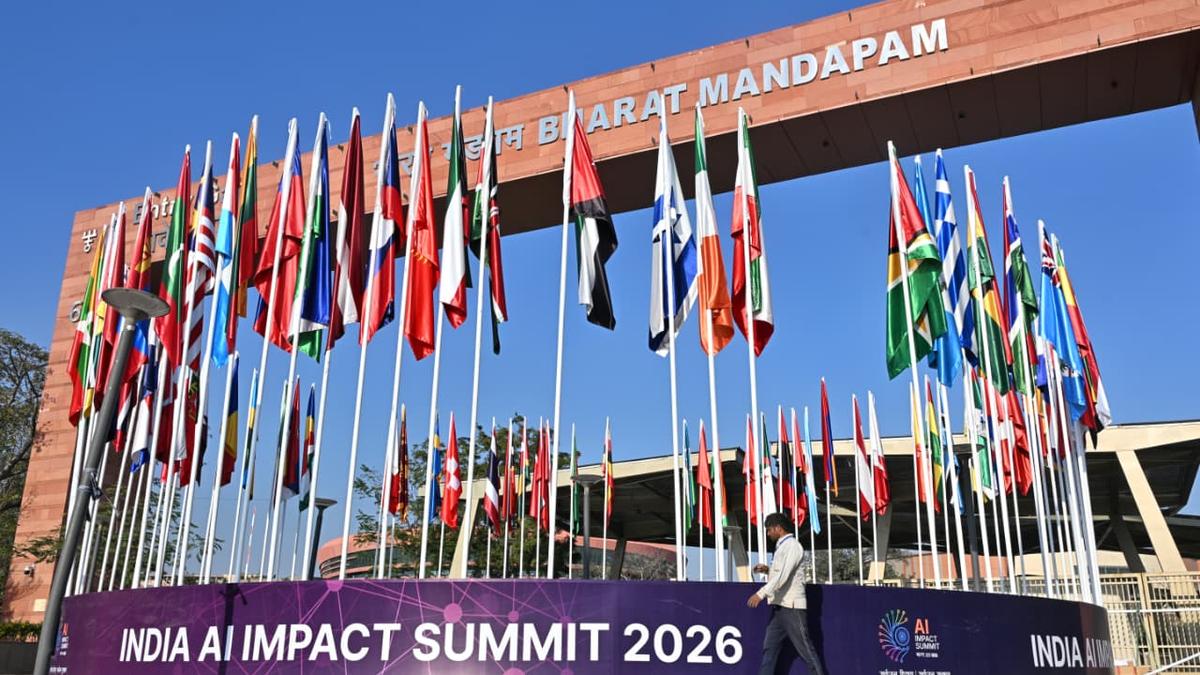
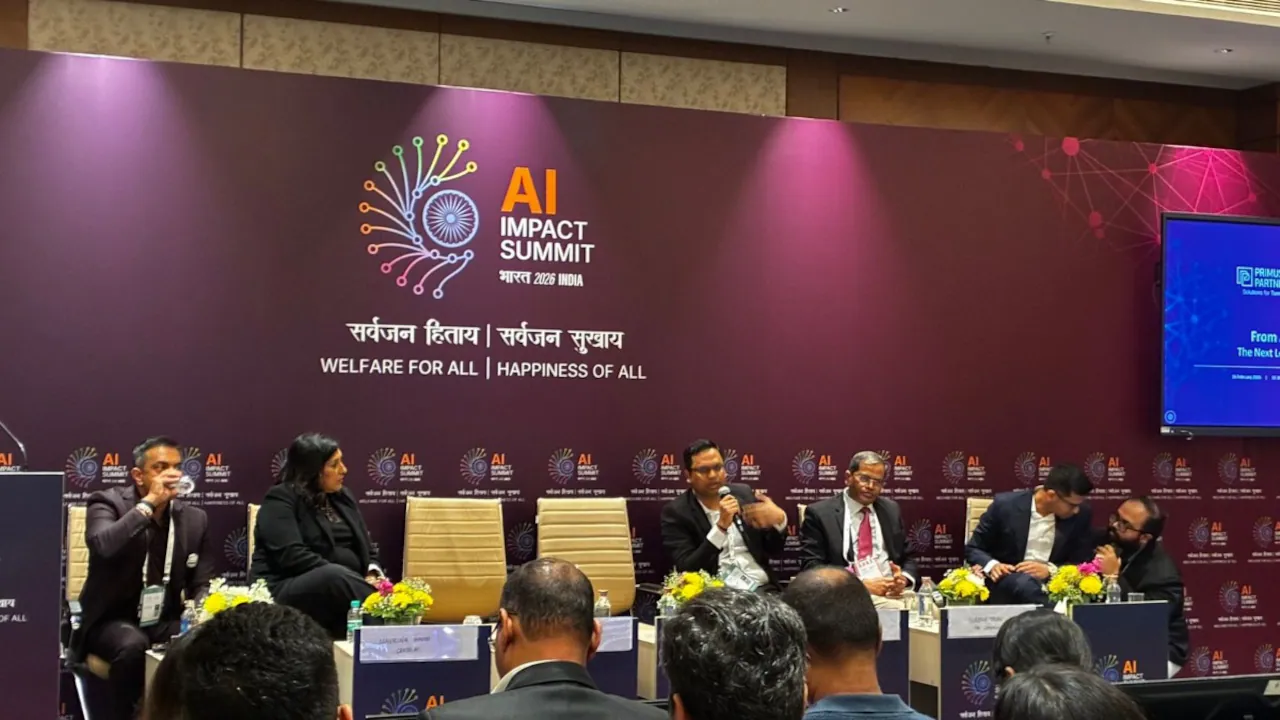
New Delhi is once again in summit mode. At Bharat Mandapam, the Indian AI Impact Summit 2026 opens with an ambitious theme—Three Sutras: People, Planet and Progress—and Seven Chakras spanning Human Capital, Safe and Trusted AI, Inclusion, Science, Resilience, Democratizing AI Resources, and Economic Growth. The choreography is familiar: carpeted halls, tightly scripted plenaries, overlapping panel discussions, declarations framed as historic, and a steady hum of policy ambition.
Prime Minister Narendra Modi is expected to meet global AI leaders, including Sam Altman, Sundar Pichai, Dario Amodei, and Demis Hassabis. IT Secretary S. Krishnan has articulated a “human-centric and inclusive” vision, emphasising democratic access to AI resources. The messaging is deliberate: India does not merely want to adopt artificial intelligence—it wants to shape its trajectory.
Yet beneath the spectacle lies a harder question: when the delegates depart, and the communiqués are archived, what, exactly, will have changed?
Summit Optics vs. Strategic Depth
India has proven it can convene. Its G20 year demonstrated formidable diplomatic choreography. But it also revealed a familiar pattern of global summit culture: optics often substitute for outcomes. Host cities receive temporary boosts in hospitality and tourism; vinyl coverings mask inconvenient urban realities; declarations proliferate. Then the global caravan moves on, and domestic realities resume their inertia.
Geopolitics is not innovation. Conferences, however crowded, do not generate technological sovereignty. The risk before India is subtle but profound: mistaking the choreography of relevance for the substance of capability; confusing the optics of leadership with the hard power of building.
This is not an AI-specific problem. We have seen it at climate conferences—COP after COP—where communiqués lengthen even as emissions plateau. We have seen it at G20 gatherings, where the assemblage itself becomes the product. Leaders appear statesmanlike in multilateral afterglow; companies signal responsibility; think tanks publish summaries. Then political leaders return to election cycles, corporations to shareholder cycles, and the urgency dissipates.
Artificial intelligence, however, raises the stakes far higher. AI is not merely another sector. It is the layer beneath sectors—the new infrastructure of power. It will shape economic primacy, military superiority, intelligence gathering, supply chains, labour markets, and the future of governance. The nations that control AI ecosystems—data, compute, talent, algorithms, semiconductor supply chains—will disproportionately shape the 21st century.
And the uncomfortable truth is that the frontier of this layer is not being built in conference halls.
The Frontier Is Elsewhere
The most advanced foundational AI models are emerging from a small number of Western and Chinese laboratories, backed by staggering amounts of capital, compute, hardware control, and audacious national-industrial intent. The pioneers of generative and autonomous AI systems are not products of summit podiums in the Global South.
India does not lack talent. It does not lack users. It does not lack a moral vocabulary around inclusion and ethics. What it lacks—still—is frontier-scale deployment audacity.
While India drafts frameworks, others are locking down chips. While panels debate ethical AI, others are acquiring compute clusters at sovereign scale. While New Delhi convenes conversations on democratization, global giants are securing cloud infrastructure, foundational model dominance, and defence-linked AI applications.
There is also froth in the system. Globally and domestically, unprofitable companies are being bid up on the expectation that AI infrastructure spending will continue indefinitely, that investment will automatically translate into returns, and that every firm must now rebrand as an AI company. The hype cycle feeds the summit cycle. Both reward performance. Both generate noise. Both risk obscuring what truly matters: who owns the core?
If India’s role in the global AI order is to provide demographic scale, rich data exhaust, moral rhetoric, and conference hospitality—while the architecture of intelligence is owned elsewhere—then the summit becomes theatre.
AI as Geopolitical Contest
Artificial intelligence has ceased to be a technological frontier alone; it is now a theatre of geopolitical contestation. Much like nuclear technology during the Cold War, AI sits at the heart of strategic competition. States are investing not merely in algorithms but in power.
For Washington, technological leadership underpins global pre-eminence. For Beijing, AI mastery is central to national rejuvenation. This is not simply economic competition, even if AI could add trillions to global GDP. The distribution of those gains will be uneven, privileging nations with advanced digital ecosystems.
Security anxieties sharpen the contest. AI enhances intelligence gathering, cyber capabilities, autonomous weapons systems, and algorithmic decision-making. The militarisation of machine learning is underway. Export controls on advanced chips, tightening semiconductor supply chains, and stricter investment regimes reflect technological decoupling—a digital Cold War emerging in slow motion.
The hardware underpinning AI depends on critical minerals—lithium, cobalt, rare earths—linking AI competition to energy geopolitics and climate politics. Data itself is fragmenting along national lines, creating sovereign digital ecosystems. The promise of a globally integrated internet is giving way to data nationalism.
Ideology is embedded in this contest. Democratic systems emphasise transparency, privacy, and human rights in AI governance. Authoritarian regimes deploy AI as an instrument of state control and social management. Competing regulatory models export competing political values.
In this landscape, AI will not level the playing field. The United States and China remain dominant. Europe seeks technological autonomy but struggles to match investment scale. Much of the Global South risks marginalisation.
For India, the strategic question is acute: will it write the code, or live by it?
The Governance Gap: Data, Consent, and AI Training
If infrastructure is one pillar of AI power, governance clarity is another. India’s Digital Personal Data Protection Act, 2023 (DPDP Act) provides a comprehensive framework. Section 6 mandates consent for processing personal data. Section 16 regulates cross-border transfers. Section 33 prescribes penalties for non-compliance. “Processing” is defined broadly, covering automated operations—arguably including AI training when identifiable data is involved.
Yet neither the statute nor the draft DPDP Rules 2025 provide explicit guidance on how consent, purpose limitation, and transparency apply when personal data contributes to AI model training and refinement.
Technological neutrality is not clarity.
India’s digital ecosystem is vast, diverse, and deeply engaged with AI tools. Global firms see it as invaluable for localisation, testing, and iterative improvement. AI services offered at low or no cost deliver immediate benefits to users—but also generate feedback loops that refine models. Access and data contribution are intertwined.
Without interpretive guidance, policymakers risk ambiguity at a moment requiring precision.
Europe’s GDPR offers a benchmark. Supervisory authorities there have clarified how consent, purpose limitation, and automated decision-making apply to AI contexts, even absent AI-specific legislation. India faces a similar inflection point. Infrastructure and investment alone will not establish leadership; governance credibility must accompany them.
Practical clarifications could include:
-
Whether interactions with AI tools require explicit consent for use in model training.
-
How secondary uses—such as training and refinement—align with original consented purposes.
-
What disclosures companies should provide regarding Indian data used to improve AI systems.
-
Documentation standards for data provenance and model accountability.
-
Operational guidance on implementing human-centric and inclusive AI principles in development pipelines.
These are not new mandates. They are interpretive scaffolding—necessary to make India’s AI framework actionable and strategically credible.
Democratisation of AI resources is not only about access to compute. It is about clarity on how the data powering these systems are governed.
India-France: A Middle Path?
The AI Impact Summit 2026 builds on momentum from the 2025 AI Action Summit in Paris, signalling a deepening India-France partnership. French President Emmanuel Macron’s visit inaugurates the India-France Year of Innovation 2026. The ambition is to transition from principles to practical collaboration, positioning both countries as co-leaders in responsible and inclusive AI governance.
The partnership reflects a shared vision: leveraging AI for sustainable development, democratic values, and global digital governance. In effect, India and France seek a middle path—globally competitive yet normatively anchored.
But a middle path cannot be rhetorical. It requires material depth.
The Sovereignty Question
Strip away the ceremony, and the central question is brutally simple: when this summit ends, will India have moved one inch closer to AI sovereignty?
Not sovereignty as slogan—but as capability:
-
A robust STEM ecosystem.
-
Indigenous intellectual property ownership.
-
Domestic compute capacity at scale.
-
Indigenous foundational and domain-specific models.
-
Deep research ecosystems.
-
Hardware partnerships resilient to geopolitical shocks.
-
Serious capital pools capable of sustained risk-taking.
-
Regulatory clarity that enables national advantage rather than merely constrains.
-
Long-term technological statecraft that outlives electoral cycles.
India represents one-sixth of humanity, much of it young. The AI century will not reward nations that confuse participation with influence. The balance sheet of technological power is unforgiving.
Yet imitation is not strategy. India cannot match the United States or China dollar-for-dollar. Its path must be calibrated.
What India Brings to the Table
India’s strengths are distinct:
-
Expansive digital public infrastructure.
-
Large, linguistically diverse data ecosystems.
-
A deep reservoir of engineering talent.
-
Experience delivering technology at population scale.
-
A foreign policy tradition of strategic autonomy.
The challenge is converting these assets into leverage without becoming locked into hardened technological blocs. Partnerships are indispensable—for frontier technologies, resilient supply chains, and capital access. But alignment will remain issue-based, not absolute.
Domestically, inclusion must remain central. AI must enhance governance, productivity, and service delivery without exacerbating inequality or deepening social fault lines. Automation-driven displacement is real. AI’s appetite for energy and water, especially via large data centres, ties technological ambition to sustainability debates.
Globally, India is well placed to articulate governance frameworks sensitive to the aspirations of the Global South—avoiding binary alignment between surveillance-driven authoritarian models and purely market-driven systems.
But articulation is insufficient without ownership.
From Stage to Force
There is something cyclical about technology discourse. A year ago, many were intoxicated by AR and VR. Before that, disinformation was the civilisation-ending obsession. Today, AI dominates. The topic changes; the panels remain. Professional expertise rebrands overnight. The summit validates the panellist; the discourse justifies the next summit.
But artificial intelligence is not a passing theme. It is foundational.
Much of the world’s true AI expertise will never be shared on public stages. Frontier firms will not casually reveal the moats securing their dominance. That is precisely why India must build those moats—through compute acquisition, hardware strategy, research funding, talent retention, and regulatory precision.
If India chooses to be merely a venue—a place where leaders gather to debate AI’s future—then history will record it as a gracious host.
If it chooses to build, own, and shape AI systems—through calibrated investment, strategic partnerships, governance clarity, and frontier ambition—it can become a force.
The difference will not be decided by the applause inside Bharat Mandapam. It will be determined in research labs, semiconductor supply chains, capital markets, regulatory corridors, and classrooms across the country.
The theatre of power is easy. The construction of power is not.
India has shown it can convene the world. The question now is whether it can command the code.
With inputs from agencies
Image Source: Multiple agencies
© Copyright 2025. All Rights Reserved. Powered by Vygr Media.