
 By
By 
Every World Population Day, the global conversation follows a familiar script. Some worry that there are too many people. Others fear there are too few. Governments announce new policies, experts debate fertility rates, and social media fills with charts predicting demographic doom or economic decline.
Yet, this annual debate often misses the central question: Are we treating people as numbers to be managed or as individuals with the freedom to shape their own lives?
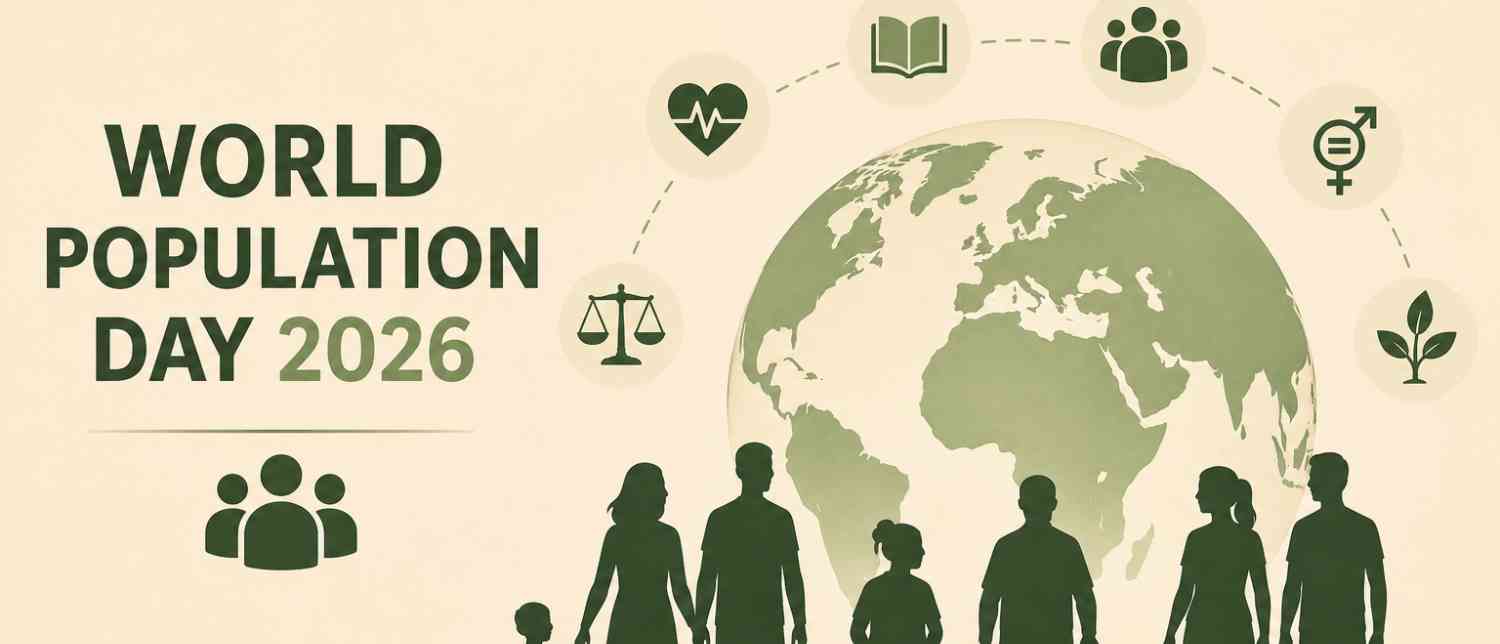
World Population Day 2026 arrives at a pivotal moment. The world is no longer grappling with a single population challenge. Instead, it faces multiple demographic realities unfolding simultaneously. While countries in Africa and parts of Asia continue to experience rapid population growth, Europe, Japan, South Korea and even China are confronting shrinking populations and ageing societies. India, now the world's most populous nation, stands somewhere in the middle—still relatively young, but steadily moving towards lower fertility rates.
The real story, therefore, isn't about whether the world has "too many" or "too few" people. It is about how demographic change is reshaping economics, geopolitics, labour markets, climate policy and, most importantly, personal freedom.

Population Is No Longer Just a Social Issue, It Is a Strategic One
For decades, population discussions largely revolved around family planning and development. Today, demographics have become a defining element of global power.
Countries with ageing populations are struggling to maintain economic growth, sustain pension systems and fill labour shortages. Nations with younger populations possess a potential demographic dividend, provided they can educate, employ and empower their youth. Those unable to do so risk turning that dividend into a demographic burden.
This changing demographic landscape is quietly redrawing global geopolitics. Military recruitment, manufacturing competitiveness, technological innovation and migration policies are all increasingly shaped by population trends rather than merely economic indicators.
China offers perhaps the clearest example. After decades of enforcing the one-child policy, it is now encouraging larger families to counter a rapidly ageing population. However, reversing demographic decline is proving far harder than creating it in the first place. Fertility rates do not simply rebound because governments change their minds. Once social norms, urban lifestyles and economic realities evolve, they rarely return to previous patterns.
Meanwhile, countries such as India possess an enormous working-age population that could become one of the greatest economic assets of the twenty-first century. But demographics alone do not guarantee prosperity. Without quality education, healthcare, employment opportunities and gender equality, even the largest youth population can become a source of instability rather than growth.
The lesson is clear: population numbers matter, but policies matter even more.
The Rise of the DINK Lifestyle Reflects Changing Aspirations
One of the most striking shifts in recent years is not government policy but individual choice.
Increasingly, educated urban couples are choosing to remain DINKs—Double Income, No Kids. Their reasons vary. Some prioritise financial independence. Others value career growth, mental well-being, travel or personal freedom. Many simply believe parenthood is a deeply personal decision rather than a social obligation.
For generations, marriage and parenthood were viewed as inseparable. Today, that assumption is steadily weakening.
This change often attracts criticism. DINK couples are frequently accused of being selfish or abandoning traditional family values. Such judgments overlook the realities of modern life.
Raising children has become significantly more expensive. Housing costs continue to rise. Competitive education demands enormous financial investment. Work-life balance remains elusive in many professions. Climate anxiety and economic uncertainty further influence family planning decisions.
Choosing not to have children is not necessarily a rejection of society. In many cases, it is an acknowledgement of present-day realities.
Equally important is recognising that reproductive decisions cannot be reduced to economics alone. Parenthood is an emotional, lifelong commitment. If individuals consciously decide that it is not the life they want, respecting that choice is not only ethical but essential in a democratic society.

India Has Already Changed More Than We Realise
Public discourse in India often continues to portray population growth as the country's biggest demographic challenge.
The data tells a more nuanced story.
India's fertility rate has already declined to around replacement level in many states, with several regions recording birth rates well below the level needed to maintain long-term population stability. Urbanisation, women's education, delayed marriages and improved access to healthcare have transformed family size across much of the country.
The larger challenge today is no longer explosive population growth but uneven demographic transition.
Southern states are ageing faster than northern states. Some regions may soon experience labour shortages, while others continue to add millions of young workers each year. These internal demographic differences will increasingly shape fiscal transfers, political representation and economic planning.
Simply put, India's population story is becoming more complex than slogans about "population explosion" suggest.
Reproductive Choices Should Never Become Political Weapons
Perhaps the most sensitive aspect of today's population debate concerns the relationship between reproductive rights and public policy.
Governments undoubtedly have legitimate interests in public health, maternal care and sustainable development. Encouraging informed family planning has contributed significantly to improved maternal health, lower infant mortality and women's empowerment across many countries.
However, there is a crucial distinction between enabling informed choices and directing personal decisions. When reproductive behaviour becomes tied to political incentives, welfare eligibility or identity-based narratives, the line between public policy and personal liberty begins to blur.
History offers cautionary lessons from both extremes.
Coercive population-control measures have violated human rights and left lasting social scars. Conversely, aggressive pro-natalist campaigns attempting to boost birth rates often fail because they ignore the structural reasons people delay or avoid parenthood.
Whether encouraging fewer children or more children, governments should remember a simple principle: people are not demographic instruments.
The most successful population policies are those that expand choices rather than restrict them.
Sustainability Is About More Than Population Size
Environmental debates often frame population growth as the primary cause of climate change and ecological degradation. The reality is considerably more complicated.
A child born in a high-income country typically consumes far more energy and natural resources over a lifetime than several individuals living in low-income regions. Consumption patterns, technology, urban planning and industrial practices frequently have greater environmental impacts than population size alone.
This does not mean population growth is irrelevant. Rapid urbanisation undoubtedly creates challenges relating to housing, transportation, water security and waste management. However, sustainability cannot be achieved merely by reducing fertility rates.
Cities need smarter infrastructure. Agriculture requires greater efficiency. Industries must embrace cleaner technologies. Governments need long-term planning instead of short-term crisis management.
Blaming population alone oversimplifies a far more complex environmental challenge.
Women Must Remain at the Centre of Population Conversations
For decades, women have carried the burden of population debates. They are expected to have fewer children when governments worry about population growth and more children when governments worry about demographic decline.
In both scenarios, women's bodies often become the primary site of public policy. This approach fundamentally misunderstands reproductive rights.
Access to contraception, maternal healthcare, safe abortion where legal, quality education and economic opportunities empowers women to make informed decisions about their futures. Evidence from around the world consistently shows that when women have greater educational and economic opportunities, fertility rates naturally stabilise without coercion.
Population policy works best when it trusts women—not when it seeks to manage them.
The Real Population Dividend Lies in Human Capital
The phrase "demographic dividend" has become almost synonymous with India's future.
But a demographic dividend is not guaranteed simply because a country has more young people.
Young populations become economic assets only when they possess quality education, employable skills, good health and productive employment opportunities.
Otherwise, demographic advantage quickly transforms into unemployment, migration pressures and social frustration.
India's future prosperity will therefore depend less on how many people it has and more on how well it prepares them for a rapidly changing global economy increasingly driven by artificial intelligence, automation and advanced technologies.
Investing in human capital will yield far greater returns than endlessly debating fertility statistics.
Moving Beyond Fear-Based Population Narratives
Population debates often swing between two extremes.
One side warns of overpopulation overwhelming resources.
The other fears demographic collapse and economic stagnation.
Both narratives rely heavily on fear.
Yet demographics are neither inherently good nor bad. They simply describe changing societies.
The appropriate response is adaptation rather than panic.
Countries experiencing ageing populations should strengthen healthcare systems, encourage workforce participation and embrace technological innovation.
Countries with younger populations should focus relentlessly on education, employment and social mobility.
Every nation requires policies tailored to its own demographic reality instead of importing solutions from elsewhere.
World Population Day Needs a New Philosophy
Perhaps the greatest shift needed is conceptual.
World Population Day should no longer be viewed merely as an occasion to discuss numbers.
Instead, it should become an opportunity to discuss dignity.
Population policy should not ask:
"How many children should people have?"
It should ask:
"Do people genuinely have the freedom, healthcare, education and economic security needed to make that decision for themselves?"
That question is infinitely more important.
Ultimately, societies flourish not because they produce more people or fewer people, but because they create conditions in which every individual can realise their potential.
The future belongs not to countries with the largest populations, but to those that invest most wisely in their people.
As World Population Day 2026 reminds us, the challenge before humanity is no longer simply managing population growth. It is ensuring that demographic change strengthens freedom rather than weakens it, empowers individuals rather than controls them, and builds societies where every birth is a matter of choice, every life has equal value, and every generation inherits a more sustainable future than the last.
In the end, population is not merely a statistic. It is humanity itself. And public policy should never lose sight of that fundamental truth.
With input from agencies
Image Source: Multiple agencies
© Copyright 2026. All Rights Reserved. Powered by Vygr Media.