 By
By 
There’s a quiet, shadowy market running parallel to India’s loudest democratic exercise. It doesn’t campaign, doesn’t canvass, and doesn’t seek votes—but it wagers on them. From election verdicts to IPL outcomes, prediction markets—many operating illegally—are fast becoming one of the most underreported intersections of finance, technology, and politics in India.
What may appear like harmless speculation is, in reality, a high-stakes ecosystem where crores of rupees ride on uncertain futures. These platforms are not just reflecting public sentiment—they are beginning to shape it.
Betting on Democracy
At the core of prediction markets lies a deceptively simple premise: trading on the probability of future events. But in India, this has evolved into something far more complex. Elections are no longer just political contests; they are being converted into tradable financial instruments.
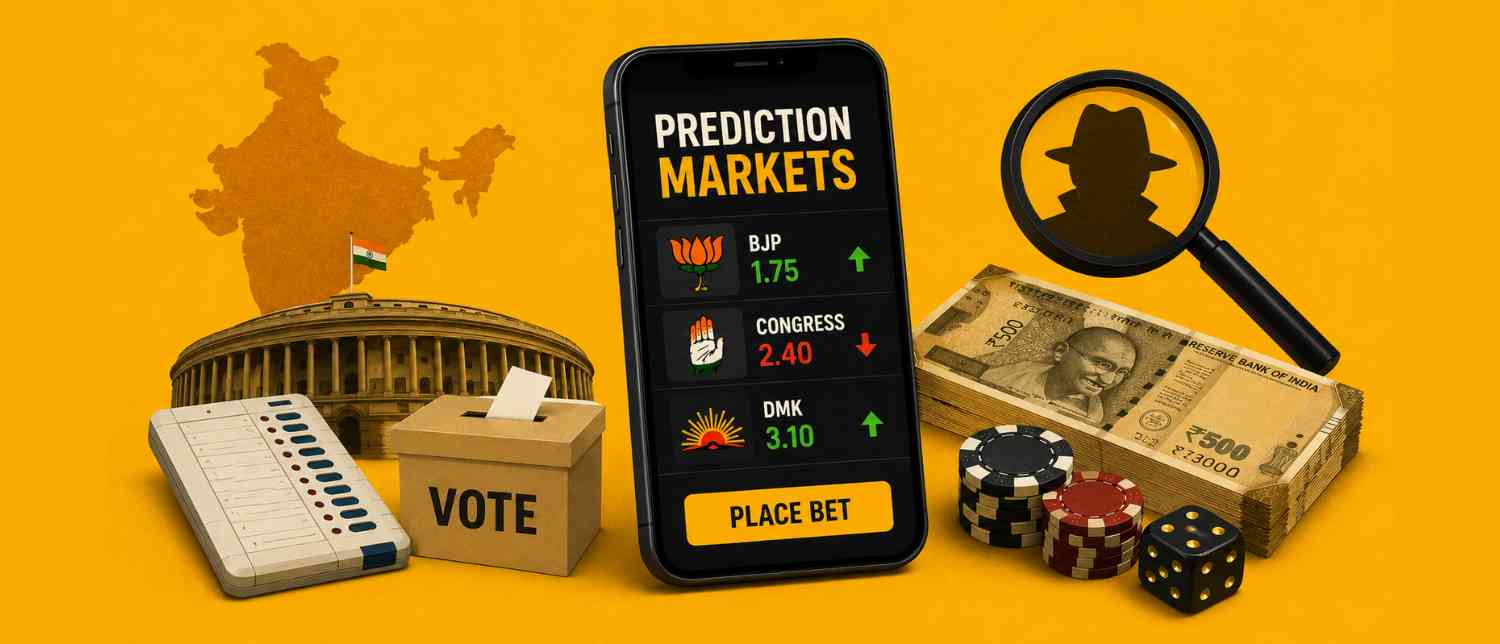
Users can now “invest” in outcomes—whether a party will secure a majority, whether a coalition will form, or whether a candidate will win a constituency. Platforms, including global players like Polymarket and domestic informal betting networks, have transformed political speculation into a monetised activity.
The scale is staggering. Reports suggest that massive sums are being wagered on election outcomes, with odds dynamically shifting in response to political developments. In several recent elections, betting markets have leaned toward parties such as the DMK, BJP, and Congress, often reacting faster than traditional opinion polls.
This speed and responsiveness create the illusion of accuracy. But that illusion can be misleading—and dangerous.
Faster Than Polls, But at What Cost?
Prediction markets pride themselves on being more efficient than polls. Unlike surveys, which rely on sampled data, these platforms aggregate real-time financial commitments from participants. The idea is simple: people are more likely to put money behind what they truly believe.
But this logic has a flaw—money doesn’t just reflect belief; it also reflects access to information.
In India’s largely unregulated environment, there are no safeguards against the misuse of privileged information. Political insiders, campaign strategists, or anyone with access to internal data could exploit these markets for profit. If internal polling data or confidential alliance negotiations leak into betting activity, it creates a scenario eerily similar to insider trading in stock markets.
Except here, there are no regulators watching closely, no compliance frameworks, and no real consequences.

The Legal Grey Zone: Neither Gambling Nor Finance
One of the biggest challenges in addressing prediction markets in India is their ambiguous legal status. The country’s gambling laws are outdated and fragmented, designed for a pre-digital era. They fail to adequately address online, decentralized platforms that operate across jurisdictions.
Prediction markets occupy a strange middle ground—they resemble gambling, but also mimic financial derivatives. This ambiguity has allowed them to flourish without clear oversight.
Global platforms often operate offshore, using cryptocurrencies to bypass traditional financial systems. Meanwhile, domestic betting networks continue to function through informal channels—local agents, encrypted messaging apps, and cash-based transactions.
The result is a sprawling, hybrid ecosystem that is both digital and deeply rooted in traditional “satta” culture.
When Markets Shape Narratives, Not Just Reflect Them
Perhaps the most underappreciated risk of prediction markets is their ability to influence perception. When betting odds strongly favour a particular outcome, they create a sense of inevitability.
This has a psychological impact.
Voters may begin to align with what appears to be the winning side. Media narratives can subtly shift, treating market odds as indicators of ground reality. Political campaigns might even respond to these signals, adjusting strategies based on perceived momentum.
In such a scenario, prediction markets stop being passive observers—they become active participants in shaping electoral discourse.
The feedback loop is powerful: perception influences betting, and betting reinforces perception.
When Bets Beat the News
The growing influence of these markets has also raised uncomfortable questions for journalism. Traditionally, news organisations have relied on reporting, fieldwork, and data analysis to gauge public sentiment. But prediction markets offer something tempting—instant, dynamic insights.
When betting trends begin to “predict” outcomes faster than news reports, there is a risk that journalism becomes reactive. Instead of interrogating facts, it may start echoing market sentiment.
This shift undermines the core role of the media as a verifier of truth. Markets are driven by incentives, not accuracy. And when financial stakes are involved, the line between information and manipulation becomes dangerously thin.
The Evolution of Satta: From Local to Global
Election betting is not new to India. Informal satta markets have long thrived, especially in politically active regions. What has changed is the scale and sophistication.
Digital platforms have globalised these practices. Today, a user sitting anywhere in India can participate in international prediction markets using a smartphone and cryptocurrency. At the same time, local betting networks have adapted, integrating digital tools into their operations.
This convergence has created a resilient system—one that is harder to track, regulate, or dismantle.
The Insider Trading Problem No One Is Addressing
One of the most alarming aspects of this ecosystem is the potential for insider trading. In financial markets, strict laws exist to prevent individuals with privileged information from exploiting it for gain.
But in prediction markets, particularly unregulated ones, no such safeguards exist.
Imagine a political insider placing large bets based on confidential strategy shifts. Or a data analyst leveraging internal polling insights before they become public. These scenarios are not hypothetical—they are entirely plausible in the current system.
And yet, there is virtually no mechanism to detect or prevent such activities.
The Ethical Dilemma: Profiting from Democracy
Beyond legality and regulation lies a deeper ethical question: should democratic processes be monetised in this way?
Elections are meant to be expressions of public will, not opportunities for financial speculation. When outcomes become betting instruments, it introduces a profit motive into civic participation.
This shift can subtly alter how people engage with democracy. The focus moves from participation to prediction, from voting to wagering.
It risks turning democracy into a marketplace—where outcomes are traded, not just decided.
Can Regulation Be the Answer?
Faced with this growing phenomenon, policymakers have limited options. An outright ban is difficult to enforce, especially given the global and decentralized nature of many platforms.
A more pragmatic approach may be regulation.
By bringing prediction markets under a legal framework, the government could introduce transparency, accountability, and safeguards against misuse. This could include monitoring transactions, preventing insider trading, and ensuring that platforms operate within defined boundaries.
However, this would require a significant overhaul of existing laws and a willingness to engage with emerging technologies.
The Road Ahead: Ignoring Is Not an Option
India stands at a crossroads. Prediction markets are no longer fringe activities—they are becoming influential forces in both politics and public perception.
Ignoring them would allow an unregulated ecosystem to grow unchecked. Cracking down without understanding them could drive them further underground.
The challenge lies in finding a balance—one that protects the integrity of democratic processes while acknowledging the realities of technological evolution.
When the Future Becomes a Tradeable Commodity
At its core, the rise of prediction markets raises fundamental questions about power, information, and influence.
Who controls the narrative?
Who profits from foresight?
And who ensures that democracy remains fair?
Because when the future itself becomes something you can bet on, the stakes are no longer just financial.
They are democratic.
With inputs from agencies
Image Source: Multiple agencies
© Copyright 2026. All Rights Reserved. Powered by Vygr Media.